




Spot Freight Rates Surge Over Past Week Following Best Month This Year
Spot truckload freight rates showed either a big improvement or turned in a disappointment over the past week while a monthly gauge of the market reveals its best performance of the year, according to DAT Solutions and its network of load boards.

Spot truckload freight rates showed either a big improvement or turned in a disappointment over the past week while a monthly gauge of the market reveals its best performance of the year, according to DAT Solutions and its network of load boards.
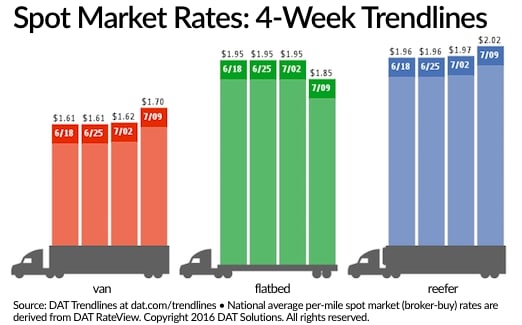
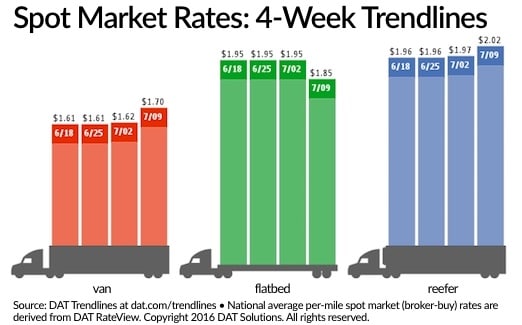
The average van rate increased 8 cents to $1.70 per mile for the week ending July 9 compared to the previous week, while the load to truck ratio improved 5.8% to 3.5 available loads per truck, its highest ratio so far this year.
Usually the ratio goes down in July but some truckers may have taken an extended holiday last week, according to DAT, which may have made it harder for shippers and brokers to find trucks. It could also be a signal of an improvement in the freight market, but it will be until next week to see if a trend starts developing.
In the reefer category, the average rate surged 5 cents to $2.02 per mile, the first time it has been beyond the $2 per mile level since October. DAT said the boost could be due to late harvests in California, where they had a very rainy winter that caused a delay in planting of some crops.
The reefer load-to-truck ratio improved 0.9% to 6.5 loads per truck as reefer load posts fell 18% and truck posts dropped 19%.
In sharp contrast, the average flatbed rate plummeted 10 cents over the past week to $1.85 per mile after holding steady at $1.95 per mile for the month of June.
Flatbed load posts declined 20% last week, the expected decline in a holiday week that included 20% fewer work days due to the Independence Day holiday. Capacity also fell 20%, leading to a slight dip in the load-to-truck ratio, from 15.7 to 15.6 loads per truck.
June Freight Index Jumps
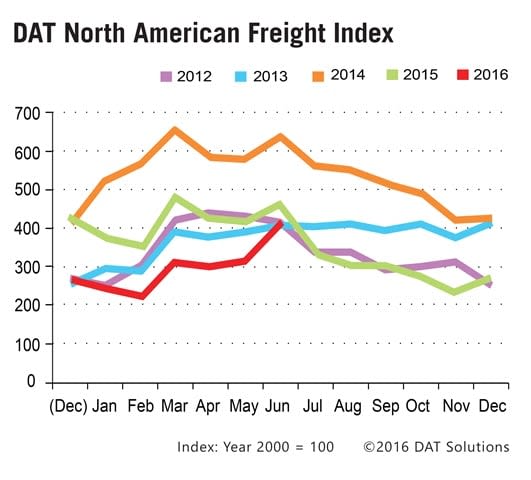
Meantime, DAT’s monthly gauge of the spot market, its North American Freight Index, increased in June as seasonal freight added 28% to spot market load availability, boosting total volume to levels seen in 2013 and 2012, and only 12% below the level of a year ago. (See graphic below.)
“It is typical for freight volume to increase in June and decline in July, but this year's surge also jump-started volume and rates in July to-date,” said DAT.
Month-over-month by equipment type, dry and refrigerated vans enjoyed the biggest volume increases, up 49% and 39%, respectively. Both segments had seen only single-digit increases in June of the previous four years. Flatbed freight increased only 7.1%, a more typical increase for the month.
Average line haul rates followed the same pattern on the spot market in June, with an increase of 4.4% for vans and 3.6% for reefers, while flatbed rates rose only 0.6%, month-over-month. The average fuel surcharge also increased 10%, compared to May. The surcharge, which is pegged to the retail price of diesel fuel, comprises a portion of the total rate paid to carriers.
On a year-over-year basis, van freight volume increased 3.4% compared to June 2015, the first year-over-year improvement for vans, which comprise a large majority of for-hire trucks, in any month since December 2014. Reefer freight availability declined 5.4%, however, and flatbeds lost 28%.
Line haul rates were lower for all equipment types, falling 11% for vans, 8.9% for reefers, and 7.5% for flatbeds compared to June 2015. Total carrier revenue was eroded further by a 28%, or 8 cents per mile, decline in the fuel surcharge compared to June 2015.
More Fleet Management

Nominations Open for HDT Emerging Leaders
Heavy Duty Trucking is looking for accomplished trucking fleet professionals under 40 who are making an impact and helping lead the industry forward.
Read More →
Why Private Fleets Are Taking More Freight
Private fleets are putting their own trucks on demanding customers and high-cost lanes as companies seek greater control over service, costs, and capacity.
Read More →
Color Match Smarter: Tools That Restore & Perform
For fleet managers and collision repair professionals keeping heavy-duty trucks on the road, getting the color right the first time isn't just about appearance — it's about efficiency, turnaround time, and bottom-line results. Discover how today's digital color tools are transforming the repair process from guesswork to precision.
Read More →


FMCSA Pauses Biennial-Update Enforcement Amid Motus Transition
Carriers whose updates were due on or after June 1 have more time, while FMCSA works to stabilize its new registration system and warns of phishing sites impersonating its new carrier registration system, Motus.
Read More →
2026 Blueprint for Countering Smarter Supply Chain Theft
Cargo theft is no longer just the cost of doing business. It's a multi-billion-dollar criminal enterprise exploiting vulnerabilities across your fleet, drivers, and supply chain.
Read More →
How Telematics Improves Visibility, Control, and Performance in Refrigerated Fleets
Explore how telematics help refrigerated fleets improve visibility, uptime, efficiency, compliance, and cargo protection across connected cold chain operations.
Read More →
What the U.S.-Canada Trade War Means for Trucking
Escalating U.S.-Canada tariffs could disrupt cross-border freight, reduce truck volumes, raise costs, and create new uncertainty for carriers on both sides of the border.
Read More →
What Are Trucking’s Top Concerns for 2026?
The American Transportation Research Institute wants to know what's worrying trucking fleet managers, drivers, and other stakeholders in its annual Industry Issues survey.
Read More →
American Trucking Associations Looks for a New Leader
ATA President and CEO Chris Spear abruptly left his job at the association on August 21, at a pivotal time for the trucking industry.
Read More →
Public Wi-Fi Cybersecurity Risks: How Truck Drivers and Fleets Can Protect Their Data
Public Wi-Fi can expose truck drivers and fleets to credential theft, malware, and other cyber threats. Here’s how to reduce the risk on the road.
Read More →