




M-B Class 8 Electric Truck to be Tested in Urban Delivery Service
Heavy-duty Urban eTruck for “short radius” use in Germany and elsewhere could be in production by 2020 or soon thereafter, Daimler says.

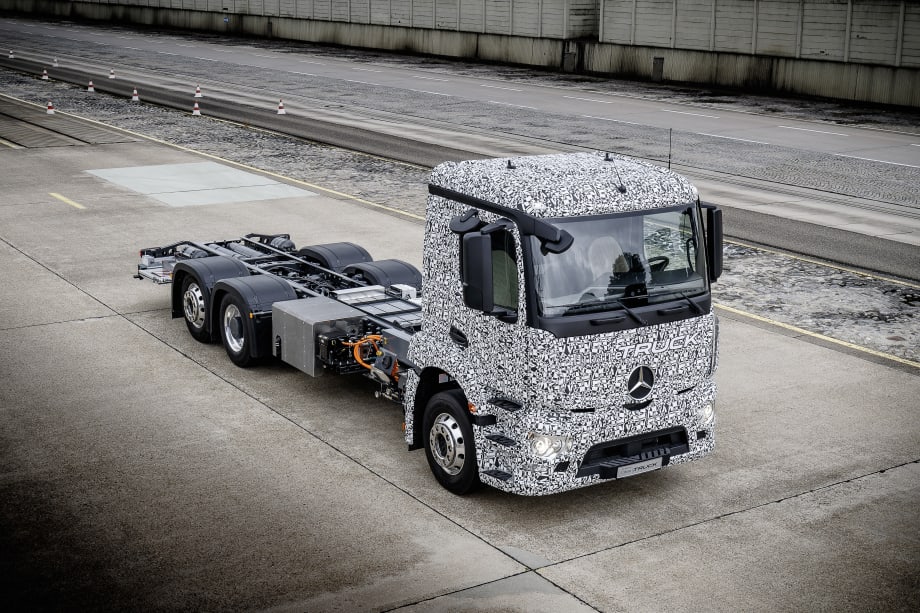
Heavy electric delivery truck's range is 200 kilometers (124 miles) and its batteries can be recharged in as little as two hours. Photos: Daimler Trucks
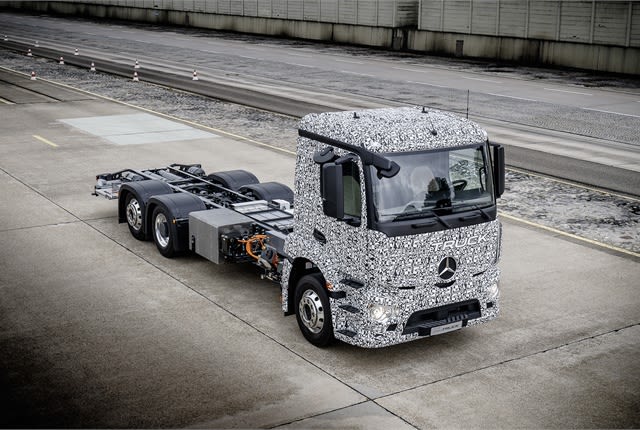
Heavy electric delivery truck's range is 200 kilometers (124 miles) and its batteries can be recharged in as little as two hours.Photos: Daimler Trucks
Mercedes-Benz says it has developed a prototype heavy-duty electric distribution truck for “short radius” use in Germany and elsewhere, and that it or trucks like it could be in production by 2020 or soon thereafter.
M-B’s 25-metric-ton (27.6-ton) 6x2 Urban eTruck uses motors at each end of a single driving axle, with power coming from a modular battery pack. It claims quiet operation and zero local emissions, which is valuable in dense cities where much manufacturing occurs and air pollution is causing governments to restrict diesels.
Daimler Trucks announced the Urban eTruck at its headquarters in Stuttgart this week, and said it will be displayed in September at the IAA Commercial Vehicle Show in Hannover.
The eTruck is based on a German Actros Class 8 chassis with an all-electric powertrain under and behind the cab. Daimler said the truck’s operating range is 200 kilometers (124 miles), using a three-module lithium-ion battery pack with a 212-kilowatt capacity. Batteries are inside crash-proof cases, and can be recharged in as little as two hours.
Two motors, one adjacent to each wheel hub, together develop 250 kW (335 hp) and peak torque of 1,000 Newton-meters (738 lb-ft.). But gearing raises maxium torque to as much as 11,000 Nm (8,113 lb-ft.), the Daimler announcement said.
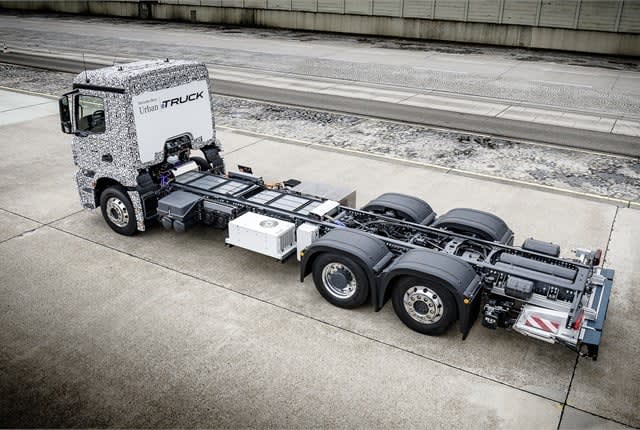
Mercedes Urban eTruck has a three-module battery pack between its frame rails and a motor at each end of its single drive axle.
“The fact that an electric motor delivers its full torque from very low revs gives the Urban eTruck a considerable level of performance and driving dynamics,” Daimler said.
Tare weight of an eTruck is nearly 3 tons more than a diesel-powered truck, noted Tim Urquhart, a principal analyst at IHS Automotive, in comments about the announcement. But the European Commission plans to increase the weight limit for electric trucks to 26 metric tons, making the effective weight penalty about 700 pounds.
Weight should be further cut and capacity increased by advances in battery technology in coming years, Daimler said.
The heavy Urban eTruck uses technology from the Fuso Canter E-Cell medium-duty truck, which has successfully undergone trials in Spain and Germany. Daimler is expected to announce production plans for the E-Cell at the IAA Show.
More Fuel Smarts

Record Diesel Prices Squeeze Trucking Fleets
Average U.S. diesel prices have climbed to nearly $6 a gallon, surpassing the 2022 record as tight refinery capacity and Middle East disruptions keep fuel costs elevated.
Read More →
How Fuel Delivery Shapes Engine Performance
Fuel delivery depends on more than what happens at the injector. For fleet, maintenance and technical professionals, looking at the full path from pump to injector can provide useful context for understanding engine performance.
Read More →
East Coast Port Launches $45M Electric Truck Push
The Port Authority of New York and New Jersey announced millions in incentives for zero-emission drayage trucks, yard tractors, and new charging hubs near the port.
Read More →

California Bill Could Shed Light on Electric Truck Prices
Why do battery-electric Class 8 trucks remain so expensive? A California bill headed to Gov. Gavin Newsom would give fleets and state agencies more visibility into what manufacturers charge.
Read More →
Detroit Opens Orders for EPA 2027 Engines
Detroit isn’t starting from scratch to meet EPA 2027 diesel emissions standards. Its Gen 6 DD13 and DD15 engines keep much of today’s platform while updating the fuel and aftertreatment systems.
Read More →
Zero-Emission Truck Corridor Planned for West Coast
California, Oregon, Washington, British Columbia and Baja California are coordinating plans for truck charging and hydrogen fueling from Canada to Mexico.
Read More →
A Closer Look at Kenworth’s Electric T880E Vocational Truck [Video]
Learn more about Kenworth's T880E battery-electric vocational truck at the Paccar Technical Center, including its range, applications, upfitting considerations, and PTO options, in this HDT Spotlight video.
Read More →
Kenworth T880E Brings EV Power to Vocational Trucks
A closer look at the Kenworth T880E’s range, charging, powertrain and upfit options — and where fleets are showing the most interest.
Read More →
Jennie Abarca Is Proving Electric Trucks Can Do the Job
HDT Truck Fleet Innovator Jennie Abarca is building confidence in fleet electrification one load at a time while openly sharing the challenges she encounters along the way as a small-fleet owner.
Read More →
Cummins Adjusts 2027 Engine Rollout After EPA Proposal
The engine maker will gradually introduce its new Model Year 2027 diesel engines while continuing to offer current models during the transition, citing the EPA's proposed emissions rule changes.
Read More →