




Related: California Awards $23.6 Million for Electric Drayage Trucks
Mack Testing Hybrid Drayage Truck at SoCal Ports
Mack Trucks will demonstrate two zero-emission capable drayage trucks as part of a California-based heavy-duty truck development project led by the South Coast Air Quality Management District.
by Staff
May 20, 2016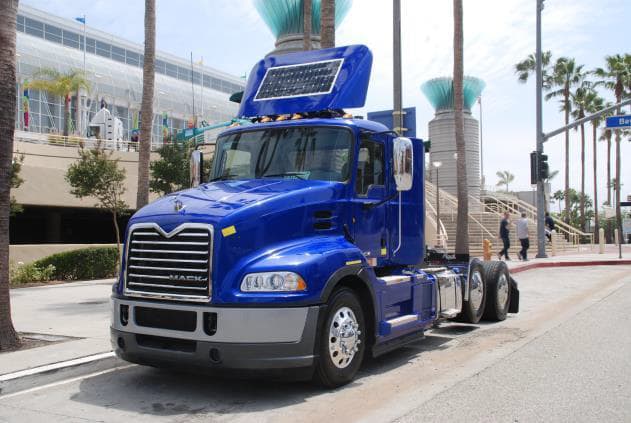
Mack's hybrid drayage truck is based on the Pinnacle daycab model. Photo: Mack Trucks
2 min to read
Mack's hybrid drayage truck is based on the Pinnacle daycab model.Photo: Mack Trucks
Mack Trucks will demonstrate two zero-emission capable drayage trucks as part of a California-based heavy-duty truck development project led by the South Coast Air Quality Management District.
The manufacturer will receive funding for the vehicle through a $23.6-million grant from the State of California aimed at reducing air pollution at freight-intensive locations throughout the state.
As one of the truck manufacturers selected to receive funding, Mack will focus on ultra-low NOx technologies and advancing plug-in hybrid and geo-fencing capabilities that it has already explored in previous and on-going projects.
The goal of the zero-emission capable drayage truck project is to reduce pollution and greenhouse gas emissions at locations like ports, rail yards and the freight corridors connecting them where there is a higher concentration of freight volume and truck traffic.
Mack’s efforts will build on it experience designing and demonstrating a plug-in electric drayage truck based on a Mack Pinnacle daycab model.
Mack already showed off a version of the drayage truck, which was built during an earlier SCAQMD-sponsored project. It is currently undergoing testing and evaluation in a drayage fleet at the Ports of Long Beach and Los Angeles.
The hybrid truck integrates a Mack MP7 diesel engine with a parallel hybrid system and lithium-ion battery back. The prototype truck also features lightweight and aerodynamic-enhancing components, which were included to extend the benefits of the hybrid technology and improve the vehicle’s zero-emission range.
The truck also makes use of a geo-fencing technology that designates areas with the heaviest freight traffic as a zero-emission zone where the truck operates in pure electric mode. When outside of the geo-fence, the diesel engine is enabled allowing for hybrid operation and battery recharging.
“This unique collaborative effort is aimed at fostering the development of advanced zero-emission truck technologies that are vital to improving air quality in communities near our busy freight corridors,” said Joe Buscaino, Los Angeles City Councilman and SCAQMD board member. “Cleaner truck fleets on our roadways are important for air quality and climate goals, and essential to protecting public health.”
More Fuel Smarts

How Volvo Updated Its D13 for EPA 2027 [Watch]
Volvo’s updated D13 promises lower emissions without sacrificing performance or fuel economy. Take a closer look at what changed inside the engine in this HDT Spotlight video.
Read More →
Diesel Price Spike Shortens Payback for Natural Gas Trucks, Report Says
Energy Vision estimates fleets could recover the higher purchase price of an RNG-fueled Class 8 tractor in 1.3 to 2.8 years under current fuel-price scenarios.
Read More →
Calstart Becomes Catalyst Mobility, Reflecting Broader Focus
Calstart is now Catalyst Mobility, reflecting the nonprofit’s growing national role in clean transportation, including zero-emission trucks, infrastructure and incentive programs.
Read More →

Record Diesel Prices Squeeze Trucking Fleets
Average U.S. diesel prices have climbed to nearly $6 a gallon, surpassing the 2022 record as tight refinery capacity and Middle East disruptions keep fuel costs elevated.
Read More →
Sponsored•September 9, 2026
How Fuel Delivery Shapes Engine Performance
Fuel delivery depends on more than what happens at the injector. For fleet, maintenance and technical professionals, looking at the full path from pump to injector can provide useful context for understanding engine performance.
Read More →
East Coast Port Launches $45M Electric Truck Push
The Port Authority of New York and New Jersey announced millions in incentives for zero-emission drayage trucks, yard tractors, and new charging hubs near the port.
Read More →
California Bill Could Shed Light on Electric Truck Prices
Why do battery-electric Class 8 trucks remain so expensive? A California bill headed to Gov. Gavin Newsom would give fleets and state agencies more visibility into what manufacturers charge.
Read More →
Detroit Opens Orders for EPA 2027 Engines
Detroit isn’t starting from scratch to meet EPA 2027 diesel emissions standards. Its Gen 6 DD13 and DD15 engines keep much of today’s platform while updating the fuel and aftertreatment systems.
Read More →
Zero-Emission Truck Corridor Planned for West Coast
California, Oregon, Washington, British Columbia and Baja California are coordinating plans for truck charging and hydrogen fueling from Canada to Mexico.
Read More →
A Closer Look at Kenworth’s Electric T880E Vocational Truck [Video]
Learn more about Kenworth's T880E battery-electric vocational truck at the Paccar Technical Center, including its range, applications, upfitting considerations, and PTO options, in this HDT Spotlight video.
Read More →