




Wabash Shows Almost All-Composite Prototype Reefer
The trailer uses molded structural composites, or MSCs, developed by Wabash engineers over the last three years. It uses few bolts and no metal crossmembers.


Molded structural combosites, developed by Wabash engineers over three years, are used throughout. Photo: Tom Berg
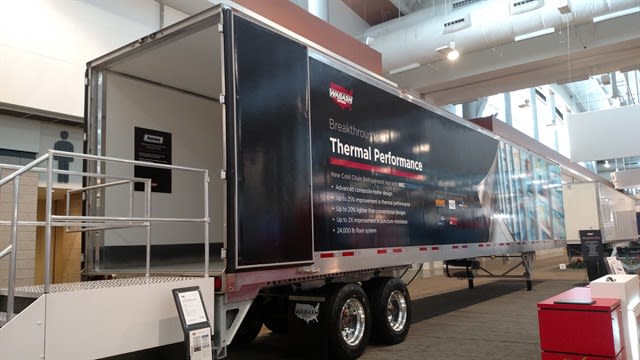
Molded structural combosites, developed by Wabash engineers over three years, are used throughout.Photo: Tom Berg
NASHVILLE — Wabash National showed a prototype composite refrigerated van with very few bolts and no rivets at the TMC’s Equipment Expo this week.
The trailer uses molded structural composites, or MSCs, developed by Wabash engineers over the last three years.The material gives the 53-foot trailer up to 25% improvement in thermal performance and is up to 20% lighter compared to conventional designs, said Brent Yeagy, group president, Commercial Trailer Products. Interior puncture resistance is 25% better.
An embossed, slip-resistant aluminum floor has a 24,000-pound rating, which is 50% more than a standard aluminum floor, he said. Its floor support comes completely from MSC components, so the vehicle has no metal crossmembers. This lowers the floor height and the vehicle’s center of gravity, and adds several inches of vertical interior room.
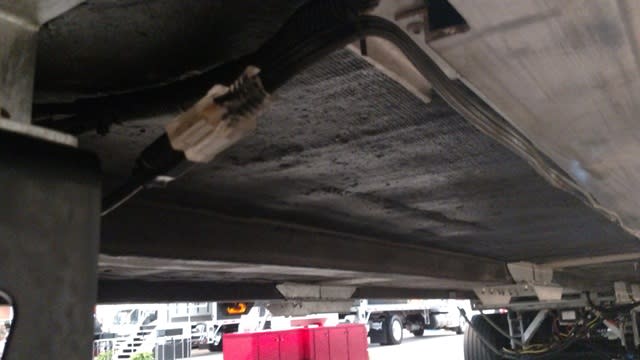
Crossmember-less floor reduces weight and height and eliminates corrosion, Wabash National says.Photo: Tom Berg
Metal bolts are still used at the upper coupler and in areas near the tandem slider, but most of those should be eliminated with further bonding adhesives, said Dick Giromini, president and chief executive officer.
Wabash is also showing a truck body using the same materials. Molded structural composites are used in a wide range of aerospace, automotive, marine and commercial construction applications, Yeagy said, but this is the first time the technology is being used in trailer and truck body manufacturing.
“What this means for our customers is improved thermal efficiency, reduced fuel costs, increased payload and cargo capacity, optimized utilization and enhanced durability,” said Yeagy. “We’re excited about the potential molded structural composites have for our industry, and we look forward to the feedback from our customers so our engineers can take this technology and our designs to even greater levels of performance.”
More Fuel Smarts

Why Small Fuel Savings Matter in Trucking
Can better fuel economy help pay for driver raises? In this podcast, GP Transco explains how small efficiency gains create room to reinvest in its people.
Read More →
How GP Transco Cuts Trucking Fuel Costs, a Tenth of a Gallon at a Time
What’s another tenth of a mile per gallon worth? GP Transco shares how equipment upgrades and driver coaching turn small gains into meaningful fuel savings.
Read More →
Electric Yard Tractors Move Beyond Pilots
Operating-cost savings have overtaken sustainability goals as the leading reason surveyed fleets are adopting battery-electric terminal tractors, according to new NACFE research.
Read More →
Geotab Links Fleet Card to Vehicle Data
The new card combines fuel discounts with telematics-based purchase controls. Geotab’s analysis also points to potential savings from choosing lower-priced fuel stops.
Read More →
Fleet Economics Shape Electric Truck Outlook
ACT Research expects costs, charging infrastructure, and technology improvements to drive zero-emission commercial vehicle adoption as federal regulations and incentives retreat.
Read More →
Wex Adds Cardless Fuel Payments for Over-the-Road Customers
A new fuel card feature for Wex customers offers convenience and security.
Read More →
New California Law Could Shed Light on Electric Truck Prices
Why do battery-electric Class 8 trucks remain so expensive? A California bill signed by Gov. Gavin Newsom would give fleets and state agencies more visibility into what manufacturers charge.
Read More →
How Volvo Updated Its D13 for EPA 2027 [Watch]
Volvo’s updated D13 promises lower emissions without sacrificing performance or fuel economy. Take a closer look at what changed inside the engine in this HDT Spotlight video.
Read More →
Diesel Price Spike Shortens Payback for Natural Gas Trucks, Report Says
Energy Vision estimates fleets could recover the higher purchase price of an RNG-fueled Class 8 tractor in 1.3 to 2.8 years under current fuel-price scenarios.
Read More →
Calstart Becomes Catalyst Mobility, Reflecting Broader Focus
Calstart is now Catalyst Mobility, reflecting the nonprofit’s growing national role in clean transportation, including zero-emission trucks, infrastructure and incentive programs.
Read More →