




Government Revises Diesel, Gasoline Price Forecast Lower
Average prices for trucking’s main fuel along with those for gasoline and crude oil are all expected to remain low this year, according to the latest U.S. Energy Department Short-Term Energy Outlook, and aren’t expect to rise significantly next year.

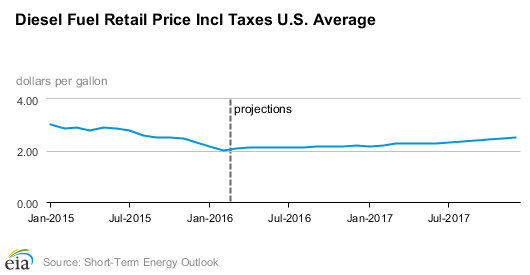

Average prices for trucking’s main fuel along with those for gasoline and crude oil are all expected to remain low this year, according to the latest U.S. Energy Department Short-Term Energy Outlook, and they aren’t expect to rise significantly next year.
On-highway diesel fuel is projected to average $2.12 per gallon in 2016, rising to $2.32 in 2017. This latest forecast is 10 cents and 26 less, respectively, than in last month’s report. It also compares to an average diesel price of $2.71 per gallon in 2015 and $3.83 in 2014.
The outlook comes as continued warmer-than-normal winter temperatures and the growing global supply of distillate fuel helped weekly U.S. average retail diesel fuel prices fall below $2.00 per gallon for the first time in more than 10 years in February. This week the average price is slightly higher at $2.021 per gallon.
“Consumption of distillate fuel, which includes diesel fuel and heating oil, fell by 60,000 barrels per day, or 1.5%, in 2015, and it is expected to fall by an additional 50,000 barrels per day, or 1.1% in 2016,” the report said. “Stronger economic and manufacturing growth in 2017 [will] contribute to distillate fuel consumption growth of 110,000 barrels per day, or 2.9%.”
For regular grade gasoline, the department projects retail prices to average $1.85 per gallon in the first quarter of 2016, before reaching an average of $2.02 per gallon in June, the start of the summer driving season.
The fuel, which averaged $2.43 per gallon in 2015, is projected to average $1.89 per gallon in 2016, 8 cents per gallon lower than in last month’s forecast. This would be the lowest annual average since 2004. U.S. regular gasoline retail prices are forecast to average $1.97 per gallon in 2017.
According to the department, this low price follows U.S. gasoline consumption increasing by an estimated 2.7% in 2015 to the highest level since the record high set in 2007.
“Although total nonfarm employment and total highway travel have increased by 2.9% and 3.7%, respectively, since 2007, improving vehicle fuel economy continues to hold gasoline consumption in check throughout the forecast period,” the report said. “Gasoline consumption is forecast to increase by 1% in 2016, as a forecast 2.1% increase in highway travel because of employment growth and low retail prices is partially offset by continuing increases in vehicle fleet fuel economy. In 2017, gasoline consumption is forecast to fall by 0.2%.”
Helping to push prices down for both diesel and gasoline is the expectation that oil prices will remain at current levels or will fall slightly more this year.
Also, global inventories of crude are forecast to increase by more than 2 million barrels per day by the end of 2017, greater than last month’s forecast while an increase in worldwide crude oil consumption is expected to be less than the previous projection, due to weaker than anticipated global economic growth.
The full report is available from the department’s Energy Information Administration website.
More Fuel Smarts

Cummins Adjusts 2027 Engine Rollout After EPA Proposal
The engine maker will gradually introduce its new Model Year 2027 diesel engines while continuing to offer current models during the transition, citing the EPA's proposed emissions rule changes.
Read More →
EPA Proposal Could Ease 2027 Truck Costs and Buying Uncertainty
The proposal doesn't change the tougher NOx standard, but it would revise key implementation requirements that manufacturers say have driven up costs and complicated fleet purchasing decisions.
Read More →
Cummins, Paccar Ease DEF Derates After EPA Guidance
Updated diesel engine software gives truck operators more time to address emissions-system issues while staying compliant with EPA emissions standards.
Read More →
Maintenance in the Messy Middle Part 3: Biodiesel
Biodiesel can reduce emissions, improve fuel-system lubricity and use existing diesel infrastructure. But NACFE’s Messy Middle maintenance report says fleets must actively manage storage, cold-weather operation, filters and oil drain intervals to avoid problems.
Read More →
Enhance Fleet Performance with High-Efficiency Auxiliary Power Units
Drive sustainable cost savings while increasing driver comfort during short- and long-haul logistics operations.
Read More →
Maintenance in the ‘Messy Middle’ Part 2: Renewable Diesel Fuel
NACFE's latest Messy Middle Powertrain Service & Maintenance report says renewable diesel gives fleets an opportunity to reduce carbon emissions without changing trucks, fueling infrastructure or maintenance practices. But technicians still need to understand several important operational differences.
Read More →
The Diesel Engine Enters NACFE’s ‘Messy Middle’
NACFE’s new Messy Middle Powertrain Service & Maintenance report says keeping modern diesel engines running now depends as much on software, diagnostics and data as traditional mechanical service.
Read More →
DTNA Software Update Gives Truckers More Time Before DEF Derates Take Effect
The changes reflect EPA guidance aimed at reducing downtime caused by emissions-system faults while maintaining compliance requirements.
Read More →
New Agentic Predictive Maintenance Report Demonstrates How Degraded Aftertreatment Systems Waste Fuel
Questar analyzed a large mixed-class fleet and discovered it was wasting as much as $30 in fuel per vehicle, per day, because of mechanically degraded aftertreatment systems.
Read More →
New York City's Microhub Project is Delivering Results
Trucking, last-mile delivery companies, and environmental advocates like what they are seeing so far with New York's microhub program.
Read More →