Legislation that was intended to strengthen the suspension of some controversial provisions related to the 34-hour restart rules regulating driver hours of service could accidentally kill the 34-hour restart altogether.
by Staff
February 16, 2016
Photo by Jim Park
2 min to read
Photo by Jim Park
Legislation that was intended to strengthen the suspension of some controversial provisions related to the 34-hour restart rules regulating driver hours of service could accidentally kill the 34-hour restart altogether.
In December, President Obama signed into law a fiscal 2016 omnibus funding bill that requires that a study of the restart rule, showing how the rule offers improvements “related to safety, operator fatigue, driver health,” as well as work schedules. But it turns out the law is missing an important sentence.
Ad Loading...
In late 2014, Congress ordered the Federal Motor Carrier Safety Administration to suspend enforcement of the provisions of the restart that required drivers to take two 1 a.m. to 5 a.m. periods as part of their 34-hour off-duty period and to wait 168 hours from the beginning of one restart period to the beginning of the next.
The suspension was to remain in effect until the Department of Transportation conducted a study of whether or not the more restrictive provisions provided “a greater net benefit for the operational, safety, health and fatigue impacts” and submitted a final report to the House and Senate appropriations committees.
What was previously unclear was what action the DOT was supposed to take on completion of that study.
Ad Loading...
Apparently, what the omnibus bill did was say that the rule suspension can only be lifted if the Department of Transportation can establish that commercial motor vehicle drivers who operated under the restart provisions in effect between July 1, 2013 (when the new more restrictive restart provisions went into effect), and the day before the restart provisions were suspended "demonstrated statistically significant improvement in all outcomes related to safety, operator fatigue, driver health and longevity, and work schedules, in comparison to commercial motor vehicle drivers who operated under the restart provisions in effect on June 30, 2013.”
However, the American Trucking Associations recently became aware of a problem with the legislative language. Missing is a sentence that should have stated that the current 34-hour restart provision truckers currently use is to remain in place if that DOT study doesn’t prove that the controversial modifications are beneficial.
Without that language, it appears that DOT would have to completely remove the entire 34-hour restart provision when the study is released.
“The impact of the omission is that if the congressionally directed study shows that there were not safety and other benefits to the restart restrictions, then the entire restart — the ability to take a 34-hour rest and reset your weekly clock — goes away. We are working with lawmakers to reach a solution that keeps America’s freight moving safely and efficiently,” an ATA spokesperson was quoted as saying in the association’s Transport Topics newspaper.
Winter roadway “pileups” aren’t one crash — they’re a chain reaction. Here’s what triggers them, how truck drivers can spot the danger early, and what to do if you're suddenly trapped in the mess.
Heavy Duty Trucking is searching for forward-looking leaders at trucking fleets as nominations for HDT’s Truck Fleet Innovators 2026. Deadline is May 15.
Detroit’s next-generation ABA6 safety system adds cross-traffic detection and enhanced side guard assist with left-turn protection, targeting high-risk urban scenarios.
The American Transportation Research Institute will examine driver coaching, regulatory impacts — including the "Beyond Compliance" concept —and weather disruptions that shape trucking operations.
New requirements add firm deadlines and independent review steps, addressing long-standing complaints about inconsistent rulings and slow response times.
Heavy Duty Trucking's Top 20 Products awards recognize the best new products and technologies. Check out the award presentations at the 2026 Technology & Maintenance Council annual meeting.
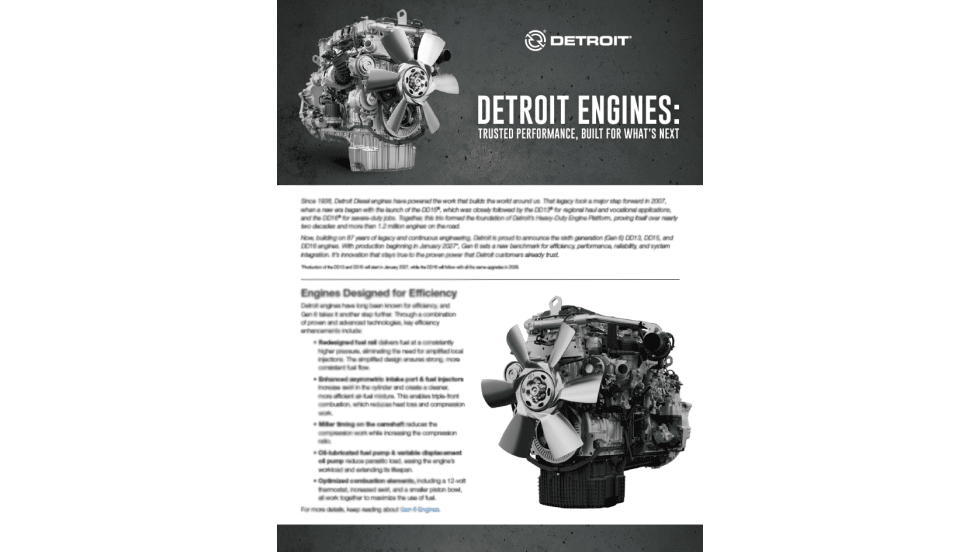
The Detroit® Gen 6 engine platform proves that real progress doesn’t require a complete redesign. Built on 20 years of trusted technology, these engines are designed for efficiency, stronger performance, and greater reliability than before. And they do it all while complying with 2027 EPA standards on every mile.
Aperia Technologies introduced a new automatic tire inflation system for steer axles and a partnership with Fontaine Fifth Wheel to integrate coupling status into its Halo Connect platform.