




NY-NJ Port Authority Revises Older-Trucks Plan
The Port Authority of New York and New Jersey is proposing to deny access to trucks with model year 1994 and 1995 engines, effective January 1, 2018, and to require that, effective March 1, 2016, new trucks seeking to serve the port terminals must be equipped with a 2007 or newer model year engine..

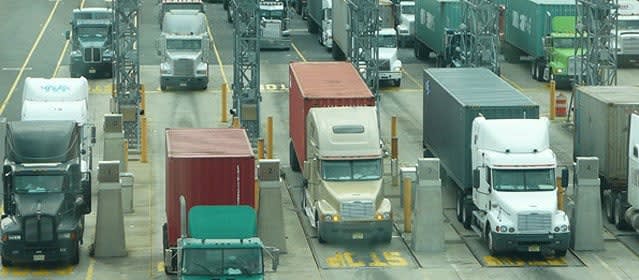
Photo: Port Authority of New York and New Jersey
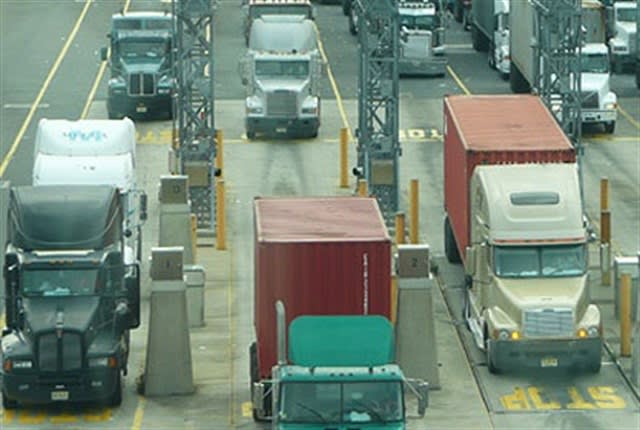
Photo: Port Authority of New York and New Jersey
The Port Authority of New York and New Jersey is proposing to modify the tariff for operating at its marine terminals to deny access to trucks with model year 1994 and 1995 engines, effective January 1, 2018, and to require that, effective March 1, 2016, new trucks seeking to serve the port terminals must be equipped with a 2007 or newer model year engine.
The proposed changes to engines allowed by the tariff will be posted on the Port Authority website and available for comment during a 30-day period beginning in February. Comments may be emailed to: publiccomments@panynj.gov.
PANYNJ also announced that it will commit $1.2 million to supplement the $9 million the joint agency expects to receive in federal funding to assist port truckers operating older trucks to buy newer, more environmentally friendly vehicles.
The joint agency said the total $10.2 million in funds for its Truck Replacement Program will provide grants for a portion of the cost of replacement trucks. The program’s stated goal is to replace some 400 trucks with model-year 1994 and 1995 engines that now call on the port.
According to PANYNJ, the approximately 400 newer trucks would result in emissions reductions of about 184 tons of fine particulate matter and 3,843 tons per year of nitrogen oxides over the remaining useful life of the vehicles being replaced. “This is the equivalent of taking more than 56,000 automobiles off the road each year, based on an Environmental Protection Agency formula,” the agency noted.
In addition, the Port Authority has set a goal to eventually have all trucks serving its terminals equipped with 2007 or newer engines.
The agency said it is “working closely with financial institutions to explore whether low-interest loans can be made available to truckers for the replacement of trucks serving the port with model year 1996 to 2006 engines.”
Since the Truck Replacement Program was launched in 2010, PANYNJ has facilitated the replacement of 429 trucks with newer models.
To date, the program has resulted in an estimated emission reduction of 157 tons of fine particulate matter and 4,122 tons of nitrogen oxide for the remaining useful life of the vehicles that were replaced.
“Our goal is to balance the need to efficiently and effectively move goods to and from our port terminals, while continuing to be good environmental stewards to the communities that surround our port facilities," said Port Authority Port Commerce Director Molly Campbell. "We believe our plan achieves this balance and will ensure that we continue to systematically address this issue for all stakeholders.”
More Fleet Management

Why Private Fleets Are Taking More Freight
Private fleets are putting their own trucks on demanding customers and high-cost lanes as companies seek greater control over service, costs, and capacity.
Read More →
Color Match Smarter: Tools That Restore & Perform
For fleet managers and collision repair professionals keeping heavy-duty trucks on the road, getting the color right the first time isn't just about appearance — it's about efficiency, turnaround time, and bottom-line results. Discover how today's digital color tools are transforming the repair process from guesswork to precision.
Read More →
FMCSA Pauses Biennial-Update Enforcement Amid Motus Transition
Carriers whose updates were due on or after June 1 have more time, while FMCSA works to stabilize its new registration system and warns of phishing sites impersonating its new carrier registration system, Motus.
Read More →


2026 Blueprint for Countering Smarter Supply Chain Theft
Cargo theft is no longer just the cost of doing business. It's a multi-billion-dollar criminal enterprise exploiting vulnerabilities across your fleet, drivers, and supply chain.
Read More →
How Telematics Improves Visibility, Control, and Performance in Refrigerated Fleets
Explore how telematics help refrigerated fleets improve visibility, uptime, efficiency, compliance, and cargo protection across connected cold chain operations.
Read More →
What the U.S.-Canada Trade War Means for Trucking
Escalating U.S.-Canada tariffs could disrupt cross-border freight, reduce truck volumes, raise costs, and create new uncertainty for carriers on both sides of the border.
Read More →
What Are Trucking’s Top Concerns for 2026?
The American Transportation Research Institute wants to know what's worrying trucking fleet managers, drivers, and other stakeholders in its annual Industry Issues survey.
Read More →
American Trucking Associations Looks for a New Leader
ATA President and CEO Chris Spear abruptly left his job at the association on August 21, at a pivotal time for the trucking industry.
Read More →
Public Wi-Fi Cybersecurity Risks: How Truck Drivers and Fleets Can Protect Their Data
Public Wi-Fi can expose truck drivers and fleets to credential theft, malware, and other cyber threats. Here’s how to reduce the risk on the road.
Read More →
For Nicky Cupp, Fleet Innovation Starts With Frustration
HDT Truck Fleet Innovator Nicky Cupp turns everyday pain points at Fraley & Schilling into opportunities for better technology and smarter processes.
Read More →