




"A second consecutive month of outright deflation certainly calls into question the Federal Open Market Committee's expectation for inflation to reverse course near-term and head back towards the Fed's longer-tem objective of 2%.”
Economic Watch: Latest Numbers Disappoint, More Uncertainty with Fed
While a recent good unemployment report led some to speculate the Federal Reserve will raise interest rates at year-end, new numbers released Friday remind us there's more to the equation.

Evan Lockridge・Former Business Contributing Editor
4 min to read

While a recent good unemployment report led some to speculate the Federal Reserve will raise interest rates at year-end, new numbers released Friday remind us there's more to the equation.
U.S. retail sales increased a weaker-than-expected 0.1% in October from the month before. That follows September's retail sales being downwardly revised to no change, according to the Commerce Department.
Auto sales, though still at a high level, unexpectedly dropped 0.5%, taking back a portion of the 1.4% increase recorded in September.
Core retail sales (which exclude motor vehicle, gas station, food and building material store receipts) rose a smaller-than-expected 0.2%, following an upwardly revised 0.1% gain in September.
Retail sales are a closely watched economic indicator. Accounting for about two-thirds of total economic activity, it's a key barometer of nation’s overall economic health.
Despite the month-over-month decline, retail sales in October increased 1.7% from the level of a year earlier. However, those year over year increases are lower than the 2.2% increase at the end of the third quarter and even further below the 4.7% year over year improvement this time last year.
Meanwhile, a separate report from the Commerce Department on wholesale prices shows they fell 0.4% in October from the month before.
The downturn in the Producer Price Index is the second consecutive monthly of decline. Year-over-year, headline producer prices continue to retreat, moving from a drop of 1.1% in September to decline of 1.6% in October, the weakest pace since the index began in November 2010.
The more closely watched indicator of inflation, the Consumer Price Index, is set to be released Nov 17.
So What Does All This Mean? Hmmmm...
“What a turn of events,” says Lindsey Piegza, chief economist at Stifel Fixed Income. “Inflation, nonexistent inflation that is, has long been the sticking point for Federal Reserve officials. A second consecutive month of outright deflation certainly calls into question the Federal Open Market Committee's expectation for inflation to reverse course near-term and head back towards the Fed's longer-tem objective of 2%.”
She points out, as policymakers have said, monetary policy is not based on expectations but on the actual evolution of the data.
“This morning's report is just a reminder of why such a policy is necessary," Piegza said. "Despite expectations for further price pressures, an expectation, mind you, that the Fed has held onto since 2011, inflation continues to retreat. Even with one half of the Fed's mandate – full employment – arguably met, can the Fed raise rates with the other half of the equation – stable prices – vehemently unattained?”
Piegza is pointing to a recent U.S. Labor Department report showing unemployment in the country fell to a seven and a half year low of 5% as the number of non-farm jobs added was the largest since last December. This report led to speculation that the Fed will increase interest rates when officials meet in next month.
“Indications of a continued solid pace of domestic spending supports the case for the Fed to start to withdraw some of the current highly accommodative monetary stimulus," said Paul Ferley, assistant chief economist with RBC Economics. "Volatility in global financial markets was a factor staying the Fed’s hand at the September FOMC though pressures along this front have subsequently eased. With upcoming data expected to provide further confirmation of solid economic growth, our outlook for monetary policy is that the fed funds range will rise 25 basis points to 0.25% to 0.50% at the December 16 policy meeting.”
One could argue that a third report released Friday adds fuel to such a stance.
Preliminary results of the University of Michigan’s Survey of Consumers shows confidence rose in early November, mainly due to a stronger outlook for the domestic economy.
Its readings of consumer sentiment, feelings on current economic conditions, along with expectations, all registered increases from the month before as well as year-over-year, beating many analyst expectations.
“Overall, the most recent confidence reading was equal to the average during the first 10 months of 2015, and higher than any year since 2004," according to Surveys of Consumers Chief Economist Richard Curtin.
“Two trends dominated the early November data. Consumers anticipated somewhat larger income increases during the year ahead, as well as expected a somewhat lower inflation rate,” he said. “This meant that consumers held the most favorable inflation-adjusted income expectations since 2007. Moreover, the somewhat larger gains were anticipated by lower income households. Buying plans for large discretionary purchases improved, especially for vehicles.”
Based on this report, along with the recent one on employment/unemployment, one could easily make an argument that the Fed hiking interest rates is a slam dunk decision.
However, when you look at a wider amount of data, retail sales and wholesale prices, plus a report from last month showing growth in the nation’s gross domestics product slowed to an annual rate of 1.5% in the third quarter from 3.9% in the second quarter, only one thing seems certain – Federal Reserve Chair Janet Yellen and her compadres will keep everyone guessing about what they are going to do with interest rates.
More Fleet Management

What the U.S.-Canada Trade War Means for Trucking
Escalating U.S.-Canada tariffs could disrupt cross-border freight, reduce truck volumes, raise costs, and create new uncertainty for carriers on both sides of the border.
Read More →
What Are Trucking’s Top Concerns for 2026?
The American Transportation Research Institute wants to know what's worrying trucking fleet managers, drivers, and other stakeholders in its annual Industry Issues survey.
Read More →
American Trucking Associations Looks for a New Leader
ATA President and CEO Chris Spear abruptly left his job at the association on August 21, at a pivotal time for the trucking industry.
Read More →
Public Wi-Fi Cybersecurity Risks: How Truck Drivers and Fleets Can Protect Their Data
Public Wi-Fi can expose truck drivers and fleets to credential theft, malware, and other cyber threats. Here’s how to reduce the risk on the road.
Read More →
For Nicky Cupp, Fleet Innovation Starts With Frustration
HDT Truck Fleet Innovator Nicky Cupp turns everyday pain points at Fraley & Schilling into opportunities for better technology and smarter processes.
Read More →
Adam Buttgenbach’s Approach to Electric Trucks: Start With Where They Fit
HDT Truck Fleet Innovator Adam Buttgenbach helped PepsiCo build one of North America’s largest EV fleets by focusing on where electric trucks make operational sense.
Read More →
Deen Albert: Let Automation Do the Math, People Make the Decisions
HDT Truck Fleet Innovator Deen Albert makes sure people are still at the heart of operations at Grand Island Express, even while adopting artificial intelligence tools. AI-assisted dispatch helped boost revenue 25% with the same number of trucks.
Read More →
Trimble’s New AI Agent Takes Aim at Fleet Back-Office Busywork
Arc Agent works across Trimble TMS products to automate repetitive tasks such as freight orders, maintenance, invoices, fuel costs and more.
Read More →
How HDT’s 2026 Truck Fleet Innovators Are Rethinking Fleet Operations
Meet five trucking leaders who are challenging assumptions, solving operational problems, and putting innovative ideas to work.
Read More →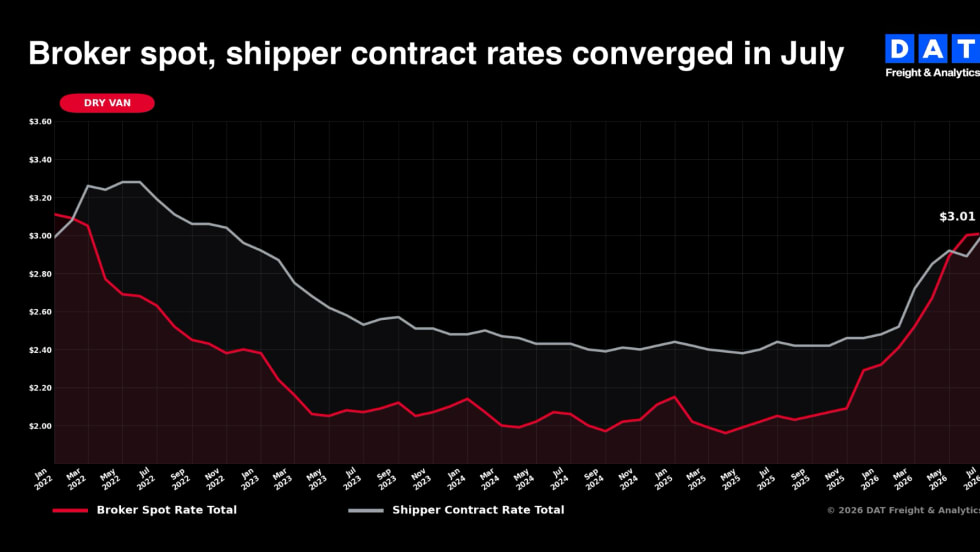
Tight Trucking Capacity Pushes Rates Higher Even as Freight Volumes Fall
“Spot rates moving ahead of contract rates have historically signaled a tightening market, but we haven’t seen a capacity-driven market quite like this one,” said DAT's Dean Croke.
Read More →