




OnGuard Active to Sense Stationary Objects in Lane Ahead
Meritor Wabco’s OnGuard radar-based collision mitigation system will react to stationary objects as well as slower moving objects in an enhanced version that will be available early next year.

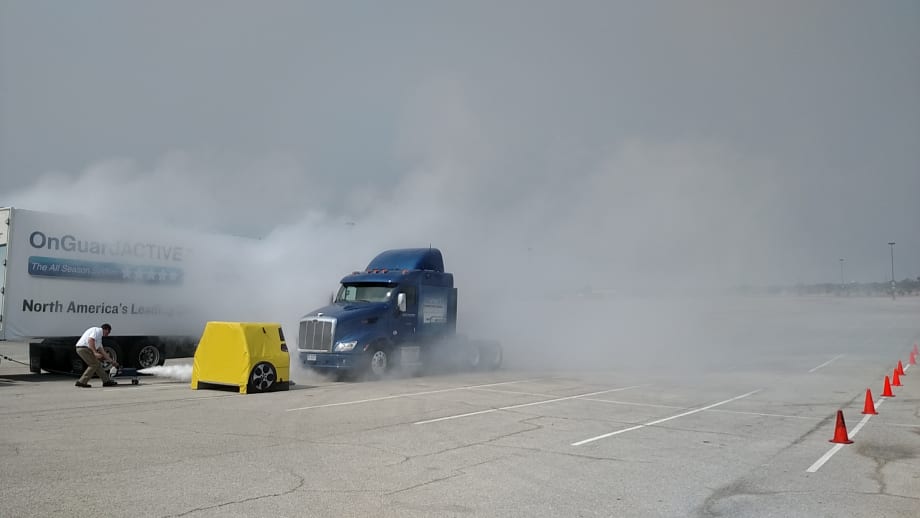
Though the driver can’t see the “car,” OnGuard Active’s radar can, and the system brakes the truck to a stop. Higher road speeds might have meant a collision, but damage would’ve been less than if the truck hadn’t slowed at all. Thus “mitigation” rather than “avoidance.”
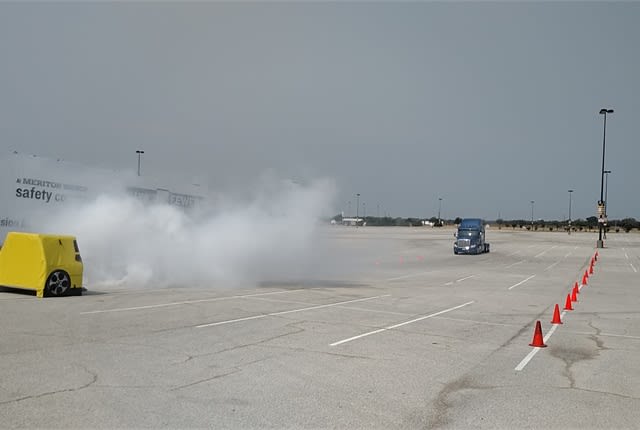
Tractor with OnGuard Active begins its run toward smoke, much like what wild fires sometimes send across highways. Here it obscures an inflatable car sitting in the truck’s lane. Test speed was 18-19 mph.
Meritor Wabco’s OnGuard radar-based collision mitigation system will react to stationary objects as well as slower moving objects in an enhanced version that will be available early next year.
Called OnGuard Active, the new system adds protection against rear-end collisions that are dangerous and costly. The current system has drastically reduced incidents to save lives and money, executives said at a demonstration on August 27 at Lone Star Park, a horse racing complex near Dallas, Tex.
OnGuard Active’s radar sees through smoke, fog, heavy snow and other obstructions, and the system warns drivers of objects in the same lane ahead. The system will slow or stop the truck if the driver fails to react.
Heavy trucks hitting stopped motor vehicles and other obstructions account for 20% of all rear-end accidents and 30% or truck-involved fatalities, said Mark Melletat, director of field operations. Hitting slower moving objects comprise higher percentages of incidents and fatalities, which is why that situation was handled first by Meritor Wabco engineers.
Seeing through smoke
Limited visibility causes 20% of all such crashes and 12% of fatals, and the radar function virtually ignores such conditions, including darkness, he said. OnGuard’s radar also looks at what’s in adjacent lanes to consider whether the driver can avoid an impending wreck by swerving.
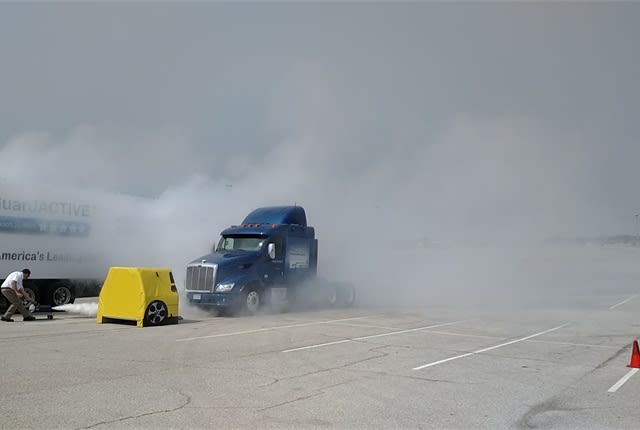
Though the driver can’t see the “car,” OnGuard Active’s radar can, and the system brakes the truck to a stop. Higher road speeds might have meant a collision, but damage would’ve been less than if the truck hadn’t slowed at all. Thus “mitigation” rather than “avoidance.”
The demonstration used machine-generated smoke, simulating smoke from a forest fire, that obscured an inflated “automobile” stopped in a lane. OnGuard aboard a Peterbilt tractor detected the car and automatically stopped the truck just short of it.
The tractor was moving at 18 to 19 mph, explained its driver, Bill Schlak, a service and sales technician. If it had been going much faster, it might’ve hit the rubber car, but “damage” and any human toll would’ve been far less than if the truck had not been slowed at all.
Damage reduction is why OnGuard and other products are called collision “mitigation” rather than “avoidance” systems. “They can’t promise to avoid all accidents, but they can reduce the severity of many of them, the companies say.
OnGuard's competitors are Bendix’s Wingman Fusion and Daimler’s Detroit Assurance systems.
Braking capabilities
Meritor Wabco’s current product, brought to market in 2013, supplies up to 50% of a truck’s braking capability, adds adaptive cruise control, and is always on. The original OnGuard, released in 2007, also worked when the truck’s cruise control was on.
The new OnGuard Active also remains always on, adds stationary objects to its list of things to watch for, and in some instances will use full braking, called “extended brake assist.” The Active version applies new software to existing hardware, so it can be flashed onto the electronic controls of existing systems made since January 2013, Merritat said.
Customers have reported reduction of rear-end collisions by up to 87% and reduced costs from such wrecks by 89%, all since its introduction eight years ago, he said. OnGuard is now running on more than 90,000 trucks, 60,000 of them with the newer 2013 version.
The Active version is expected to further prevent another 4,500 collisions, cut 3,500 injuries and deaths, and save $2.5 billion per year, estimates Meritor Wabco, based on government statistics. OnGuard now claims 70% of the market for collision mitigation systems and a 100% reorder rate from customers.
Also according to government stats, one rear-end collision costs about $123,000 in damage, and far more if injuries or deaths are involved. So reducing or preventing damage in just one instance can pay for the systems in many trucks.
Truck manufacturers set prices for OnGuard, but a typical fleet price on a heavy truck or tractor is about $2,500, said Mike Lambie, Meritor Wabco’s director of marketing.
As now, OnGuard Active will work at speeds above 15 mph, but not below that. The higher-speed capability was tackled first because accidents at those speeds result in more damage, injuries and fatalities, said Lambie. That’s because crash energy increases exponentially as road speed increases.
A future product might add lower-speed activation, he said, and that would be valuable to users of medium-duty trucks on which OnGuard will soon be offered. First will be Daimler Trucks’ Freightliner M2, according to an announcement made last week.
Daimler also offers OnGuard on the Freightliner Cascadia and Western Star 5700. It’s an option from Paccar on the Kenworth 680, the Peterbilt 579 and 587, and from Navistar on the International ProStar.
Click here for more information about OnGuard.
More Safety & Compliance

FMCSA Pauses Biennial-Update Enforcement Amid Motus Transition
Carriers whose updates were due on or after June 1 have more time, while FMCSA works to stabilize its new registration system and warns of phishing sites impersonating its new carrier registration system, Motus.
Read More →
ZF Expands Commercial Vehicle Push in North America
ZF is expanding its North American commercial-vehicle presence with new transmission applications, electrification, trailer technology and autonomous-driving systems.
Read More →
Truck Drivers Need More Than Another Alert
Fleets have more visibility into truck health, safety events, and driver activity than ever. The next challenge is turning all that information into useful guidance for the person who has to decide what to do next.
Read More →
Tesla Wants a Self-Driving Semi. Are Cameras Enough?
Could Tesla’s camera-only autonomous driving technology work on an 80,000-pound Semi? In this commentary, HDT's Deborah Lockridge takes a look at Tesla, Cybercab, and how autonomous trucks see the road.
Read More →
What DOT’s Automated Vehicle Strategy Means for Trucking
The U.S. Department of Transportation issued a new automated-vehicle strategy that outlines plans for driverless-truck regulations, cross-state freight corridors, and federal safety standards.
Read More →
NYC Expands Speed, Pedestrian Safety Tech Across Fleet
New York City is expanding intelligent speed assistance and pedestrian-alert systems across its municipal fleet, moving the technologies from pilot programs into vehicle procurement and retrofit requirements.
Read More →
FMCSA Removes 110 Truck Driver Training Schools from Certified ELDT List
Federal regulators also are targeting more than 160 additional training providers and launching a nationwide audit of third-party CDL skills testers as part of a broader crackdown on trucking fraud.
Read More →
Beyond DOT Compliance: What Makes a Trucking Fleet Truly Safe?
A trucking fleet can follow every rule and still make unsafe decisions. The real test comes when safety conflicts with freight, productivity, or cost.
Read More →
Hours of Service Pilot Programs: FMCSA Readies for 2027 Rollout
Two pilot programs could eventually reshape hours-of-service rules, giving truck drivers options to pause their 14-hour clock or use longer split sleeper rest periods.
Read More →
New Guide Offers Pet Safety Tips for Truck Drivers
Hundreds of thousands of pets travel in truck cabs. A new safety guide from Volvo Trucks and the Center for Pet Safety offers practical advice for truck drivers who bring dogs and cats along for the ride.
Read More →