





Related: Truck Platooning System Offers Fuel Savings Potential
Volvo Invests in Platooning Technology
A Volvo Group subsidiary is investing in Peloton Technology, which is working on a truck "platooning" system that would save fuel and reduce congestion by allowing trucks to travel in a close-following "platoon" on the highway.
April 27, 2015
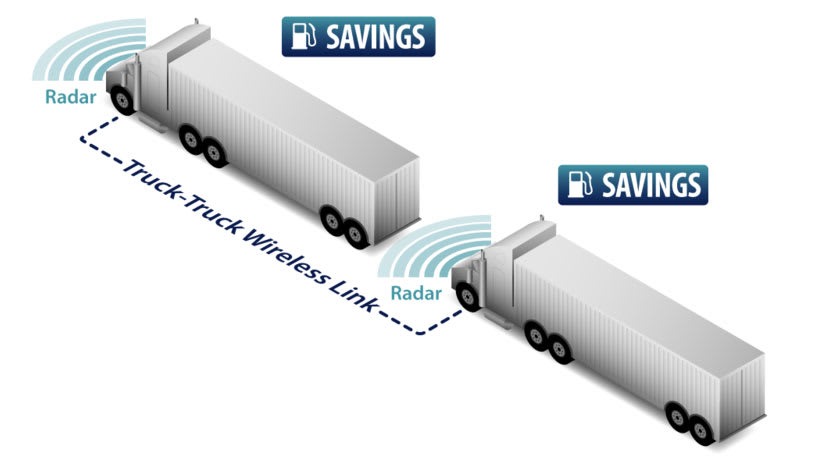
Photo: Peloton
3 min to read
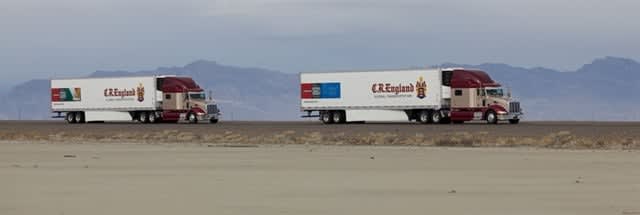
Photo: Peloton
Volvo Group Venture Capital, a subsidiary of the Volvo Group, announced an investment in Peloton Technology, which is developing a truck "platooning" system, which would allow trucks to save fuel by traveling in a close-following, semi-autonomous "platoon" on the highway.
The Peloton system builds on advanced safety technologies such as collision mitigation and adaptive cruise control systems. It electronically couples trucks through a combination of vehicle-to-vehicle communications, radar-based active braking systems and proprietary vehicle control algorithms. The result is enhanced collision avoidance capabilities and increased fuel efficiency for the front and rear trucks in a two-truck platoon.
A study of Peloton’s system by the North American Council for Freight Efficiency and a major fleet, using the industry standard SAE Type II test, showed reductions in fuel consumption of 10% for the rear commercial vehicle and by more than 4% for the front vehicle. Other U.S. and international studies of truck platooning have also shown high levels of fuel efficiency improvement.
Peloton, based in Mountain View, California, also is developing a Platooning Network Operations Center, a cloud-based service that helps trucks find platooning partners, collects vehicle and driver data and allows the approval or adjustment of platooning parameters.
“The societal demand for reduced traffic congestion, as well as improved safety on our nation’s highways, will continue to drive the need for innovative advanced technologies, such as platooning,” said Stephen Roy, president of Mack Trucks North America.
“Volvo Trucks has long been a leader in offering advanced technology to our customers, and we were the first OEM to lead a platoon,” said Goran Nyberg, president of Volvo Trucks North America.
In Europe, Volvo Group has been involved in a project called Sartre (Safe Road Trains for the Environment), which has successfully tested a road train, led by a commercial truck driven by a professional driver, followed by a number of autonomously driven cars. It builds on safety systems built into the vehicles, such as cameras, radar and laser senros, to monitor not only the lead vehicle but also other vehicles in the vicinity. Wireless communication allows the cars in the platoon to mimic the lead vehicle, accelerating, braking and turning the same way as the leader.
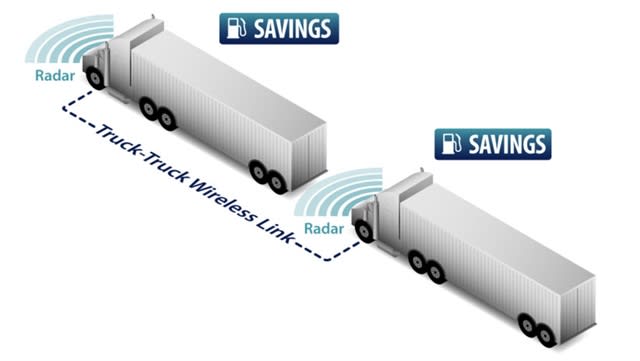
Photo: Peloton
During a panel discussion on "The Road to the Self-Driving Truck" last month at the Mid-America Trucking Show Fleet Forum, Susan Alt, Volvo Group senior vice president of public affairs, showed a video of the Sartre test with a car driver reading a newspaper behind the wheel as the car automatically keeps itself in line in a platoon behind a Volvo truck. "The actual driving of the road train is handled by a professional truck driver" supported by state of the art technology, she said.
"The study has shown it is technologically possible and could be reality in five to 10 years," Alt said. "What could take time is legislation and public acceptance."
For instance, she said, platooning would violate tailgating laws. And in fact practical concerns could trump the legal ones, she said. "What happens if a car cuts in front of a platoon?" she said in a question and answer session. "That's why you will only have platooning on certain roads under certain conditions with certain drivers."
While the Peloton system only calls for two trucks, Alt said theoretically there could be more vehicle in a platoon, including cars as in the Sartre project.
During that same panel discussion, Sandeep Kar, global director of commercial vehicle research with Frost & Sullivan, predicted that we will see platooning introduced in North America around 2018 or 2019 and that more fully automated trucks would follow.
More Fuel Smarts

Why Diesel Price Relief Efforts May Fall Short
Diesel prices have eased from September’s record high, but doubts about additional Russian supply and limits on dyed-diesel tax relief mean trucking fleets still face expensive fuel. And prices could go higher.
Read More →
Why Small Fuel Savings Matter in Trucking
Can better fuel economy help pay for driver raises? In this podcast, GP Transco explains how small efficiency gains create room to reinvest in its people.
Read More →
How GP Transco Cuts Trucking Fuel Costs, a Tenth of a Gallon at a Time
What’s another tenth of a mile per gallon worth? GP Transco shares how equipment upgrades and driver coaching turn small gains into meaningful fuel savings.
Read More →
Electric Yard Tractors Move Beyond Pilots
Operating-cost savings have overtaken sustainability goals as the leading reason surveyed fleets are adopting battery-electric terminal tractors, according to new NACFE research.
Read More →
Geotab Links Fleet Card to Vehicle Data
The new card combines fuel discounts with telematics-based purchase controls. Geotab’s analysis also points to potential savings from choosing lower-priced fuel stops.
Read More →
Fleet Economics Shape Electric Truck Outlook
ACT Research expects costs, charging infrastructure, and technology improvements to drive zero-emission commercial vehicle adoption as federal regulations and incentives retreat.
Read More →
Wex Adds Cardless Fuel Payments for Over-the-Road Customers
A new fuel card feature for Wex customers offers convenience and security.
Read More →
New California Law Could Shed Light on Electric Truck Prices
Why do battery-electric Class 8 trucks remain so expensive? A California bill signed by Gov. Gavin Newsom would give fleets and state agencies more visibility into what manufacturers charge.
Read More →
How Volvo Updated Its D13 for EPA 2027 [Watch]
Volvo’s updated D13 promises lower emissions without sacrificing performance or fuel economy. Take a closer look at what changed inside the engine in this HDT Spotlight video.
Read More →
Diesel Price Spike Shortens Payback for Natural Gas Trucks, Report Says
Energy Vision estimates fleets could recover the higher purchase price of an RNG-fueled Class 8 tractor in 1.3 to 2.8 years under current fuel-price scenarios.
Read More →