




Related: FMCSA May Reward Carriers for Going Beyond Safety Regs
ATA Outlines Truck Safety Recommendations to Congress
American Trucking Associations outlined three strategies to improve truck related traffic accidents in testimony before Congress.
by Staff
April 29, 2015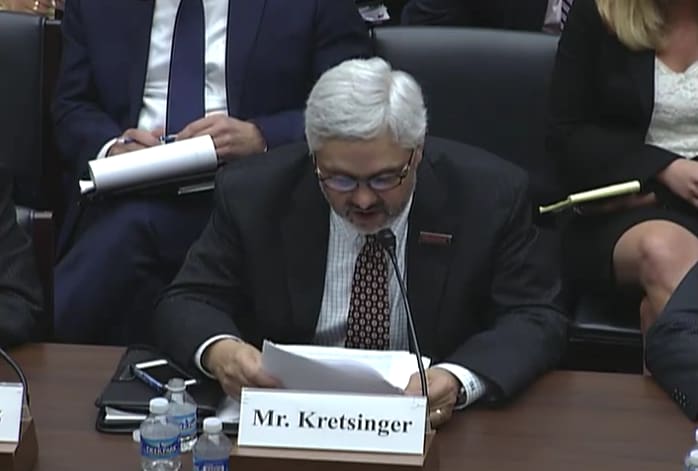
Tom Kretsinger testifies before Congress on behalf of ATA. Photo via Transportation and Infrastructure Committee
2 min to read

Tom Kretsinger testifies before Congress on behalf of ATA.Photo via Transportation and Infrastructure Committee
The American Trucking Associations outlined three strategies to improve truck-related traffic accidents in testimony to the House Transportation and Infrastructure Committee’s Highway and Transit Subcommittee.
The testimony took place during a Congressional hearing on technology, safety initiatives and the role of federal regulation.
Also giving testimony at the hearing were representatives from the Owner Operator Independebt Drivers Association, the Commercial Vehicle Safety Alliance, the Teamsters union and the United Motorcoach Association.
Tom Kretsinger, president and CEO of American Central Transport spoke on ATA’s behalf, testifying that to decrease fatal truck-involved accidents, the industry must address key issues.
“The truck-involved fatality rate has decreased 74% since 1975 and in the last decade alone, it has dropped 38%,” said Kretsinger. “But continued improvement will require an acknowledgement of the principal causes of truck crashes and appropriate countermeasures.”
He mentioned ATA’s support of the electronic logging device, electronic stability control and mandatory speed limiter rules among several proposals to address safety issues.
Kretsinger also urged the Federal Motor Carrier Administration to step up traffic enforcement coupled with a limited inspection. He cited FMCSA data indicating that highway enforcement was “at least four times more effective” at preventing accidents than roadside inspections alone.
He suggested that FMCSA partner with the trucking industry to develop an enforcement strategy that would add a reward-based approach for fleets that meet a gold standard of compliance and safety.
FMCSA recently requested public comment on the very same proposal.
“The trucking industry is justifiably proud of its long-term safety record,” Kretsinger said. “However, to continue this trend we will require more creative approaches and acknowledgment of the most common causes of truck crashes.”
More Safety & Compliance

ZF Expands Commercial Vehicle Push in North America
ZF is expanding its North American commercial-vehicle presence with new transmission applications, electrification, trailer technology and autonomous-driving systems.
Read More →
Truck Drivers Need More Than Another Alert
Fleets have more visibility into truck health, safety events, and driver activity than ever. The next challenge is turning all that information into useful guidance for the person who has to decide what to do next.
Read More →
Tesla Wants a Self-Driving Semi. Are Cameras Enough?
Could Tesla’s camera-only autonomous driving technology work on an 80,000-pound Semi? In this commentary, HDT's Deborah Lockridge takes a look at Tesla, Cybercab, and how autonomous trucks see the road.
Read More →
What DOT’s Automated Vehicle Strategy Means for Trucking
The U.S. Department of Transportation issued a new automated-vehicle strategy that outlines plans for driverless-truck regulations, cross-state freight corridors, and federal safety standards.
Read More →
NYC Expands Speed, Pedestrian Safety Tech Across Fleet
New York City is expanding intelligent speed assistance and pedestrian-alert systems across its municipal fleet, moving the technologies from pilot programs into vehicle procurement and retrofit requirements.
Read More →
FMCSA Removes 110 Truck Driver Training Schools from Certified ELDT List
Federal regulators also are targeting more than 160 additional training providers and launching a nationwide audit of third-party CDL skills testers as part of a broader crackdown on trucking fraud.
Read More →
Beyond DOT Compliance: What Makes a Trucking Fleet Truly Safe?
A trucking fleet can follow every rule and still make unsafe decisions. The real test comes when safety conflicts with freight, productivity, or cost.
Read More →
Hours of Service Pilot Programs: FMCSA Readies for 2027 Rollout
Two pilot programs could eventually reshape hours-of-service rules, giving truck drivers options to pause their 14-hour clock or use longer split sleeper rest periods.
Read More →
New Guide Offers Pet Safety Tips for Truck Drivers
Hundreds of thousands of pets travel in truck cabs. A new safety guide from Volvo Trucks and the Center for Pet Safety offers practical advice for truck drivers who bring dogs and cats along for the ride.
Read More →
Medical Cards, English Proficiency Reshape Roadcheck Violations
Medical-card violations jumped to the top of the driver out-of-service list during CVSA’s 2026 International Roadcheck, while English-language proficiency violations appeared among the leading violations for the first time.
Read More →