




Daimler Achieves 115% Efficiency Improvement with SuperTruck
Daimler Trucks North America unveiled its futuristic SuperTruck at the 2015 Mid-America Trucking Show, saying the project exceeded the company’s expectations. The DTNA SuperTruck has achieved 115% freight efficiency improvement, surpassing the Department of Energy program’s goal of 50% improvement.

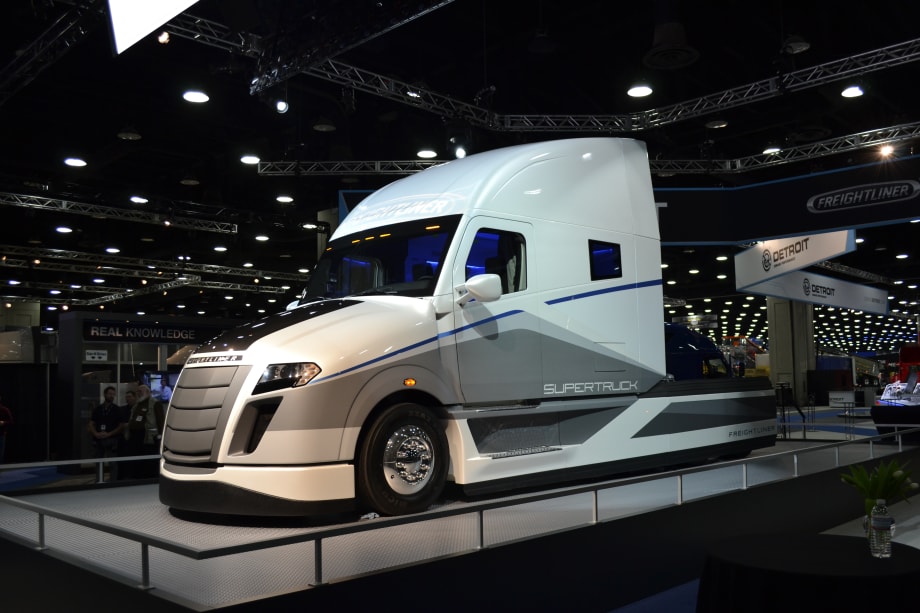
Freightliner's SuperTruck. Photo: Stephane Babcock
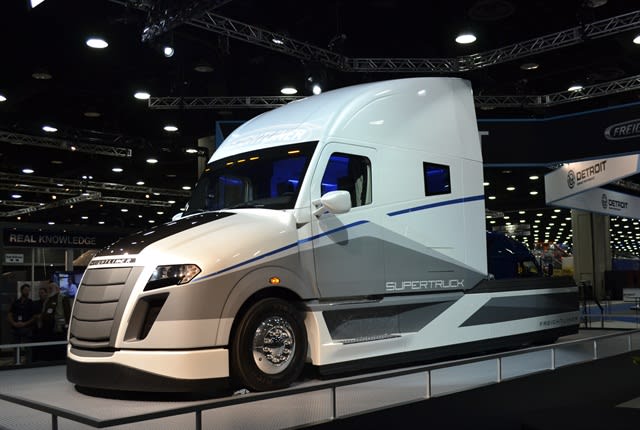
Freightliner's SuperTruck. Photo: Stephane Babcock
Daimler Trucks North America unveiled its futuristic SuperTruck at the 2015 Mid-America Trucking Show, saying the project exceeded the company’s expectations. The DTNA SuperTruck has achieved 115% freight efficiency improvement, surpassing the Department of Energy program’s goal of 50% improvement, according to Diane Hames, general manager of marketing and strategy.
“This has been a very fruitful use of taxpayer dollars,” said Hames, referring to the $40 million grant DTNA received from the DOE to participate in the SuperTruck program, “and I’m happy to be here today with the results of our efforts and a product that has far exceeded our expectations – hats off to our engineers.”
To validate the efficiency targets set by the DOE, DTNA engineers conducted a series of tests, including running the vehicle on highway routes in Oregon and Texas, one city route in Portland, Ore., and anti-idle testing in both a cold chamber and hot chamber. These tests resulted in a combined 115% freight efficiency improvement over a 2009 baseline truck.
Further testing conducted at the DTNA Detroit engineering facility demonstrated engine efficiency by achieving 50.2% engine brake thermal efficiency. The final test consisted of a five-day, 312-mile round trip route on Texas Interstate 35 between San Antonio and Dallas, at a weight of 65,000 lbs GVWR at a speed of 65 mph, where it achieved an average result of 12.2 mpg.
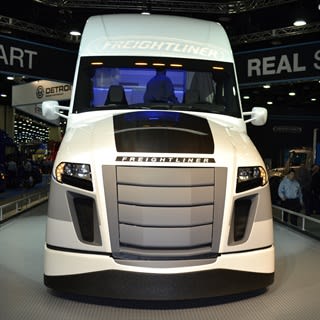
The articulating grill opens at lower speeds to cool the engine and closes at higher speeds when aerodynamics is more important.Photo: Stephane Babcock
Principal SuperTruck Investigator Derek Rotz pointed out some of the conflicting goals that had to be resolved to produce a highly efficient Class 8 truck.
“Cooling the engine and improving aerodynamic performance are typically at odds with each other in terms of how they handle the air flow,” explained Rotz. “Aerodynamics wants to keep the air external to the vehicle, and cooling requires air to go within the engine compartment.”
The solution was an articulating grill that opens at lower speeds to cool the engine and closes at higher speeds when aerodynamics is more important. During the development of the SuperTruck, engineers also investigated technologies such as electrified auxiliaries, controlled power steering and air systems, active aerodynamics, a long-haul hybrid system, waste heat recovery and trailer solar panels.
The DTNA SuperTruck team discovered that some of these components, due to regulatory or economic barriers, may not be commercially viable in the near future.
Other components were taken from the OE’s existing tool belt, including 6x2 optimization, aerodynamic components found on the Freightliner Cascadia Evolution, and the integrated Detroit Powertrain. Downspeeding with a custom engine rating, and using the predictive capabilities of Intelligent Powertrain Management (IPM) components such as pre-loaded 3D digital maps to control shifting and eCoast events, also increased efficiency and economy.
More Fuel Smarts
Trucking’s Diesel Squeeze Isn’t Letting Up
With diesel topping $6 a gallon nationally, ATA's Bob Costello explains why fleets should prepare for continued pressure at the pump.
Read More →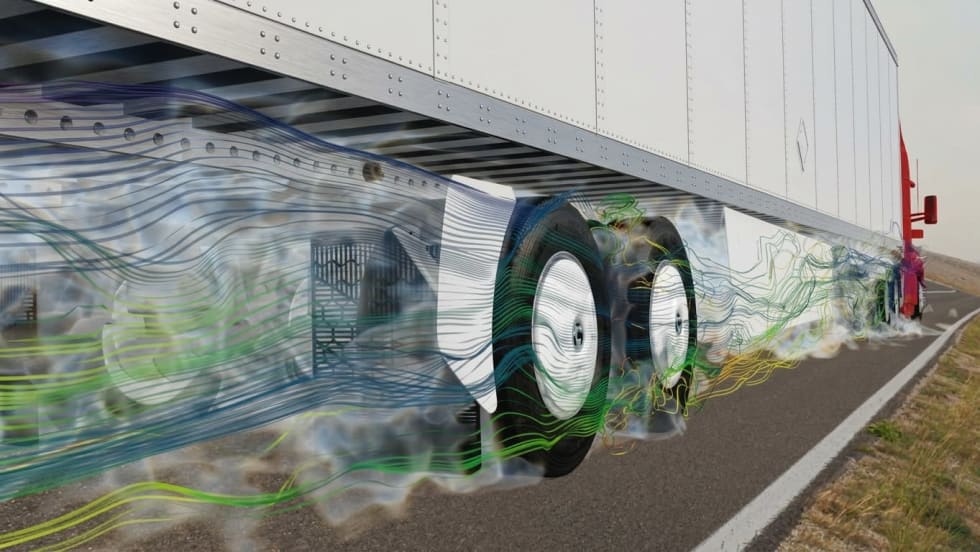
FlowBelow Redesigns Trailer AeroSlider to Cut Fuel Use
The lighter trailer aerodynamic system installs in less than 45 minutes, according to the company, with potential payback in under a year depending on fuel prices and trailer mileage.
Read More →
Why Diesel Price Relief Efforts May Fall Short
Diesel prices have eased from September’s record high, but doubts about additional Russian supply and limits on dyed-diesel tax relief mean trucking fleets still face expensive fuel. And prices could go higher.
Read More →
Why Small Fuel Savings Matter in Trucking
Can better fuel economy help pay for driver raises? In this podcast, GP Transco explains how small efficiency gains create room to reinvest in its people.
Read More →
How GP Transco Cuts Trucking Fuel Costs, a Tenth of a Gallon at a Time
What’s another tenth of a mile per gallon worth? GP Transco shares how equipment upgrades and driver coaching turn small gains into meaningful fuel savings.
Read More →
Electric Yard Tractors Move Beyond Pilots
Operating-cost savings have overtaken sustainability goals as the leading reason surveyed fleets are adopting battery-electric terminal tractors, according to new NACFE research.
Read More →
Geotab Links Fleet Card to Vehicle Data
The new card combines fuel discounts with telematics-based purchase controls. Geotab’s analysis also points to potential savings from choosing lower-priced fuel stops.
Read More →
Fleet Economics Shape Electric Truck Outlook
ACT Research expects costs, charging infrastructure, and technology improvements to drive zero-emission commercial vehicle adoption as federal regulations and incentives retreat.
Read More →
Wex Adds Cardless Fuel Payments for Over-the-Road Customers
A new fuel card feature for Wex customers offers convenience and security.
Read More →
New California Law Could Shed Light on Electric Truck Prices
Why do battery-electric Class 8 trucks remain so expensive? A California bill signed by Gov. Gavin Newsom would give fleets and state agencies more visibility into what manufacturers charge.
Read More →