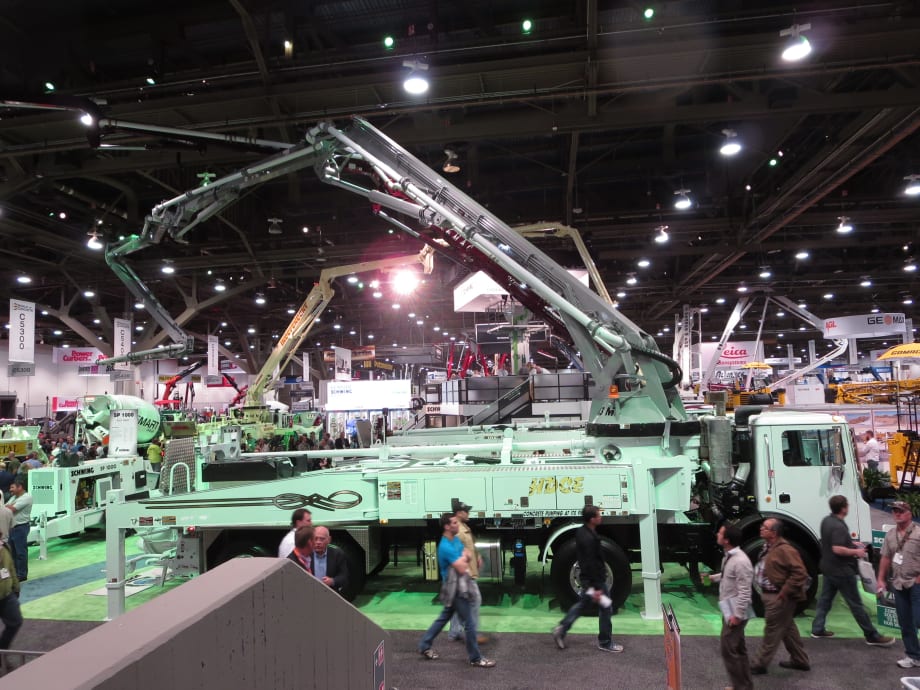
Schwing is displaying numerous wheel- and truck-mounted pumps. Equipment is painted white, but filters on overhead lights produced a green cast.Photo by Tom Berg
3 min to read
Schwing is displaying numerous wheel- and truck-mounted pumps. Equipment is painted white, but filters on overhead lights produced a green cast. Photo by Tom Berg
The economic recovery has revived construction activity, which was obvious at this week’s World of Concrete show at the Las Vegas Convention Center. It’s bigger than in previous years, with more trucks and concrete-handling equipment on display in several halls and outside lots. Among them were transporters of concrete pumping units, which are always eye-catching for their sheer size and massive weight.
As with mixer trucks, the market for pumps all but died during the Great Recession. Many of both types were on display at the show during those stagnant years, but representatives at manufacturers’ booths acknowledged that pumper chassis were a year or two or three old, as contractors with more time than work on their hands had ceased ordering them. Now the market has revived, and pumper trucks were all over the place at the World of Concrete.
Ad Loading...
Pumps are used to quickly lift the grey slurry to upper stories of buildings and place it across large pads. A large pump can move many hundreds of cubic yards of concrete in a shift. For reference, a typical load of concrete is 9 to 11 yards, so it takes a small fleet of mixer trucks to keep a pumper busy. Massive jobs can go on around the clock – occasions reported by local news media because of all the human and vehicular activity.
Pumper booms hydraulically fold out and extend to 30 to 60 meters, or roughly 100 to 200 feet. Displays have booms deployed horizontally, vertically and at various angles. Outside, some serve as expensive flag poles, flying fabric with a company’s name or the beloved Stars and Stripes.
While the American construction industry still measures almost everything in standard inch and foot terms, many pump manufacturers (like Putzmeister and Schwing) are headquartered overseas where metrics rule, so boom length is one thing described in meters (1 meter equals 39.37 inches).
Ad Loading...
Mack MR TerraPro has seven axles, three powered and several actively steered. Photo by Tom Berg
Mack has long dominated the pumper-chassis business in North America with its MR (now called TerraPro), a heavy low-cab-forward model also employed by trash-collection fleets. Many multi-axle MRs are displayed in implement makers’ booths. Most have at least four axles and at least one had seven, with two or more axles actively steered.
The largest and heaviest trucks sit on big-single flotation tires to better carry the weight over soft dirt, and are stabilized by hefty outriggers while working on site. One of these trucks can weigh 40 or more tons just sitting there, and some must move under special permits.
Operators need high horsepower not just to move the truck to and from job sites, but also to spin the massive pumps that propel concrete through piping in the long booms. So MP7 and MP8 diesels with 400 to 500 hp are used in Macks. Because the trucks spend more time sitting than moving down highways, multi-speed manual transmissions rather than the Allison automatics used in trash trucks are the rule.
Peterbilt showed 320 with a wide-spread twin-steer forward tandem. Photo by Tom Berg
Heavy low-cabovers from other builders also compete in this segment. Peterbilt’s Model 320, also primarily a trash chassis, has long been in it, and the company has put new emphasis on the concrete pump market since it came alive.
Now that the market's revived, Autocar expects more pump-chassis sales of its Xpeditor. Photo by Tom Berg
Autocar, a firm formed to take over the Volvo Xpeditor, is another. Over the years Autocar has built Xpeditor pumper chassis in ones and twos under special order, but it can expect more these days – at least as long as the economic recovery lasts.
Ad Loading...
Smaller pumps are toted by heavy or medium-duty conventional-cab chassis. Their comparative compactness and high maneuverability make them useful in tight urban areas. But they look less impressive than their big brothers, and we failed to photograph even one.
Westport and Volvo are demonstrating a 500-hp truck with diesel-like efficiency — one that also offers what Westport says is a better pathway to using hydrogen fuel in trucks.
New sensor integrations and component validation signal a shift from strategy to execution as Kodiak and Bosch push toward high-volume driverless truck deployment.
The evolution of the modern truck was a long, slow affair. But perhaps no other company did more to establish the template for what a modern truck should be, and how it should perform, than REO.
Western Star has expanded its operator-focused Star Nation competition and outreach to spotlight skill, attract new drivers, and strengthen industry ties.
The all-new Volvo VNR is jam-packed with advanced safety features. Join HDT for a first-hand look at how Volvo is keeping drivers safer and productive on the road.
At Volvo’s New River Valley customer center, the all-new VNR proves that maneuverability, safety, and driver confidence can coexist in a regional-haul workhorse.
March trailer orders posted an unexpected monthly jump, but demand still trails historical norms as fleets prioritize power units over trailing equipment.
A new autonomous truck startup company is targeting yard, port, and short-haul freight with a lighter, fully autonomous platform designed for dock-to-dock moves.