


Related:
FMCSA Ends Cross-Border Pilot, Grants Authority to Mexican Carriers
 MENU
MENU SEARCH
Fourteen years later, the Mexican cross-border trucking provisions of the North American Free Trade Agreement will finally be implemented.

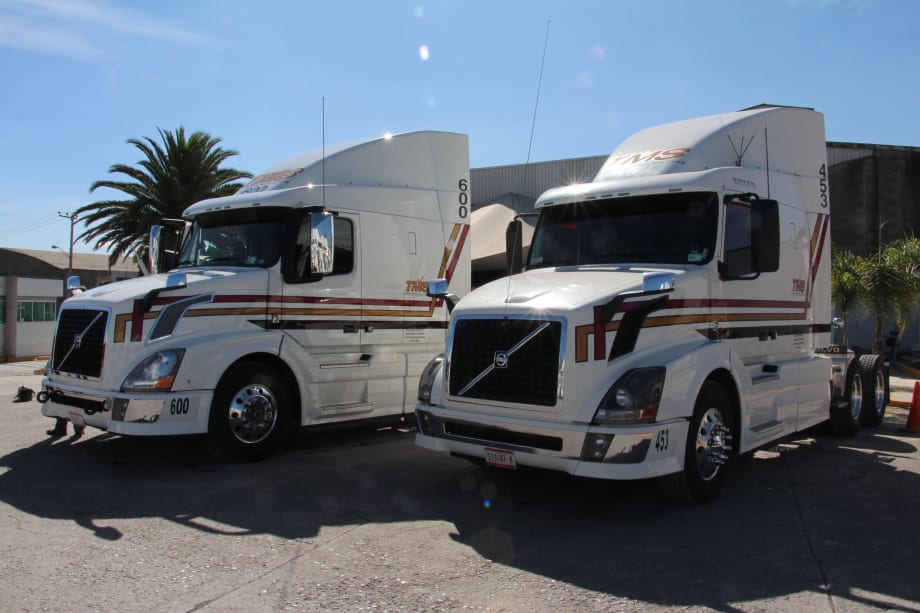
Mexican fleets like this one can now apply for U.S. operating authority under NAFTA. Photo by Evan Lockridge
Mexican fleets like this one can now apply for U.S. operating authority under NAFTA.Photo by Evan Lockridge
UPDATED -- The United States will start accepting applications from Mexican carriers to provide long-haul cargo delivery across the border. The Department of Transportation announced the move Friday. Official notice is likely to be published in the Federal Register next week.
The announcement marks a significant and long-delayed milestone in implementation of the North American Free Trade Agreement. It follows the Federal Motor Carrier Safety Administration’s final report to Congress on the three-year border pilot program set up to test the agency’s cross-border safety regime.
The agency found that Mexican carriers can operate safely.
“FMCSA concludes that the Pilot Program successfully demonstrated that Mexican motor carriers can and do operate throughout the United States at a safety level equivalent to U.S and Canada- domiciled motor carriers and consistent with the high safety standards that FMCSA imposes on all motor carriers authorized to operate in the United States,” the agency said.
The Mexican carriers in the program had much lower driver and vehicle out-of-service rates than U.S. or Canadian carriers.
Their driver OOS rate was 0.2% compared to 5.3% for U.S. carriers and 3.7% for Canadian carriers. Their vehicle OOS rate was 8.9% compared to 22% for U.S. carriers and 12.5% for Canadian carriers.
The agency ended the pilot last October and granted either normal or provisional operating authority to the 13 Mexican carriers that participated in the program.
The agency said that Mexican carriers applying for long-haul authority will have to clear a Pre-Authorization Safety Audit and confirm that they have safety management systems in place. These systems must include hours-of-service monitoring and drug testing.
Mexican drivers must have either a U.S. commercial license or the Mexican equivalent and be proficient in English. Once a carrier is approved to operate across the border, its trucks must clear a North American Standard Level I inspection every 90 days for four years.
The decision to accept Mexican applications closes a chapter in the 14-year U.S. effort to comply with terms of the North American Free Trade Agreement.
Under the agreement, the border should have been opened to long-distance trucking in both directions in 2000. The opening was stalled until 2007 by difficult negotiations with Mexico and opposition from U.S. labor unions and owner-operators who oppose free trade, fear the loss of jobs and argued that Mexican trucking is not safe.
In 2007 the Bush administration started a demonstration program to test a safety regime set up by FMCSA. When Congress killed this program in 2010 Mexico retaliated with $2 billion in import tariffs on agricultural and industrial products.
In 2011 the Obama administration negotiated a deal in which Mexico agreed to drop the tariffs while the U.S. put in place a revised program to vet Mexican carriers for safety. This is the three-year program that ended last October.
“Opening the door to a safe cross-border trucking system with Mexico is a major step forward in strengthening our relationship with the nation’s third largest trading partner, and in meeting our obligations under NAFTA,” said Transportation Secretary Anthony Foxx in a statement.
U.S. Trade Representative Michael Froman said the announcement sets the stage for Mexico to withdraw the threat of tariffs.
“We have been, and will continue to work with Mexico to ensure that the threat of retaliatory duties will now be brought to a swift conclusion,” he said in a statement.
But reaction from labor and owner-operators indicates that the issue is not closed.
When the agency granted authority to the Mexican pilot carriers in October, the Teamsters and the Owner-Operator Independent Drivers Association registered strong objections.
OOIDA Executive Director Todd Spencer indicated that court action against the border opening is an option, and that the group would seek support from members of Congress who oppose the opening.
Opponents of the opening are focusing on an audit of the pilot program by the DOT Inspector General.
The Inspector General confirmed that proper safety controls are in place but added that the program had too few participants to project the outcome of a full border opening.
This shortage of participants is evidence that the pilot program failed, said Teamsters General President Jim Hoffa.
“(The pilot program) did not provide enough data for the (Inspector General) to determine with any confidence that the trucks participating in the program were representative of those that could be permitted in the future,” Hoffa said in a statement.
The agency, on the other hand, says it in fact had plenty of data.
Because the Inspector General’s analysis was restricted to data collected on the program’s carriers, the agency said it also studied safety and inspection data for other long-haul Mexican carriers.
This analysis looked at an additional 952 international carriers that are either Mexican-owned or based in Mexico. Of these, 351 received authority during the three-year program, the agency said.
The agency told Congress that while the Inspector General could not determine if the program participants were representative of Mexican carriers that might apply for long-haul authority, Mexican officials indicated that the program will set the pattern for Mexican carriers' response.
Update includes more detail and reaction.

ATRI’s annual survey finds cautious optimism about freight, but diesel costs, litigation, and insurance continue to squeeze fleets. Drivers have different priorities on several issues.
Read More →
Just a few more days to nominate accomplished trucking fleet professionals under 40 who are making an impact and helping lead the industry forward for the HDT Emerging Leaders award. Deadline extended to October 20!
Read More →
Incoming President and CEO Mark Colson’s record in Alabama offers clues about his priorities and approach following Chris Spear’s abrupt departure as the head of the American Trucking Associations.
Read More →
Volvo VNL Autonomous trucks, powered by the Waabi Driver, are hauling freight directly to third-party facilities for a customer in Texas.
Read More →
Agent Studio lets fleets create AI tools for hours-of-service monitoring, reporting and driver support, including agents that communicate by phone.
Read More →
Two cabless electric trucks are hauling freight between EASE Logistics facilities in Marysville, Ohio, as part of a multi-state truck automation project.
Read More →
The new card combines fuel discounts with telematics-based purchase controls. Geotab’s analysis also points to potential savings from choosing lower-priced fuel stops.
Read More →
Multi-factor authentication adds protection when passwords are stolen. Here’s how it works and where fleets should start.
Read More →
Trucking and logistics teams have plenty of data. The problem is getting the right information in front of the right people soon enough to act. Better-connected data can help teams spot trouble earlier and make smarter decisions before small problems become big ones.
Read More →
At Insight 2026, Trimble executives argued that fleets may need to redesign workflows to get more from AI as it introduced new products and enhancements. AI’s value will depend on how fleets combine automation with their people's knowledge.
Read More →