




Fleet Survey Shows Tight Truck Capacity Slowing Freight
The latest industry survey by the consultancy group Transport Capital Partners sees a shortage of capacity and lack of qualified drivers changing the dynamics of freight, with trends in capacity and rates also contributing to a decline in broker freight.
Graphic: TCP
The latest industry survey by the consultancy group Transport Capital Partners sees a shortage of capacity and lack of qualified drivers changing the dynamics of freight, with trends in capacity and rates also contributing to a decline in broker freight.
According to the group, the trucking trade press is filled with news stories about a capacity crunch. This got it to wondering is the size of the crunch being overstated and are we hearing about the same freight marketed to many carriers?
“In the latest TCP survey, we decided to approach the issue from a slightly different angle,” said TCP Partner and Survey Leader Richard Mikes. “If stories of a capacity crunch are true, is freight being left on the shipper’s dock?”
Graphic: TCP
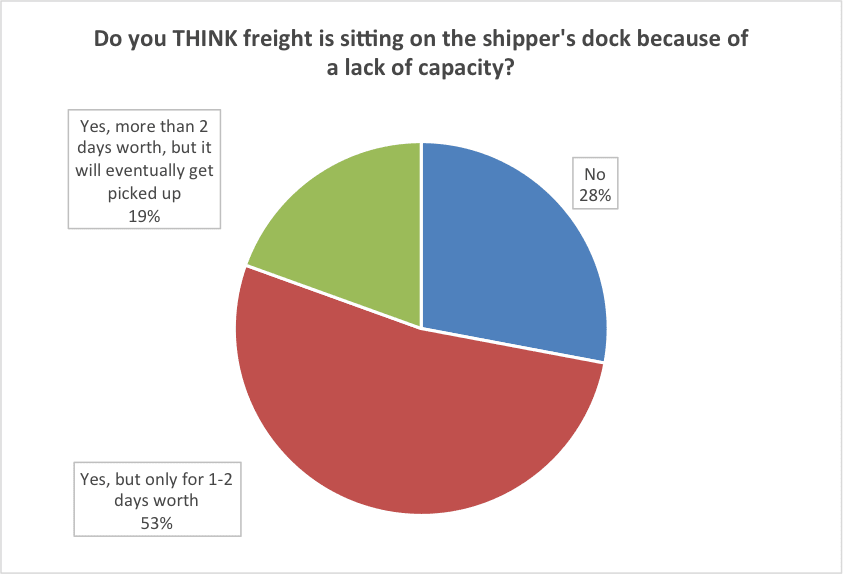
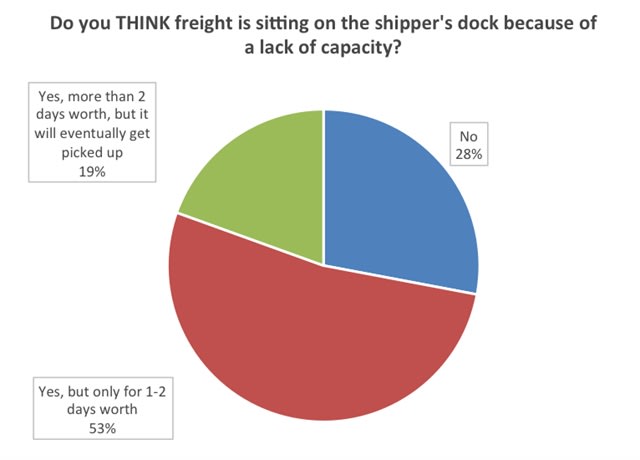
It found nearly three-fourths of carriers responded that they “think” freight is sitting on the shipper’s dock. According to TCP this lack of capacity comes as the industry faces growing volumes but a shortage of qualified drivers.
Additionally, it found rising costs and lowered driver and truck efficiency due to hours of service are also contributing to the problem. The survey was conducted in November, before Congress approved changes to the 34-hour restart rule in truckers hours of service regulations that went into effect in mid-December.
The TCP survey also found that, in every category, carriers are expecting to renegotiate accessorial charges. More than any other accessorial, 68% of carriers expect to renegotiate detention times. This is almost double the number from a year ago.
“Recent changes in hours of service have made detention times a hot button on driver efficiency and equipment efficiency,” said Lana Batts, TCP partner. “Unfortunately, it looks like larger carriers are expecting to re-negotiate more than their smaller competitors”.
Larger carriers, those doing more than $25 million a year in business, seemed more confident that smaller carriers when it came to feeling as if they could renegotiate detention times. In contrast, smaller fleets indicated they had a better chance of renegotiating fuel surcharges.
Meanwhile, the trend of carriers using less broker freight services continues with 76%percent of carriers indicated they intend to use less broker freight. “This is a logical fall out from tighter capacity and rising rates, and a consistent trend since the end of the great recession,” said Mikes.
More Fleet Management

How MFA Helps Protect Trucking Fleets
Multi-factor authentication adds protection when passwords are stolen. Here’s how it works and where fleets should start.
Read More →
How Better Freight Data Helps Trucking Teams Get Ahead of Disruption
Trucking and logistics teams have plenty of data. The problem is getting the right information in front of the right people soon enough to act. Better-connected data can help teams spot trouble earlier and make smarter decisions before small problems become big ones.
Read More →
Trimble: Taking Artificial Intelligence in Trucking Beyond Faster Tasks
At Insight 2026, Trimble executives argued that fleets may need to redesign workflows to get more from AI as it introduced new products and enhancements. AI’s value will depend on how fleets combine automation with their people's knowledge.
Read More →

Build a bulletproof fleet: Uniting ELDs and dash cams for total compliance
An ELD can prove compliance, but it cannot always prove what happened on the road. Discover how uniting accurate ELD data with AI-powered dash cam video can help your fleet strengthen compliance, defend against liability, protect drivers and reduce operational costs.
Read More →
Nominations Open for HDT Emerging Leaders
Heavy Duty Trucking is looking for accomplished trucking fleet professionals under 40 who are making an impact and helping lead the industry forward.
Read More →
Why Private Fleets Are Taking More Freight
Private fleets are putting their own trucks on demanding customers and high-cost lanes as companies seek greater control over service, costs, and capacity.
Read More →
Color Match Smarter: Tools That Restore & Perform
For fleet managers and collision repair professionals keeping heavy-duty trucks on the road, getting the color right the first time isn't just about appearance — it's about efficiency, turnaround time, and bottom-line results. Discover how today's digital color tools are transforming the repair process from guesswork to precision.
Read More →
FMCSA Pauses Biennial-Update Enforcement Amid Motus Transition
Carriers whose updates were due on or after June 1 have more time, while FMCSA works to stabilize its new registration system and warns of phishing sites impersonating its new carrier registration system, Motus.
Read More →
2026 Blueprint for Countering Smarter Supply Chain Theft
Cargo theft is no longer just the cost of doing business. It's a multi-billion-dollar criminal enterprise exploiting vulnerabilities across your fleet, drivers, and supply chain.
Read More →
What the U.S.-Canada Trade War Means for Trucking
Escalating U.S.-Canada tariffs could disrupt cross-border freight, reduce truck volumes, raise costs, and create new uncertainty for carriers on both sides of the border.
Read More →