




Detroit Assurance: Collision Mitigation, Assisted Braking, Better MPG
The new Detroit Assurance from Daimler Trucks North America is an active vehicle safety system that complements fuel efficiency while adding a huge measure of driver convenience. The system was formally unveiled at a ride-and-drive event in Miami, Florida, on Friday.


Photo by Jim Park
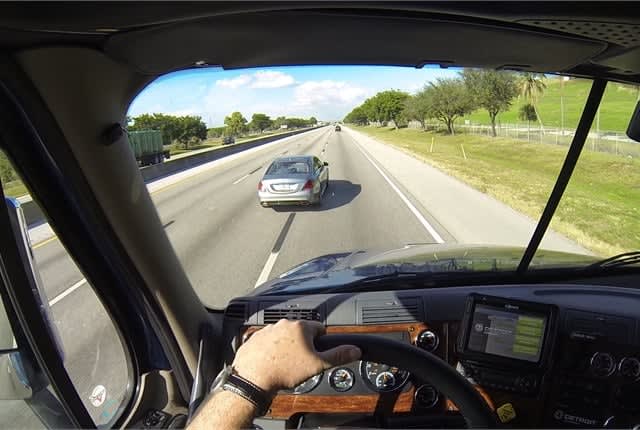
Photo by Jim Park
MIAMI -- Detroit Assurance, Daimler Trucks North America's new active vehicle safety suite, made its real-world debut on Friday. The company hosted a ride-and-drive event in Miami after first announcing the system last month during the American Trucking Association's October Management Conference in San Diego.
The Detroit Assurance suite includes Active Brake Assist for collision mitigation and Adaptive Cruise Control to maintain a safe following distance from the vehicle ahead. Customers also have the option of adding a lane departure warning system.
The functionality is not new to North America. Several third-party systems are already widely deployed and some are available on DTNA Class 8 trucks. However, Brad Williamson, manager of Powertrain Marketing for DTNA, claims the level on integration capable with its proprietary system goes beyond what an add-on system can deliver.
"The vendor systems we offer work well and perform well, but we think the deep integration offered with Detroit Assurance takes functionality and performance to a new level," he explained. "Similar systems have been in place in Mercedes Benz cars for better than two decades, and on Daimler trucks in Europe for more than 10 years. But all the software, all the logic and all the algorithms with this system are proprietary to DTNA."
The system uses radar pulses to detect metallic objects ahead of the truck. It can track up to 40 objects up to 660 feet away, DTNA says, while the Video Radar Decision Unit refreshes its speed, distance, and time calculations 200 times per second. Data from these two sources feed the Active Brake Assist and the Adaptive Cruise Control functions. The optional windshield-mounted camera supplies information to the lane departure warning.
Active Braking Assist
The ABA system will intervene under two conditions:
1. if it determines a collision is likely, and
2. to slow the truck if a pre-set following distance is compromised.
Depending on the degree of urgency, the system may simply throttle back and reduce vehicle speed to compensate for the narrower following distance, in which case the driver may not even notice the intervention. Or under more dire circumstances, the system will apply up to 100% of the trucks service brake capacity in order to slow the vehicle and mitigate the possible damage arising from a collision.
The driver gets a three-tiered alert sequence beginning with an audio and visual warning that the system has detected a potential conflict. The system will mute the radio (if it's on) and sound a buzzer while displaying "Collision Warning" on the integrated dash-mounted driver information display.
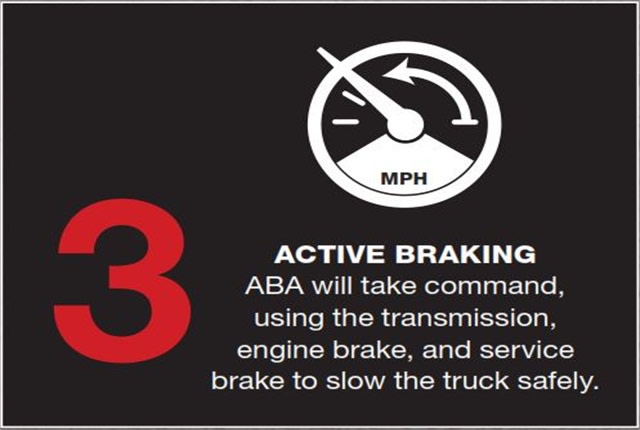
Should that fail to get the driver to initiate braking, the ABA system will partially apply the engine brake and service brakes to warn the driver to respond. The next step sees the ABA take command, using the transmission, engine brake and service brakes to slow the truck safely.
Depending on the dynamics of the situation, this sequence could take place over a few seconds span of time, to almost instantly. If the driver responds in a timely manner or the situation that caused the alert is disappears, the warning and braking sequence stops immediately.
Adaptive Cruise Control
When the driver has the ACC set to a certain speed, the truck will maintain that speed under normal conditions. The factory default following distance is set to 3.5 seconds, but an optional headway switch allows the driver to adjust the following distance anywhere from 2.3 seconds to 3.5 seconds in one-third second increments. ACC is active anytime the cruise control is engaged and active.
ACC uses the radar and the camera system to detect metallic objects ahead of the truck and will adjust the vehicle speed in order to maintain the preset following distance. For example, while cruising at 65 mph, if the truck comes up on a vehicle moving at 55 mph, the system will de-throttle the engine to reduce speed in order to maintain the preset gap. In cases where the speed delta is small and the distance between is good, the driver may not even notice the deceleration. In a more urgent situation, the system would engage the engine brake and possibly even the service brakes to slow the truck.
In situations where a vehicle cuts in front of the truck well inside of the preset following distance but is accelerating, nothing happens. If that vehicle slows, the response from Detroit Assurance can be quite dramatic. 728
ABA and ACC Together
While the two systems function independently, together they provide a measure of safety as well as driver convenience and even fuel efficient operation.
Because the system maintains a set following distance, the truck will follow a leading vehicle at any speed at a safe distance. The net effect is the vehicle in front will set the speed for the truck as well. The real benefit to this is driver convenience and fuel economy.
"It's hard to take full advantage of cruise control in dense traffic because the variation in speed," said Williamson. "With Detroit Assurance you can probably drive 400 miles without ever having to touch the brake or the accelerator. The less braking and accelerating you do, the better the fuel economy."
Scott Kuebler, general manager of Component Sales at DTNA, explained that the deep level of integration between Detroit Assurance and the Detroit engine and DT12 transmission results in smoother and more fuel-efficient speed and braking transitions.
"All these products speak 'Detroit,' and that really increases to the level of integration possible when the communication takes place on the J1939 data bus," he said.
Lane Departure Warning
An optional camera system provides lane departure warnings using audio and visual indicators to notify a driver he or she has unintentionally departed the lane. The camera detects reflective paint on the road, and when it detects the truck crossing from the lane, the radio will mute and the driver gets an audible warning inside the cab from the side of the truck where the crossover occurs.
The driver can disable this system with a switch on the dash while driving in conditions that may cause false warnings, such as construction zones and roads with tight curves. The disable feature will remain active for at least 15 minutes or until the truck exceeds 49 mph.
Detroit Assurance is available with Eaton manual transmissions as well, but with limited functionally. Full functionality is available only with Detroit engines and DT12 transmission. It's available for the Freightliner Cascadia Evolution and Cascadia trucks equipped with Detroit engines,
"If we can mitigate a collision and down scale the severity of the crash, we can save you a lot of money on just one accident," Williamson said. "There's absolutely a value proposition there, and that doesn't include the reduced downtime resulting from a less severe repair job."
Watch for an upcoming QuickSpin feature on how Detroit Assurance handles itself in traffic. In the meantime, check out this Ultimate Test Drive promo for an upcoming UTD video feature on the system.
More Safety & Compliance

A Camera Isn't a Safety Program. Here's What Brokers Are Screening for Now
Footage alone may not be enough to pass broker vetting processes. Here's what counts as a defensible safety program now.
Read More →
Marijuana and Trucking’s Drug-Testing Dilemma
Marijuana is getting stronger, laws are changing, and drug tests still can’t reliably establish impairment. What does that mean for truck drivers and the fleets that employ them?
Read More →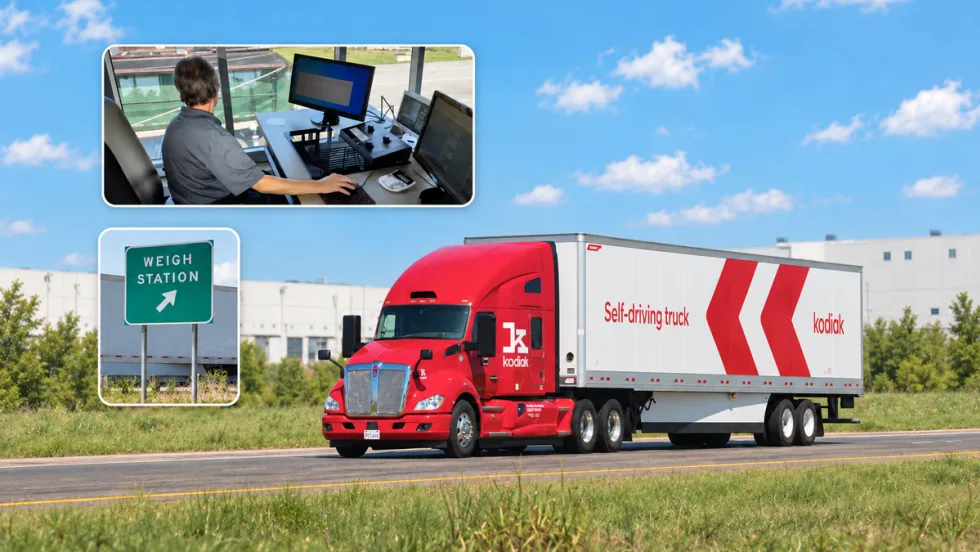
PrePass, Kodiak Connect Driverless Trucks to Roadside Enforcement
The system will allow enforcement agencies to verify Enhanced Inspection information and decide whether Kodiak’s autonomous trucks can bypass roadside screening sites.
Read More →

From One Generation to the Next: How Mentorship Builds Safer Truck Drivers
After three decades in trucking, Harold Perry shares what he's learned about driver safety, mentorship, and helping the next generation build confidence behind the wheel.
Read More →
FMCSA Pauses Biennial-Update Enforcement Amid Motus Transition
Carriers whose updates were due on or after June 1 have more time, while FMCSA works to stabilize its new registration system and warns of phishing sites impersonating its new carrier registration system, Motus.
Read More →
ZF Expands Commercial Vehicle Push in North America
ZF is expanding its North American commercial-vehicle presence with new transmission applications, electrification, trailer technology and autonomous-driving systems.
Read More →
Truck Drivers Need More Than Another Alert
Fleets have more visibility into truck health, safety events, and driver activity than ever. The next challenge is turning all that information into useful guidance for the person who has to decide what to do next.
Read More →
Tesla Wants a Self-Driving Semi. Are Cameras Enough?
Could Tesla’s camera-only autonomous driving technology work on an 80,000-pound Semi? In this commentary, HDT's Deborah Lockridge takes a look at Tesla, Cybercab, and how autonomous trucks see the road.
Read More →
What DOT’s Automated Vehicle Strategy Means for Trucking
The U.S. Department of Transportation issued a new automated-vehicle strategy that outlines plans for driverless-truck regulations, cross-state freight corridors, and federal safety standards.
Read More →
NYC Expands Speed, Pedestrian Safety Tech Across Fleet
New York City is expanding intelligent speed assistance and pedestrian-alert systems across its municipal fleet, moving the technologies from pilot programs into vehicle procurement and retrofit requirements.
Read More →