




FMCSA Ends Cross-Border Pilot, Grants Authority to Mexican Carriers
A three-year pilot program testing the safety of cross-border trucking between the U.S. and Mexico is ending, and the Mexican truck lines that have been providing long-distance, cross-border service under that pilot program will move to normal operating status. HDT Washington Editor Oliver Patton has the details.



The Mexican truck lines that have been providing long-distance, cross-border service under a federal pilot program will move to normal operating status.
The Federal Motor Carrier Safety Administration announced that it is ending the 3-year pilot program and granting authority to the carriers, pending final reports on the program from an advisory committee and the Transportation Department’s Inspector General.
“In the interim, based upon successful completion of the program, as well as a review of safety and inspection data collected during the program, the Department has converted the 13 participants to provisional or standard operating authority, allowing those carriers to continue to operate in the United States,” the agency said in a statement.
The Mexican carriers in the pilot program are running 55 vehicles with either permanent or provisional authority.
The latest FMCSA report shows that these trucks have crossed the border more than 27,000 times and U.S. officials have conducted 5,408 inspections.
The results of the inspections vary. Several of the Mexican carriers have no driver or vehicle out-of-service orders. The largest Mexican operation, Tijuana-based Servicio de Transporte de Internacionale y Local with 30 trucks and 17 drivers, has a vehicle OOS rate of 9.63% and a driver OOS rate of .13%.
The Transportation Department Inspector General is working on a final audit of the program to see if it is preserving safety, if it ensures that the carriers are complying with the rules and if enough Mexican carriers are participating to yield a valid assessment. The report is expected by mid-December.
The last audit, in February 2013, found that the Mexican carriers were safe but there were too few to prove that the regulatory system would work in the long run.
At that time there were just 558 inspections. FMCSA has since exceeded its target of 4,100 inspections.
In addition, the agency has tasked its Motor Carrier Safety Advisory Committee with producing a report on the effectiveness of the program. A MCSAC subcommittee has been studying the issue and is scheduled to meet again later this month. A final report is due next Spring.
Meanwhile, the agency will continue to inspect the Mexican carriers at the border and they will have to abide by U.S. regulations.
The pilot program was set up by the Obama administration in 2011 to prove that the agency can ensure the safety of Mexican trucks crossing the border.
This is the latest development in a 14-year U.S. effort to comply with terms of the North American Free Trade Agreement.
Under the agreement, the border should have been opened to long-distance trucking in both directions in 2000. The opening was stalled until 2007 by difficult negotiations with Mexico and opposition from U.S. labor unions and owner-operators who oppose free trade, fear the loss of jobs and argue that Mexican trucking is not safe.
In 2007 the Bush administration started a demonstration program to test a safety regime set up by FMCSA. When Congress killed this program in 2010 Mexico retaliated with import tariffs on agricultural and industrial products.
In 2011 the Obama administration negotiated a deal in which Mexico agreed to drop the tariffs while the U.S. put in place a revised program to vet Mexican carriers for safety. This is the three-year program that just expired.
More Safety & Compliance

ZF Expands Commercial Vehicle Push in North America
ZF is expanding its North American commercial-vehicle presence with new transmission applications, electrification, trailer technology and autonomous-driving systems.
Read More →
Truck Drivers Need More Than Another Alert
Fleets have more visibility into truck health, safety events, and driver activity than ever. The next challenge is turning all that information into useful guidance for the person who has to decide what to do next.
Read More →
Tesla Wants a Self-Driving Semi. Are Cameras Enough?
Could Tesla’s camera-only autonomous driving technology work on an 80,000-pound Semi? In this commentary, HDT's Deborah Lockridge takes a look at Tesla, Cybercab, and how autonomous trucks see the road.
Read More →
What DOT’s Automated Vehicle Strategy Means for Trucking
The U.S. Department of Transportation issued a new automated-vehicle strategy that outlines plans for driverless-truck regulations, cross-state freight corridors, and federal safety standards.
Read More →
NYC Expands Speed, Pedestrian Safety Tech Across Fleet
New York City is expanding intelligent speed assistance and pedestrian-alert systems across its municipal fleet, moving the technologies from pilot programs into vehicle procurement and retrofit requirements.
Read More →
FMCSA Removes 110 Truck Driver Training Schools from Certified ELDT List
Federal regulators also are targeting more than 160 additional training providers and launching a nationwide audit of third-party CDL skills testers as part of a broader crackdown on trucking fraud.
Read More →
Beyond DOT Compliance: What Makes a Trucking Fleet Truly Safe?
A trucking fleet can follow every rule and still make unsafe decisions. The real test comes when safety conflicts with freight, productivity, or cost.
Read More →
Hours of Service Pilot Programs: FMCSA Readies for 2027 Rollout
Two pilot programs could eventually reshape hours-of-service rules, giving truck drivers options to pause their 14-hour clock or use longer split sleeper rest periods.
Read More →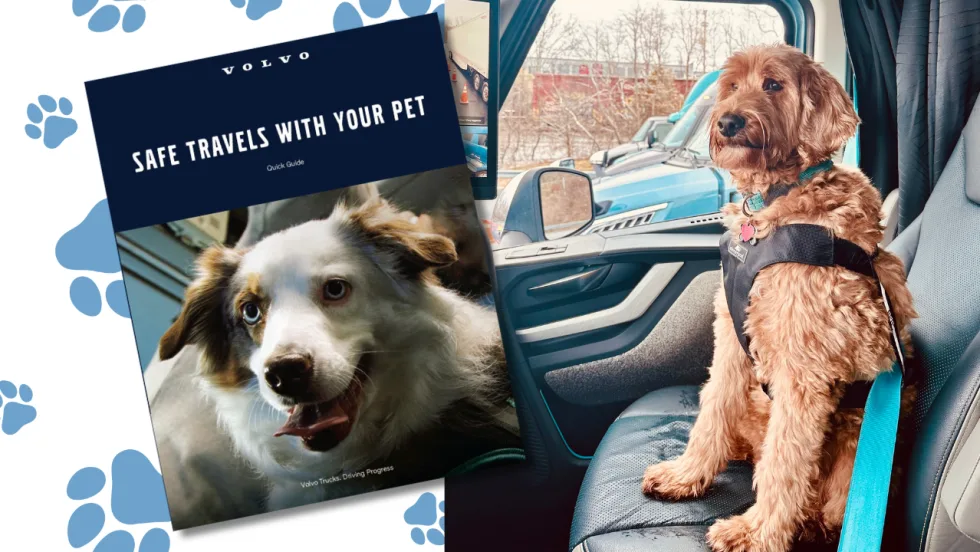
New Guide Offers Pet Safety Tips for Truck Drivers
Hundreds of thousands of pets travel in truck cabs. A new safety guide from Volvo Trucks and the Center for Pet Safety offers practical advice for truck drivers who bring dogs and cats along for the ride.
Read More →
Medical Cards, English Proficiency Reshape Roadcheck Violations
Medical-card violations jumped to the top of the driver out-of-service list during CVSA’s 2026 International Roadcheck, while English-language proficiency violations appeared among the leading violations for the first time.
Read More →