




Congressmen Air Concerns About Sleep Apnea Training
Two congressmen have told the Federal Motor Carrier Safety Administration that some of the organizations providing sleep apnea training to medical examiners are teaching the wrong material.


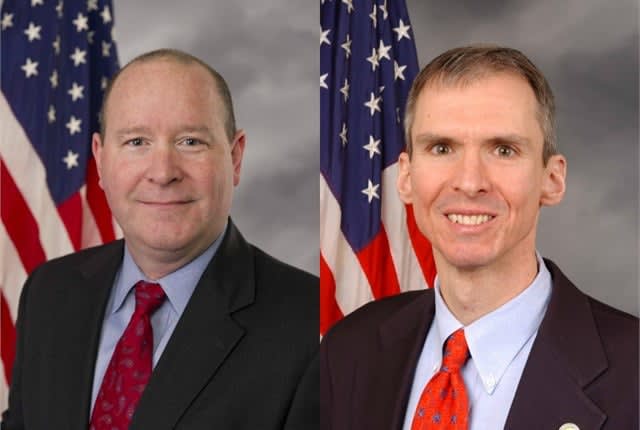
Congressmen Larry Bucshon (left) and Daniel Lipinski (right).
Two congressmen have told the Federal Motor Carrier Safety Administration that some of the organizations providing sleep apnea training to medical examiners are teaching the wrong material.
President Obama last year signed a law requiring the agency to write a rule covering sleep disorders, rather than handling them through guidance to medical examiners.
But Reps. Larry Bucshon, R-Ind., and Daniel Lipinski, D-Ill., who wrote the law, now say some trainers are giving medical examiners incorrect information.
In an October 2 letter to acting FMCSA chief Scott Darling, Bucshon and Lipinski said the agency should tell its approved training organizations that they should not follow any specific steps with respect to sleep apnea testing and treatment.
“Specific steps means that they are not to follow the specific steps in the training materials or provide guidance in the absence of a rulemaking,” said Lipinski spokesman Isaac Sancken in response to an email query.
“All it says is that medical examiner training organizations aren’t to give specific steps as there technically aren’t any in the absence of a rulemaking.”
The congressmen said the agency may not be involved with the curriculum, but they are troubled that the training organizations are listed on the FMCSA web site.
They want the agency to tell the trainers to remove from their materials any references to recommendations by the Medical Review Board, the Motor Carrier Safety Advisory Committee and the agency itself.
That information is available online but it is not supposed to be on the formal medical guidance for examiners
Bucshon and Lipinski also want the agency to tell examiners who have already been trained to correct their practices.
“It is imperative that FMCSA address these issues as soon as possible,” they said. “These faulty training courses are keeping qualified drivers off the road.”
The congressmen also want the agency to say when it will start the sleep apnea rulemaking.
This situation arises from concern in the industry about the agency’s former plan to address sleep apnea by beefing up its long-standing guidance to medical examiners.
The agency traditionally relied on guidance to make sure that examiners can spot drivers who may have a sleep disorder. In recent years, as doctors and medical researchers learned more about sleep disorders, the agency’s initial reaction was to pass that information on to examiners by strengthening its guidance.
But trucking interests were concerned about that approach because it would not give employers a clear enough statement of their legal responsibilities.
The solution was to write a rule that will cover not just the newest understanding of sleep disorders but also the full impact of such a rule, including costs and benefits. American Trucking Associations has estimated that the rule will cost $1 billion a year.
The agency has said it intends to write the rule but has not yet posted a schedule.
Related:
Commentary: Do Drivers With Sleep Apnea Have to Use a CPAP Machine?
More Drivers

Samsara Launches Custom AI Agent Builder
Agent Studio lets fleets create AI tools for hours-of-service monitoring, reporting and driver support, including agents that communicate by phone.
Read More →
Trucker Path Expands Reserved Parking Network
Trucker Path has added close to 6,000 more truck parking spaces to its Trucker Path Reserved Parking Network with the addition of Safe Truck Parking.
Read More →
EEOC Sues Texas Trucking Company Over Driver Age Limits
The agency says Trancasa USA rejected applicants over 65 and applied tougher driving-record standards to those over 60.
Read More →
Nussbaum, Roehl Announce Second Driver Pay Increase This Year
This year has seen a swath of major truck driver pay increases as freight capacity has tightened.
Read More →
From One Generation to the Next: How Mentorship Builds Safer Truck Drivers
After three decades in trucking, Harold Perry shares what he's learned about driver safety, mentorship, and helping the next generation build confidence behind the wheel.
Read More →
Truck Drivers Need More Than Another Alert
Fleets have more visibility into truck health, safety events, and driver activity than ever. The next challenge is turning all that information into useful guidance for the person who has to decide what to do next.
Read More →
FMCSA Removes 110 Truck Driver Training Schools from Certified ELDT List
Federal regulators also are targeting more than 160 additional training providers and launching a nationwide audit of third-party CDL skills testers as part of a broader crackdown on trucking fraud.
Read More →
Hours of Service Pilot Programs: FMCSA Readies for 2027 Rollout
Two pilot programs could eventually reshape hours-of-service rules, giving truck drivers options to pause their 14-hour clock or use longer split sleeper rest periods.
Read More →
Medical Cards, English Proficiency Reshape Roadcheck Violations
Medical-card violations jumped to the top of the driver out-of-service list during CVSA’s 2026 International Roadcheck, while English-language proficiency violations appeared among the leading violations for the first time.
Read More →
Driver Trust Can Make or Break the Success of Fleet Safety Technology
New Teletrac Navman research suggests that onboarding, transparency about driver data, and positive feedback can play a significant role in how commercial drivers respond to safety and coaching technology.
Read More →