




FMCSA Makes Changes to SMS Website to Improve User Experience
An FMCSA representative offers a guide to the changes in the website that hosts and displays safety information under the government's Compliance, Safety, Accountability enforcement program plus a rules update at TMW's annual user conference.


Joseph DeLorenzo, director office of enforcement and compliance, FMCSA, explained change to the agency’s SMS website during a conference at TMW Systems’ annual user conference in Nashville. Photo: Jim Beach
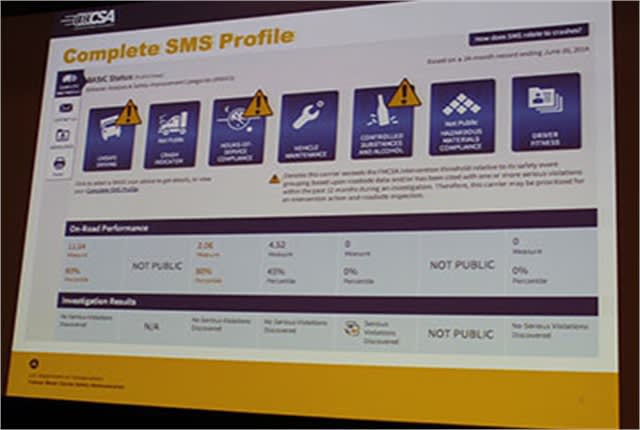
FMCSA redesigned its SMS web page to make it easier for carriers to use and to keep tabs on how they are doing under the CSA program.
NASHVILLE -- The website that hosts and displays safety information under the government's Compliance, Safety, Accountability enforcement program has undergone a redesign after the agency discovered "people are looking at data in a little different way than we thought."
The recent changes to the Federal Motor Carrier Safety Administration’s Safety Management System’s website did not change “anything that goes into SMS,” explained Joseph DeLorenzo, director office of enforcement and compliance for the FMCSA, at TMW's Transforum user conference this week.
He explained there were three things the agency tried to do with the re-design:
Make it easier to understand what you are looking at,
Get all the information in one place
Give motor carriers a tool to make it easier to monitor their performance.
Most of the important information is shown on the main page of the system, with more detailed information available by clicking on certain items.
“These are cosmetic changes, not methodology changes,” he said. But you now can use the page to bring up more detailed information, how a carrier ranks in relation to similar carriers for each BASIC, and a measure over time graph that give carriers a view of how they are doing.
“If you want to know how you are doing, this what you should be looking at,” he said, noting it is based only on the inspections a carrier has had and the violations they received from those inspections.
The carrier registration page now includes a flag to show a carrier if is Carrier MCS-150 is outdated. If the information needs updating, carriers can click an “update” button to do that online.
The redesign also includes a help center to aid navigation through the system, fact sheets and other information.

Joseph DeLorenzo, director office of enforcement and compliance, FMCSA, explained change to the agency’s SMS website during a conference at TMW Systems’ annual user conference in Nashville.Photo: Jim Beach
Rules Update
As for other rules the agency is currently working on, DeLorenzo said they were “shooting for a rulemaking sometime next year” on a safety fitness determination rule.’
And the long-awaited rule requiring electronic logging devices is also expected to be published soon. The interaction between ELDs and roadside inspection officers is “a key for the ELD rule,” he said.
“The goal is to make it easy,” he said. Another thing to iron out is the kind of documentation carriers need to retain to back up their ELDs, plus there is the issue of harassment to work through.
“Once we have it out there, I think it will make it easier for everybody.”
The agency continues to work on the Uniform Registration System, taking the 16 or so forms now used and combining them into one and to develop that as a web-based form.
He said by Oct. 23, 2015, the agency plans to go to all online registration with no more paper registration.
On the near-term horizon, he said, is a rule creating a Drug and Alcohol Clearing House. “The idea here, is to create a clearinghouse that will include verified drug and alcohol test, refusals, etc. to make it easy for trucking companies to check that database before hiring drivers.” The comment period closed earlier this year, and the agency is going through the comments and figuring out how to implement it.
When questioned about the current hours of service rule and if the agency would reconsider it as some members of Congress have requested, DeLorenzo said, “Our position is that the rule has been through the process and that’s the rule.”
More Fleet Management

Nomination Deadline Extended for HDT Emerging Leaders
Just a few more days to nominate accomplished trucking fleet professionals under 40 who are making an impact and helping lead the industry forward for the HDT Emerging Leaders award. Deadline extended to October 20!
Read More →
What Will ATA’s New Leader Bring to Trucking's Table?
Incoming President and CEO Mark Colson’s record in Alabama offers clues about his priorities and approach following Chris Spear’s abrupt departure as the head of the American Trucking Associations.
Read More →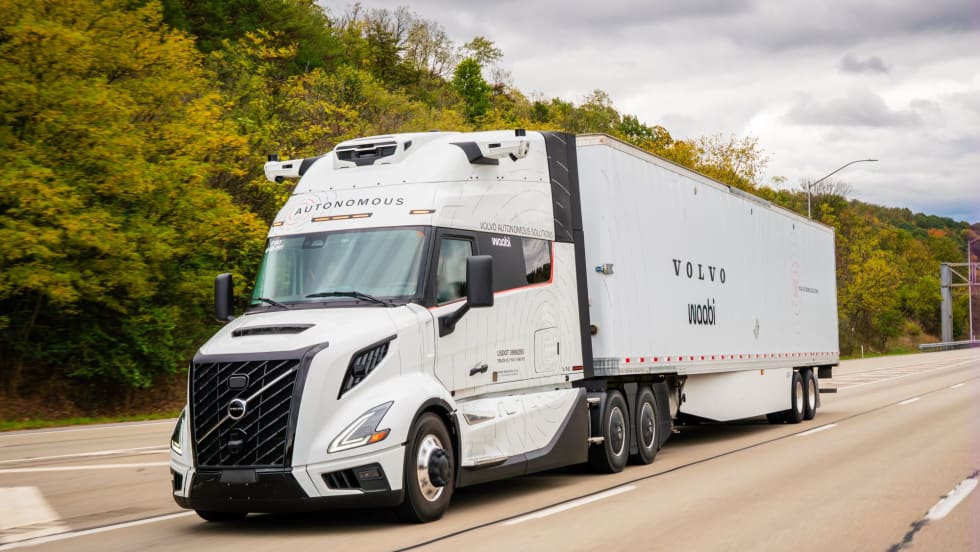
Volvo, Waabi Start Commercial Autonomous Operations in Texas
Volvo VNL Autonomous trucks, powered by the Waabi Driver, are hauling freight directly to third-party facilities for a customer in Texas.
Read More →
Samsara Launches Custom AI Agent Builder
Agent Studio lets fleets create AI tools for hours-of-service monitoring, reporting and driver support, including agents that communicate by phone.
Read More →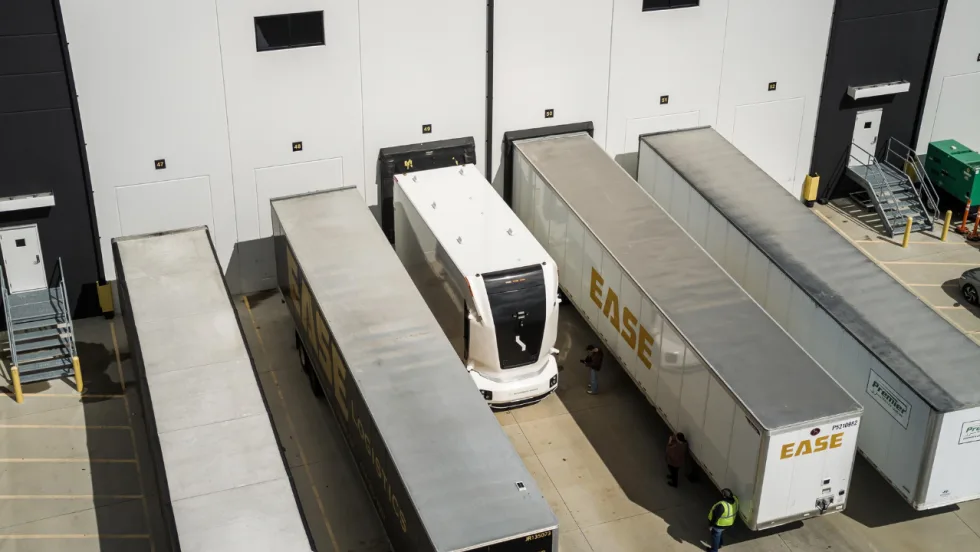
Einride Driverless Electric Trucks Begin Daily Freight Operations in Ohio
Two cabless electric trucks are hauling freight between EASE Logistics facilities in Marysville, Ohio, as part of a multi-state truck automation project.
Read More →
Geotab Links Fleet Card to Vehicle Data
The new card combines fuel discounts with telematics-based purchase controls. Geotab’s analysis also points to potential savings from choosing lower-priced fuel stops.
Read More →
How MFA Helps Protect Trucking Fleets
Multi-factor authentication adds protection when passwords are stolen. Here’s how it works and where fleets should start.
Read More →
How Better Freight Data Helps Trucking Teams Get Ahead of Disruption
Trucking and logistics teams have plenty of data. The problem is getting the right information in front of the right people soon enough to act. Better-connected data can help teams spot trouble earlier and make smarter decisions before small problems become big ones.
Read More →
Trimble: Taking Artificial Intelligence in Trucking Beyond Faster Tasks
At Insight 2026, Trimble executives argued that fleets may need to redesign workflows to get more from AI as it introduced new products and enhancements. AI’s value will depend on how fleets combine automation with their people's knowledge.
Read More →
Build a bulletproof fleet: Uniting ELDs and dash cams for total compliance
An ELD can prove compliance, but it cannot always prove what happened on the road. Discover how uniting accurate ELD data with AI-powered dash cam video can help your fleet strengthen compliance, defend against liability, protect drivers and reduce operational costs.
Read More →