




Researchers Working to Bring Road Signs into Vehicles
Researchers at the Virginia Tech Transportation Institute are in the early stages of an idea to move stop and yield signs from the side of the road into the car itself, where a dashboard screen will automatically alert the driver of what actions to take, if any.
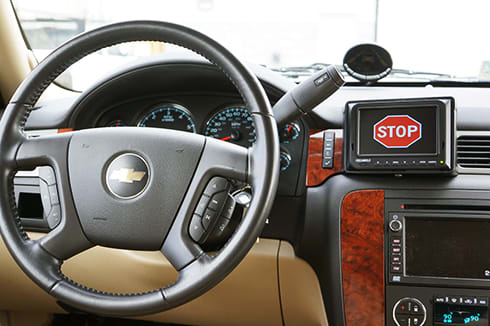
Photo: VTTI
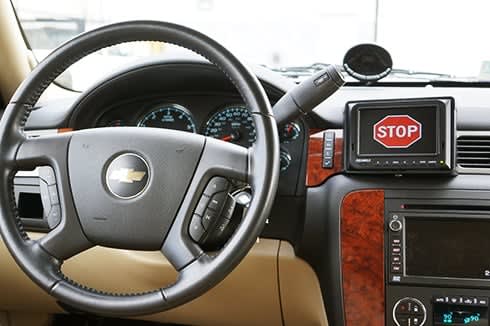
Photo: VTTI
Researchers at the Virginia Tech Transportation Institute are in the early stages of an idea to move stop and yield signs from the side of the road into the car itself, where a dashboard screen will automatically alert the driver of what actions to take, if any.
Alexandria Noble, a master’s student with the Virginia Tech Charles E. Via Jr. Department of Civil and Environmental Engineering, is spearheading the proof of concept adaptive stop-yield study with funding from the U.S. Department of Transportation.
The project directly ties into the institute’s growing endeavor into connected-vehicle technology, a futuristic intranet-like grid system where “smart” cars and other vehicles will be able to communicate not only with each other but surrounding infrastructure to help prevent auto crashes and ease congestion.
Noble recently finished a 17-week closed experiment directly behind the institute’s main base, involving dozens of local test participants, aged 18-25 and then older than 50, in cars outfitted with small GPS-like dashboard screens that would alert the driver with a flashing display to either stop or yield, and proceed through the intersection.
Institute researchers trained to safely interact with the participant driving test vehicles drove additional cars at intersections during the tests.
Cameras set up inside the institute-provided test vehicle filmed test subjects, capturing images of the motorist’s upper body, line of sight, the dashboard, and the vehicle itself. Also part of the test, were scenarios where the automated sign technology was allowed to fail, leaving the test subject to act on their own accord.
“This study was set up to take place in a future where all static traffic control infrastructure, such as stop signs and yield signs, are no longer needed, and you have an adaptable in-vehicle display telling you when you need to stop and when a stop is unnecessary,” said Noble.
“The deployment of this technology in the real world would involve a whole re-working of the transportation system and is not likely to be deployed in the near future,” she said. “However, this study will be useful in developing future connected-vehicle applications in a general sense and demonstrates that this is possible and how well it is received by naive drivers with minimal training on the subject.”
The project is only beginning, according to the university, noting this idea has not been tested in real traffic environments. Hours of footage of tests subjects will be reviewed and compared to that of drivers filmed during naturalistic conditions in separate institute studies.
Reasons for bringing traffic signage and warnings directly into cars are many according to the university. Roadside stop and yield signs are often overlooked or outright ignored. Physical signs also are costly, they must be kept up, replaced when damaged, and there’s always the danger of a sign being stolen or covered by tree growth.
Other traffic signs also only have limited use. For example, “Bridge Freezes Before Road” signs. Such signs may be needed during most winter days in, say, Rhode Island, but during summer it’s not likely. And in a warm state such as Alabama, even during winter, its need is rare. Adaptive in-car warnings would be better for the driver, as and when needed, according to researchers.
More Safety & Compliance

ZF Expands Commercial Vehicle Push in North America
ZF is expanding its North American commercial-vehicle presence with new transmission applications, electrification, trailer technology and autonomous-driving systems.
Read More →
Truck Drivers Need More Than Another Alert
Fleets have more visibility into truck health, safety events, and driver activity than ever. The next challenge is turning all that information into useful guidance for the person who has to decide what to do next.
Read More →
Tesla Wants a Self-Driving Semi. Are Cameras Enough?
Could Tesla’s camera-only autonomous driving technology work on an 80,000-pound Semi? In this commentary, HDT's Deborah Lockridge takes a look at Tesla, Cybercab, and how autonomous trucks see the road.
Read More →
What DOT’s Automated Vehicle Strategy Means for Trucking
The U.S. Department of Transportation issued a new automated-vehicle strategy that outlines plans for driverless-truck regulations, cross-state freight corridors, and federal safety standards.
Read More →
NYC Expands Speed, Pedestrian Safety Tech Across Fleet
New York City is expanding intelligent speed assistance and pedestrian-alert systems across its municipal fleet, moving the technologies from pilot programs into vehicle procurement and retrofit requirements.
Read More →
FMCSA Removes 110 Truck Driver Training Schools from Certified ELDT List
Federal regulators also are targeting more than 160 additional training providers and launching a nationwide audit of third-party CDL skills testers as part of a broader crackdown on trucking fraud.
Read More →
Beyond DOT Compliance: What Makes a Trucking Fleet Truly Safe?
A trucking fleet can follow every rule and still make unsafe decisions. The real test comes when safety conflicts with freight, productivity, or cost.
Read More →
Hours of Service Pilot Programs: FMCSA Readies for 2027 Rollout
Two pilot programs could eventually reshape hours-of-service rules, giving truck drivers options to pause their 14-hour clock or use longer split sleeper rest periods.
Read More →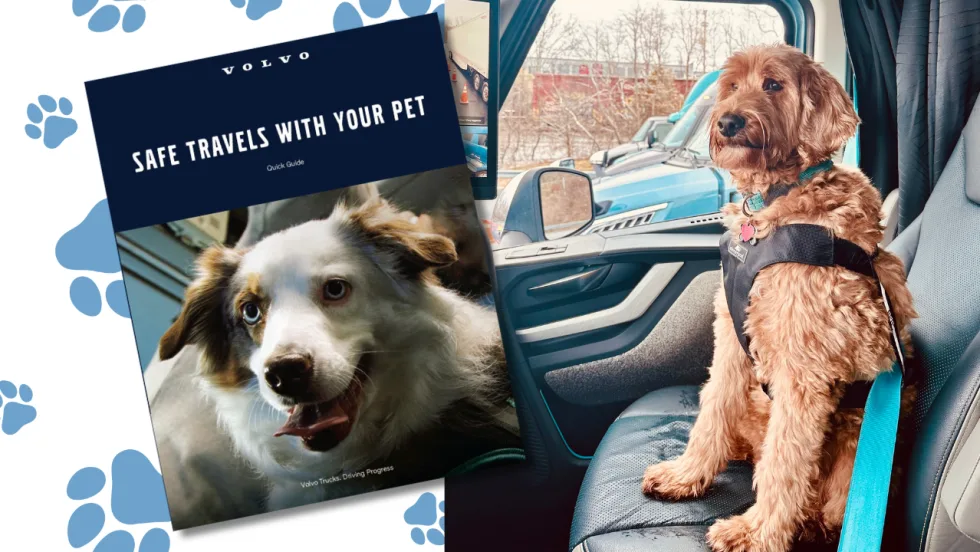
New Guide Offers Pet Safety Tips for Truck Drivers
Hundreds of thousands of pets travel in truck cabs. A new safety guide from Volvo Trucks and the Center for Pet Safety offers practical advice for truck drivers who bring dogs and cats along for the ride.
Read More →
Medical Cards, English Proficiency Reshape Roadcheck Violations
Medical-card violations jumped to the top of the driver out-of-service list during CVSA’s 2026 International Roadcheck, while English-language proficiency violations appeared among the leading violations for the first time.
Read More →