




Economic Watch: Durable Goods Higher, Construction Advances
UPDATED -- Shipments and new orders for durable manufactured goods both increased in June following declines the month before, while total U.S. construction in June hit its highest level so far this year.
UPDATED -- Shipments and new orders for durable manufactured goods both increased in June following declines the month before, while total U.S. construction in June hit its highest level so far this year.
The 0.1% gain in shipments erased the 0.1% decline in May and is the fourth hike out of the last five months. It was led by an increase in transportation shipments, gaining 0.7% following two straight monthly declines, according to the U.S. Commerce Department.
New orders for manufactured durable goods increased 0.7% in June following a 1% drop in May and is the fourth increase out of the last five months. New orders for machinery led the gain, picking up 2.4% from the month before.
Orders for all capital goods increased 1.9% in June from May; nondefense capital goods orders picked up 1.8%; and capital goods orders, minus military and aircraft, increased 1.4%.
Shipments of orders for all capital goods gained 1%; nondefense capital goods shipments increased 1.2%; and shipments of capital goods, minus military and aircraft, fell 1%.
Compared to the same time last year total manufactured durable goods shipments are 3.9% higher while new orders have increased 3.5%.
Construction Increases
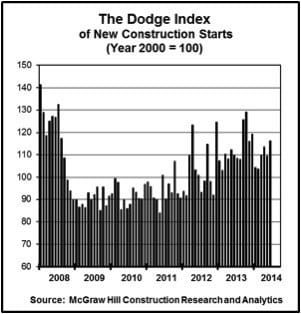
New construction starts in June advanced 6% to a seasonally adjusted annual rate of $549.7 billion, the highest level so far in 2014, according to McGraw Hill Construction and its Dodge Index.

Nonresidential building strengthened after pulling back in May, with the lift coming from the start of several large manufacturing plant projects. Modest gains in June were also reported for housing and non-building construction, such as public works and electric utilities. During the first six months of 2014, total construction starts on an unadjusted basis were $254.1 billion, up 1% from the same period a year ago.
June's data raised the Dodge Index to 116 up from 109 in May. During the first two months of 2014 the Index had averaged a sluggish 104, but then the pace of construction starts began to pick up, as the Index averaged 112 over the next four months.
"The first half of 2014 revealed a mixed performance by project type," said Robert A. Murray, chief economist for McGraw Hill Construction. "Single family housing stands out as the biggest surprise on the negative side, as its upward trend present for much of 2012 and 2013 has stalled for now. Public works and electric utilities are seeing generally decreased activity, as expected.”
He said on the positive side, multifamily housing is still proceeding at a healthy clip, and commercial building continues to move hesitantly upward, with office construction this year providing most of the support.
“Manufacturing-related construction surged in the first half of 2014, boosted by the start of several massive chemical plants and refineries, while the institutional building sector is still trying to make the transition from lengthy decline to modest growth,” said Murray. The year-to-date increase for total construction starts, at a slight 1%, reflects the lackluster activity present in January and February. More recent statistics suggest that the expansion for total construction is getting back on track in a moderate, if selective, manner."
Updated adds construction figures.
More Fleet Management

How Waste Connections is Using Data, Telematics, and AI
How do you manage and maintain more than 18,000 connected trucks? Data. Lots of it.
Read More →
Why Fleet Data Matters More Than Ever at Waste Connections [Watch]
Waste Connections' Chuck Palmer explains how telematics, predictive maintenance, safety analytics, and AI help keep vehicles on the road and drivers safe in this episode of HDT Talks Trucking.
Read More →
NMFTA Launches Free, Anonymous Cybersecurity Threat Report Portal
Organizations are encouraged to anonymously report freight fraud, cargo crime, and cyber threats while gaining visibility into incidents reported across the transportation sector.
Read More →
AI Can Optimize a Fleet. Can It Replace Human Judgment?
Fleets fear falling behind if they don’t adopt AI quickly enough. They also fear what happens if the technology makes the wrong decision.
Read More →
Jamie Hagen Gets Real About Running a Small Fleet in an Uncertain Economy
Small fleet owner Jamie Hagen says new legal risks, volatile fuel prices, and a changing freight market are forcing small carriers to rethink how they operate — and what they can afford.
Read More →
Jamie Hagen Gets Real About Freight, Fuel Prices, Safety, and Small-Fleet Survival
Running a small trucking fleet right now isn’t easy, especially right now. And Jamie Hagen doesn’t sugarcoat it.
Read More →
Jamie Hagen Gets Real About Freight, Fuel Prices, Safety, and Small-Fleet Survival
Running a small trucking fleet right now isn’t easy, especially right now. And Jamie Hagen doesn’t sugarcoat it.
Read More →
Data Lock‑In or Integration Lock‑Out?
Data fragmentation is costing dealerships, OEMs, fleets, and upfitters millions. Here’s why interoperability may be the fix the trucking industry needs.
Read More →
What Trucking Fleets and Brokers Need to Know About This Supreme Court Case
In May, the U.S. Supreme Court ruled that freight brokers can be held liable for damages if a truck they have contracted with is involved in an accident. Listen as this transportation attorney breaks down the ruling and its implications for the trucking industry.
Read More →
The Trucking Industry’s Threat Intelligence Gap
The trucking industry has no shortage of cybersecurity reports and cargo crime statistics. What it lacks is timely, operational intelligence that fleets can actually use.
Read More →