




E85-Fueled Engine Cuts CO2 by Up to 80%, Cummins Says
Based on a 2.8-liter diesel, the spark-ignited Ethos engine runs on corn- or lignocellulosic-derived fuel, and also produces high power and torque.
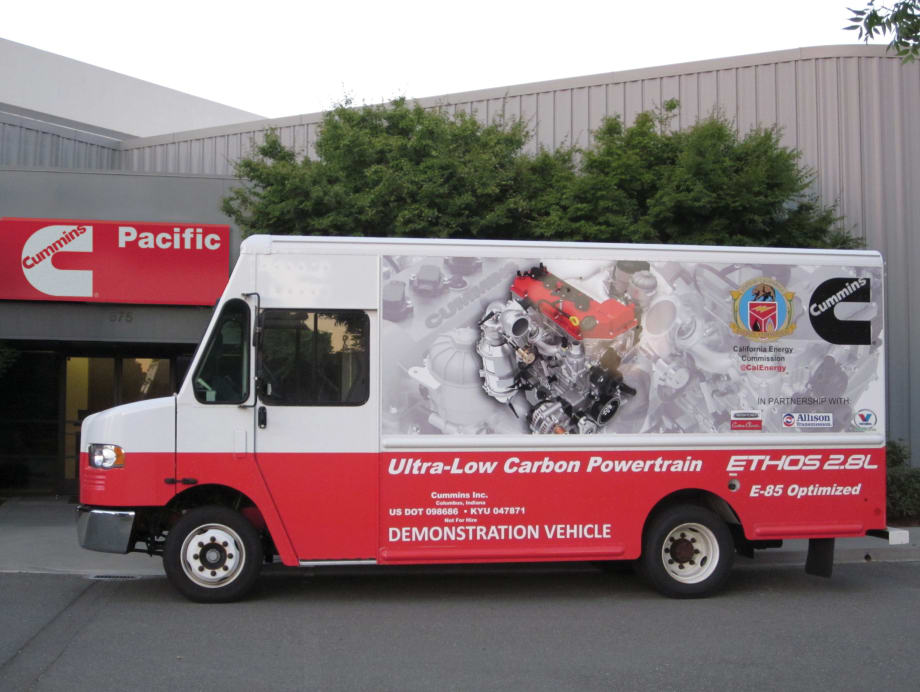
Cummins says it’s developing an E85-fueled engine that reduces carbon dioxide emissions by as much as 80% compared with a baseline gasoline-powered medium-duty truck engine.
The work was jointly funded by Cummins in partnership with the California Energy Commission, with support from Allison Transmission, Valvoline division of Ashland Inc., and Freightliner Custom Chassis. CEC is providing $2,712,140 and project participants are providing a minimum of $3,790,027, the commission said.
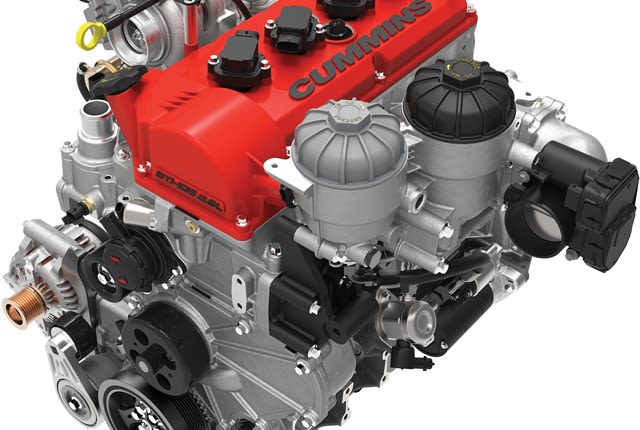
Called Ethos 2.8L, the engine is a spark-ignition adaption of a 2.8-liter four-cylinder diesel previously shown by Cummins. Its fuel, E-85, is a clean-burning blend of 85% ethanol and 15% gasoline, said Wayne Eckerle, vice president for research and technology.
Carbon dioxide, or CO2, is the primary greenhouse gas emitted through human activities, accounting for the vast majority of greenhouse-gas emissions in the United States. It is thought to be contributing to climate change around the world.
More than 1,000 miles and 1,500 hours have been accumulated on the Ethos 2.8L engine over the past 2.5 years, demonstrating that this technology is capable of far exceeding the 50% CO2 emissions reductions outlined in the project's goals.
A final on-road validation testing phase has been underway in the Sacramento, Calif., area since June and continuing into this month. It is being managed by Cummins Pacific, the California and Hawaii distributor for Cummins.
"The Cummins Ethos engine, developed through a research partnership with CEC, clearly demonstrates that by combining innovative engine design and combustion approaches with low-carbon alternative fuels, we can determine a path to significant reductions in greenhouse gas emissions," said Eckerle.
"Cummins produces industry-leading emissions-controls technologies and products, and we continue to explore new ways to make our company stronger and our customers more successful, while reducing our environmental footprint," he said.
The Ethos engine operates at diesel-like cylinder pressures and incorporates advanced spark-ignition design, he said. Its output, up to 250 horsepower and 450 pound-feet, is similar to gasoline and diesel engines nearly twice its 2.8-liter displacement.
The Cummins Ethos 2.8L engine also incorporates an integrated stop-start system, which further reduces fuel consumption and emissions. In stop-start mode, the engine shuts down after the vehicle comes to a complete stop and the brake pedal remains depressed. As the driver lifts his foot from the brake, the system automatically starts the engine to allow acceleration from the stop.
Cummins-integrated specific system controls, along with a strong starter, smart alternator and sensors, are designed to handle the additional stop-start duty cycle and maintain reliable operation over the life of the engine, according to the company.
Cummins worked closely with Allison to integrate a 2000 Series automatic transmission for efficient urban-type operation. The transmission is equipped with hydraulic circulation features to ensure smooth operation and quick vehicle launch during stop-start driving.
Additional partners in the project included Valvoline, which supplied NextGen engine oils specifically designed for lower CO2 emissions, and Freightliner Custom Chassis, which provided a prototype MT45 Class 5 walk-in van.
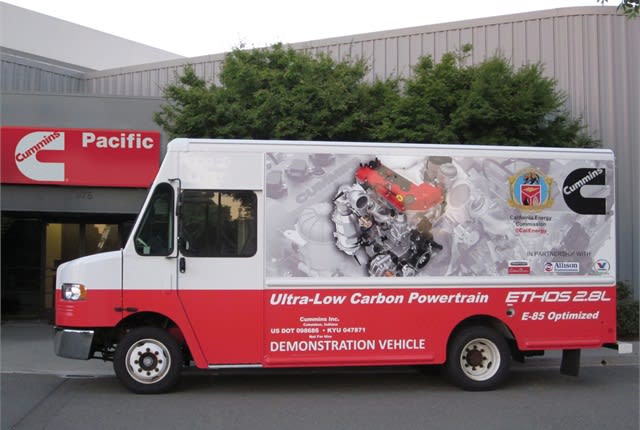
Using corn-derived E-85, the high thermal efficiency and power-to-weight ratio of the engine results in 50 to 58% lower well-to-wheels CO2 emissions compared with the gasoline engine baseline.
Using second-generation lignocellulosic-derived E-85, the powertrain's efficiency features deliver 75 to 80% lower well-to-wheels CO2 emissions, depending on the drive cycle.
Cellulosic E-85 is less intensive in land use, tilling, fertilizing and harvesting than corn-derived E-85. Although not in high-volume production today, cellulosic ethanol represents a promising production pathway for future fuels, Cummins and CEC said.
More information about the Cummins Ethos 2.8L engine and California's Ultra-Low Carbon Powertrain Program is at http://www.energy.ca.gov/drive/projects/ARV-10-044.html.
More Equipment

ZF Expands Commercial Vehicle Push in North America
ZF is expanding its North American commercial-vehicle presence with new transmission applications, electrification, trailer technology and autonomous-driving systems.
Read More →
Tesla Wants a Self-Driving Semi. Are Cameras Enough?
Could Tesla’s camera-only autonomous driving technology work on an 80,000-pound Semi? In this commentary, HDT's Deborah Lockridge takes a look at Tesla, Cybercab, and how autonomous trucks see the road.
Read More →
Kodiak: Driverless Long-Haul Truck Launch on Track for 2026
Kodiak AI says its driverless long-haul safety case is 93% complete and it remains on track to begin commercial operations by year-end 2026.
Read More →
What DOT’s Automated Vehicle Strategy Means for Trucking
The U.S. Department of Transportation issued a new automated-vehicle strategy that outlines plans for driverless-truck regulations, cross-state freight corridors, and federal safety standards.
Read More →
East Coast Port Launches $45M Electric Truck Push
The Port Authority of New York and New Jersey announced millions in incentives for zero-emission drayage trucks, yard tractors, and new charging hubs near the port.
Read More →
PlusAI Going Public to Fund Autonomous Truck Launch
A SPAC deal could provide PlusAI with up to $300 million as it works toward a 2027 commercial launch of factory-built autonomous trucks.
Read More →
NHTSA Moves to Rewrite Truck Fuel-Economy Rules
The National Highway Traffic Safety Administration says it lacks authority to regulate medium- and heavy-duty truck engines separately from complete vehicles, but the existing standards have not yet been eliminated.
Read More →
Detroit Opens Orders for EPA 2027 Engines
Detroit isn’t starting from scratch to meet EPA 2027 diesel emissions standards. Its Gen 6 DD13 and DD15 engines keep much of today’s platform while updating the fuel and aftertreatment systems.
Read More →
Carrier Transicold Adds All-Electric TRU for Stationary Cold Storage
Carrier Transicold’s new Vector 8200 all-electric transport refrigeration unit gives fleets a diesel-free option for temporary refrigerated and frozen trailer storage.
Read More →
A Closer Look at Kenworth’s Electric T880E Vocational Truck [Video]
Learn more about Kenworth's T880E battery-electric vocational truck at the Paccar Technical Center, including its range, applications, upfitting considerations, and PTO options, in this HDT Spotlight video.
Read More →