




Senate Panel Votes to Suspend Hours of Service Restart Pending Study
The Senate Appropriations Committee voted by a wide margin to suspend the current 34-hour restart provision of the hours of service rule while the Federal Motor Carrier Safety Administration studies the impact of the rule.

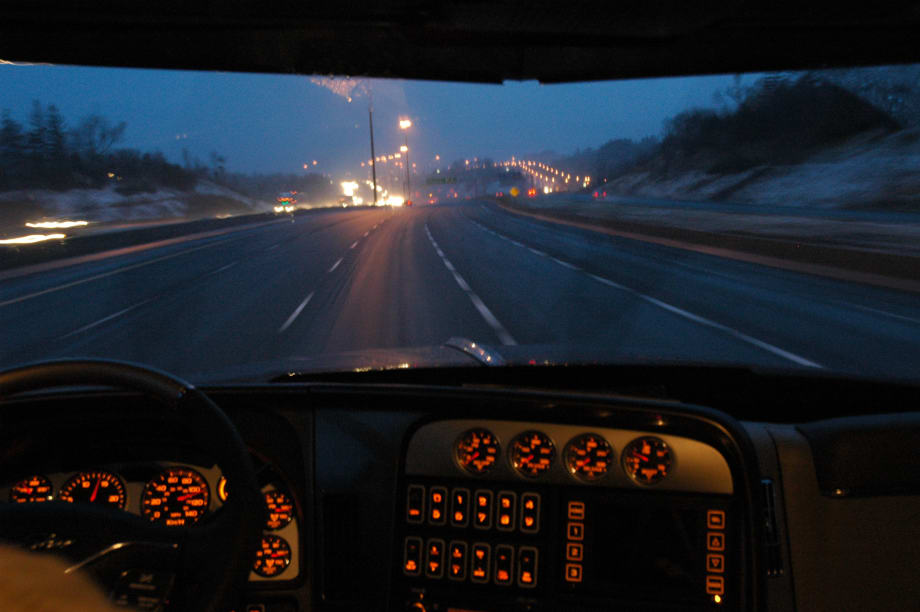
The suspension would start after the bill is passed and FMCSA posts public notice, and last until September 30, 2015, or when FMCSA finishes the study. Photo by Jim Park
UPDATED -- The Senate Appropriations Committee voted by a wide margin to suspend the current 34-hour restart provision of the hours of service rule while the Federal Motor Carrier Safety Administration studies the impact of the rule.

The suspension would start after the bill is passed and FMCSA posts public notice, and last until September 30, 2015, or when FMCSA finishes the study. Photo by Jim Park
The committee voted 21- 9 in favor of an amendment offered by Sen. Susan Collins, R-Maine, who said “it has become clear that the rules have had unintended consequences that are not in best interest of carriers, shippers and the public.”
The amendment is attached to a Senate bill appropriating transportation funds for fiscal year 2015. It says that FMCSA funding will not include money to enforce the restart rule that took effect last June as part of the new hours of service rules.
In effect, the amendment would suspend the two-night rest requirement and the once-a-week limitation on the restart.
The suspension would start after the bill is passed and FMCSA posts public notice, and last until September 30, 2015, or when FMCSA finishes the study.
During that time, the old restart provision would be in effect. That provision does not contain the requirement that drivers be off between 1 a.m. and 5 a.m. on two successive nights during their restart, and the restriction limiting use of the restart to once a week.
The study must compare the work schedules and fatigue of two groups of drivers: those operating under the pre-2013 provision, and those operating under the new provision.
The groups would have to be large enough to produce statistically significant results.
The study also must compare five months of work schedules and safety critical events, such as crashes and near-crashes, for fleets of all sizes and types of operations. The language specifically mentions long-haul, regional and short-haul, flat-bed, refrigerated, tank and dry-van.
Researchers would track fatigue and safety-critical events using electronic logging data, a psychomotor vigilance test that gauges the impact of fatigue on a person’s reactions, actigraph watches and cameras or other onboard monitoring systems.
The amendment says researchers would use data from electronic logging devices that comply with the mandate pending at FMCSA. The mandate, which spells out the technical requirements for the devices, is due later this year.
The amendment also says that the Department of Transportation’s Inspector General must review the research plan before FMCSA starts work on it. Specifically, the IG must agree that there are enough drivers in the study and that the technologies the researchers will use are reliable.
The amendment is a long way from being a done deal.
It must clear the full Senate and then be reconciled with whatever the House does on appropriations, leaving plenty of opportunities for opponents to seek changes.
Sen. Barbara Mikulski, D-Md., chair of the Appropriations Committee, said she expects the bill to go to the Senate floor June 16.
The amendment represents a compromise. Collins said some members of the committee wanted a full repeal of the restart, a position she opposed, and she worked closely with Sen. Patty Murray to craft the details of the study.
In the end, the amendment blends competing proposals by various industry groups.
American Trucking Associations originally wanted the committee to suspend the restart while the Government Accountability Office finishes its ongoing study of the provision.
The Trucking Alliance, safety advocacy groups and the Teamsters proposed that the current restart rule remain in place while FMCSA conducts the study.
Then ATA, joined by numerous shipper groups and state trucking associations, agreed to the FMCSA study but held fast to suspension of the new restart.
The suspension elicited considerable discussion at the Appropriations Committee markup hearing Thursday morning.
Collins said the restart needs to be suspended because it is forcing more trucks on the road during morning rush hour. FMCSA did not consider the safety impact of that when it wrote the rule, she said.
Sen. Patty Murray, D-Wash., opposed Collins’s amendment. She said she supports the study but believes the new restart should remain in place.
Murray was joined by Sens. Dianne Feinstein, D-Calif., Dick Durbin, D-Ill., Tom Harkin, D-Iowa, and Mikulski, who said they would prefer to keep the restart intact while the study proceeds.
Speaking for the amendment were Sen. Roy Blunt, R-Mo., Mary Landrieu, D-La., Jon Tester, D-Mont., and Mark Begich, D-Ark.
ATA applauded the vote.
“Since these rules were proposed in 2010, ATA has maintained that they were unsupported by science and since they were implemented in 2013 the industry and economy have experienced substantial negative effects as a result,” said ATA President and CEO Bill Graves in a statement.
“Today, thanks to Senator Collins’ leadership, we are a step closer to reversing these damaging, unjustified regulations.”
Lane Kidd, managing director of the Trucking Alliance, said that while the Alliance opposes suspension of the restart it applauds Collins for working with Murray on the study.
"And you’ll see in the overall appropriations bill that should be public tomorrow (Friday) that there is an accelerated schedule for releasing the new ELDs into the marketplace and it will be those new ELDs that will be used in the study," Kidd said. "The data generated by those ELDs will show everyone once and for all what the hours-of-service rule should be."
FMCSA opposed the suspension but supports the study.
"It’s important that we continue studying the impact of fatigue on commercial drivers and public safety to make our regulations even more effective. But this we know right now: suspending the current Hours-of-Service safety rules will expose families and drivers to greater risk every time they're on the road," said Ferro in a recent blog post.
Transportation Secretary Anthony Foxx underscored the point.
"Fatigue has long been recognized as a factor in crashes," he said in a statement. "It's why we recently revised the hours for truck drivers, where fatigue is still a leading factor in the 300,000 crashes that occur each year."
"(DOT and FMCSA) conducted unprecedented levels of research, including public input and the largest real-world study of its kind in developing a rule that protects everyone on the road, including truck drivers themselves." Foxx said.
"We are deeply concerned that Congress is considering even a temporary reversion to a system that allows drivers to log an average of up to 82 hours per week while the current rule limits the average to 70 hours a week."
The Owner-Operator Independent Drivers Association thanked Collins and the Senators who voted for the suspension.
"Truckers have long pointed out the negative impacts of the 2013 changes on their ability to get rest, stay out of busy city traffic, spend time at home, and make a family-supporting income," said OOIDA Executive Vice President Todd Spencer.
The amendment is attached to a bill that appropriates $71.1 billion for DOT in 2015. That’s $536 million more than DOT got in fiscal year 2014, but $17.8 billion less than the Obama budget requested.
It includes $550 million in TIGER (Transportation Investment Generating Economic Recovery) grants, a $50 million cut from this year. It also proposes $40.3 billion for federal-aid highways, the same as this year.
Revised late Thursday to include a statement from Transportation Secretary Anthony Foxx.
More Fleet Management

Color Match Smarter: Tools That Restore & Perform
For fleet managers and collision repair professionals keeping heavy-duty trucks on the road, getting the color right the first time isn't just about appearance — it's about efficiency, turnaround time, and bottom-line results. Discover how today's digital color tools are transforming the repair process from guesswork to precision.
Read More →
FMCSA Pauses Biennial-Update Enforcement Amid Motus Transition
Carriers whose updates were due on or after June 1 have more time, while FMCSA works to stabilize its new registration system and warns of phishing sites impersonating its new carrier registration system, Motus.
Read More →
2026 Blueprint for Countering Smarter Supply Chain Theft
Cargo theft is no longer just the cost of doing business. It's a multi-billion-dollar criminal enterprise exploiting vulnerabilities across your fleet, drivers, and supply chain.
Read More →


How Telematics Improves Visibility, Control, and Performance in Refrigerated Fleets
Explore how telematics help refrigerated fleets improve visibility, uptime, efficiency, compliance, and cargo protection across connected cold chain operations.
Read More →
What the U.S.-Canada Trade War Means for Trucking
Escalating U.S.-Canada tariffs could disrupt cross-border freight, reduce truck volumes, raise costs, and create new uncertainty for carriers on both sides of the border.
Read More →
What Are Trucking’s Top Concerns for 2026?
The American Transportation Research Institute wants to know what's worrying trucking fleet managers, drivers, and other stakeholders in its annual Industry Issues survey.
Read More →
American Trucking Associations Looks for a New Leader
ATA President and CEO Chris Spear abruptly left his job at the association on August 21, at a pivotal time for the trucking industry.
Read More →
Public Wi-Fi Cybersecurity Risks: How Truck Drivers and Fleets Can Protect Their Data
Public Wi-Fi can expose truck drivers and fleets to credential theft, malware, and other cyber threats. Here’s how to reduce the risk on the road.
Read More →
For Nicky Cupp, Fleet Innovation Starts With Frustration
HDT Truck Fleet Innovator Nicky Cupp turns everyday pain points at Fraley & Schilling into opportunities for better technology and smarter processes.
Read More →
Adam Buttgenbach’s Approach to Electric Trucks: Start With Where They Fit
HDT Truck Fleet Innovator Adam Buttgenbach helped PepsiCo build one of North America’s largest EV fleets by focusing on where electric trucks make operational sense.
Read More →