




NTSB: Trucker in Tracy Morgan Crash Was Speeding
The National Transportation Safety Board has released its preliminary report of its investigation into the June 7 truck crash that severely injured celebrity Tracy Morgan along with killing one person, showing the truck driver was traveling well beyond the posted speed limit.

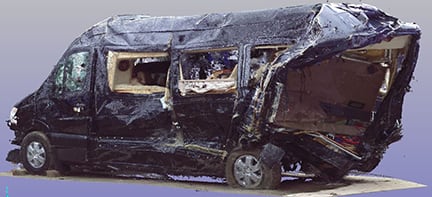
NTSB investigators documented the damage to the vehicles using 3D laser scanning technology. This is a scan of the Mercedes‑Benz limo van involved in the crash.

The National Transportation Safety Board has released its preliminary report of its investigation into the June 7 truck crash that severely injured celebrity Tracy Morgan, showing the truck driver was traveling well beyond the posted speed limit and appeared to be within legal hours of service.
“A preliminary review of the data showed that the Peterbilt combination vehicle was traveling at 65 mph for the 60 seconds preceding the collision with the Mercedes-Benz limo van,” the report said. “About 0.4 mile south of the crash location, speed limit signs were posted that reduced the speed from 55 mph to 45 mph.”
NTSB said according to electronic driver log information on the truck, driver Kevin Roper had logged 9 hours 37 minutes of driving time when the crash occurred, shortly before 1 a.m. local time, while traveling north on the New Jersey Turnpike near Cranbury.
“With respect to the maximum 14-hour consecutive duty period for commercial motor vehicle drivers, the driver had logged 13 hours 32 minutes at the time of the collision,” the report said. “NTSB investigators are comparing the log information with supporting documentation.”

NTSB investigators are also compiling and analyzing information to determine the activities of the truck driver and the amount of rest he received in the hours and days preceding the crash. In charging Roper, police claim he had not slept in more than 24 hours before the crash, but they have yet to publicly say how they came to that conclusion.
NTSB also determined as the Walmart truck approached milepost 71.4, traffic had slowed due to construction work ahead on the turnpike. It then struck the rear of a 2012 Mercedes-Benz Sprinter limo van, occupied by a driver and six passengers, including Morgan, and James McNair, who was the only person killed.
“The two vehicles moved forward and were involved in secondary impacts with other vehicles that were slowed in the traffic queue. The limo van rolled over and came to rest on its left side, facing east, across the center and right lanes,” said NTSB. “As a result of the collision, one passenger in the Mercedes‑Benz limo van was fatally injured and four other van occupants [including Morgan] were transported to the hospital with injuries of various severities”.
Last week Roper pleaded not guilty to one count of vehicular homicide and four counts of assault by auto. He remains free on $50,000 bail, while his next court appearance has not been scheduled.
Morgan remains hospitalized following the crash and serious injuries he received, but his condition was upgraded this week to fair. Others that were injured have since been treated and released from the hospital.
The crash has led to a national debate about a recent Congressional move just before the crash to change truck driver hours of service regulations, specifically the 34-hour restart provision, with Capitol Hill watchers saying such an attempt now faces a more difficult future. The case also led to a media frenzy, with some claiming the trucking industry was being vilified due to Morgan’s celebrity.
More Safety & Compliance

Trump Administration Expands Homeland Security's Role in Trucking Enforcement
The administration's latest trucking crackdown goes beyond roadside inspections, expanding Homeland Security's role in commercial vehicle enforcement and investigations involving CDL training schools.
Read More →
Paccar Recalls 2027 Trucks Built This Summer for Possible Electrical Problem
The nearly 6,000 Kenworth and Peterbilt trucks in the recall could potentially lose engine power, among other things.
Read More →
Brake Safety Week to Focus on Drums and Rotors
Commercial vehicle inspectors will be focusing on brakes during CVSA's Brake Safety Week, August 23-29.
Read More →
Trump Administration Looks to Put More Veterans Behind the Wheel
The Freedom Haulers program pulls together existing and expanded programs at several federal agencies to recruit veterans to drive commercial heavy-duty trucks and cut the red tape for them to get a CDL, training, and employment.
Read More →
$604 Million Verdict Tests Broker Liability After Supreme Court Ruling
C.H. Robinson plans to appeal after a Texas jury found it bore the largest share of responsibility for a fatal 2021 crash, in a case that follows the Supreme Court's Montgomery decision allowing negligent hiring claims against freight brokers.
Read More →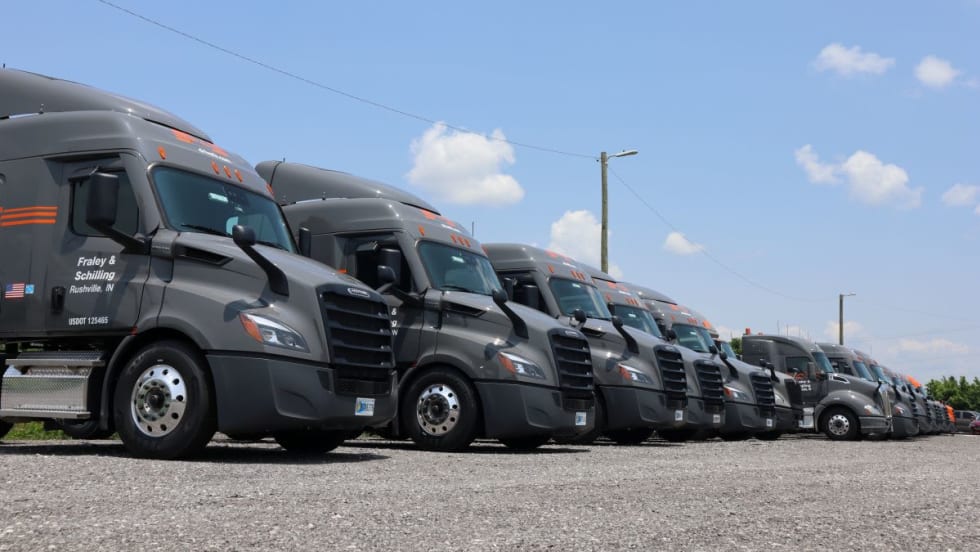
How Fraley & Schilling Improved Logbook Compliance by Over 50%
Fraley & Schilling needed a way to close a compliance workflow gap in its ELD system without adding more work from driver training, reminders, and back-office follow-ups. It found the answer in a custom driver app.
Read More →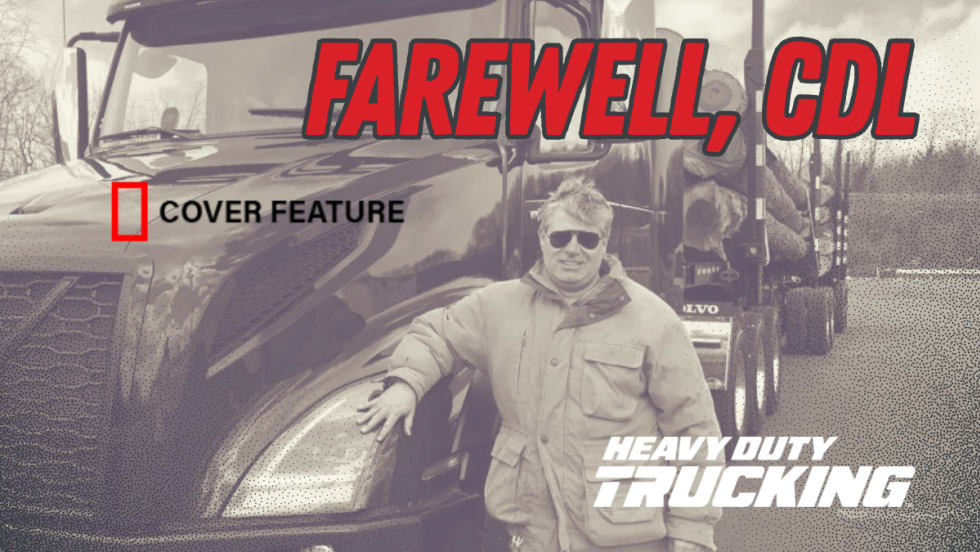
Farewell, CDL: Why I'm Giving Up My Commercial Driver's License
After more than 20 years as a CDL holder, HDT Executive Editor Jack Roberts is letting his commercial license expire. Not because he wants to — but because trucking's nuclear verdict crisis has made the risks of public-road test drives too great for editors, manufacturers, and everyone involved.
Read More →
Enhance Fleet Performance with High-Efficiency Auxiliary Power Units
Drive sustainable cost savings while increasing driver comfort during short- and long-haul logistics operations.
Read More →
Wabash Trailers Recalled for Improperly Installed Underride Guards
More than 900 Wabash dry van trailers may not comply with the Federal Motor Vehicle Safety Standard for rear impact guards.
Read More →
Why K&B Trucking Is Embracing AI and Driver Safety Technology
Crunching data and embracing artificial intelligence are key in K&B Trucking's safety efforts, says the company's safety director.
Read More →