



The time has come to take a close look at the minimum insurance requirements for trucking, says the Federal Motor Carrier Safety Administration.
 MENU
MENU SEARCH
The time has come to take a close look at the minimum insurance requirements for trucking, says the Federal Motor Carrier Safety Administration. In a new report to Congress the agency said it is clear that the current minimums need to be reevaluated.

The time has come to take a close look at the minimum insurance requirements for trucking, says the Federal Motor Carrier Safety Administration.
The last adjustment was in 1985. It set the current standard of $750,000 for general freight, $5 million for the most dangerous hazmats and $1 million for other hazmats.
The agency has formed a team to draft a new rule and considers this a high priority.
This initiative arises from a study ordered by Congress in the 2012 highway law, MAP-21, in response to the increasing costs of crashes. As it drafted the law, Congress considered raising the insurance minimum for general freight from $750,000 to $1 million, but eventually decided to have the agency prepare an analysis that could become the basis for changes in the standard. Congress also ordered the agency to conduct a review every four years, going forward.
The agency found that catastrophic crashes whose costs exceed current minimums are rare – just 1% of crashes fall into that category. But when they do happen the costs can easily exceed the current $1 million minimum.
This is due mainly to increased medical costs. The medical consumer price index has outpaced inflation in all but one of the past 29 years, the agency said.
If the minimums were pegged to the medical CPI, general freight would require $3.2 million, dangerous hazmats would require $21.3 million and other hazmats would require $4.3 million.
Even if the minimums were pegged to the lesser standard of core CPI, they still would be significantly higher: $1.6 million for general freight, $10.8 million for dangerous hazmats and $2.2 million for other hazmats.
The agency also found that insurance rates have declined slightly since the 1980s, and that it is difficult to find data on what premiums would cost if the minimums are increased. Insurers are protective of their clients and pricing, so information about costs is generic and limited, the agency said.
The study focused mainly on freight carriers but it applicable to buses and hazmat carriers as well, the agency said.
The agency said its research is supplemented by findings in other studies.
One 2013 study by the Pacific Institute for Research and Evaluation recommended a minimum of $10 million, to be indexed to inflation and productivity growth.
The amounts in these settlements were enough to create an uninsured liability of 42% for the companies, the Trucking Alliance found.
An American Trucking Associations review offered a different take on the issue. ATA looked at the risk of a carrier experiencing a crash whose costs exceed the minimums. It found a 1.4% chance of a claim exceeding $500,000, a 0.73% chance of going over $1 million and a 0.31% chance of going over $2 million. The average cost of claims between 2006 and 2011 was $11,229, ATA found.

HDTX is an intimate event that connects heavy-duty trucking fleet managers with industry suppliers through small-group discussions, educational sessions, and structured one-on-one meetings.
Read More →HDTX is an intimate event that connects heavy-duty trucking fleet managers with industry suppliers through small-group discussions, educational sessions, and structured one-on-one meetings.
Read More →HDTX is an intimate event that connects heavy-duty trucking fleet managers with industry suppliers through small-group discussions, educational sessions, and structured one-on-one meetings.
Read More →
New DAT One feature shows top-paying loads directly on an iPhone’s home screen, helping carriers react faster to spot-market opportunities.
Read More →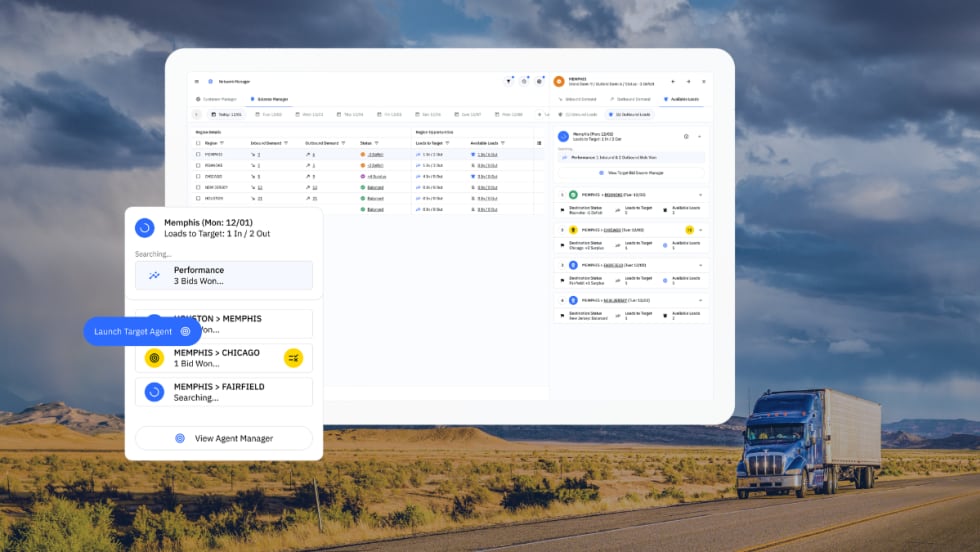
Optimal Dynamics says its new Scale platform uses AI agents and optimization to help carriers find and secure freight that improves network balance and profitability.
Read More →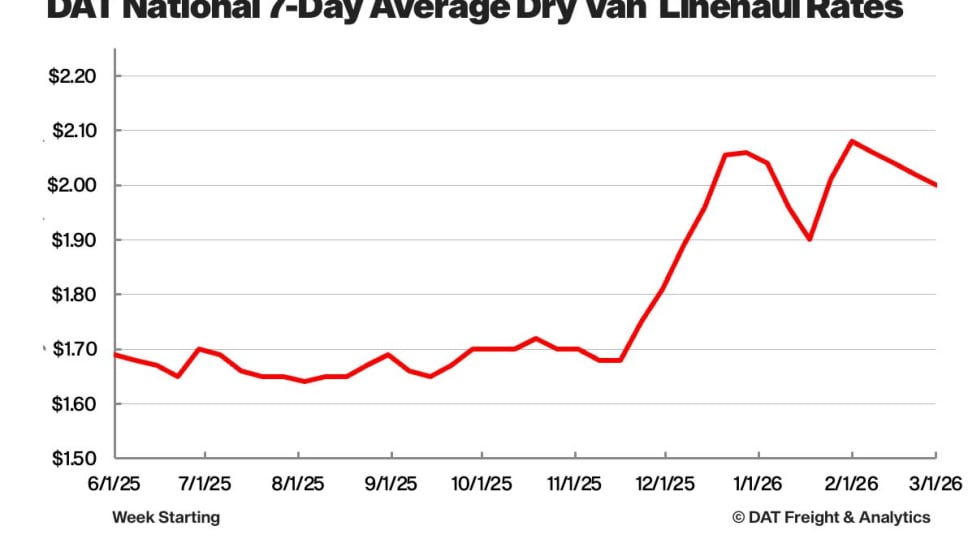
DAT Freight & Analytics data shows tightening flatbed capacity, easing produce markets, and softening van and reefer rates.
Read More →
NACFE's Run on Less - Messy Middle project demonstrates the power of data in helping to guide the future of alternative fuels and powertrains for heavy-duty trucks.
Read More →
A federal court ruling allows New York City’s congestion pricing program to continue, leaving truck tolls in place for fleets delivering into Manhattan.
Read More →A federal court ruling allows New York City’s congestion pricing program to continue, leaving truck tolls in place for fleets delivering into Manhattan.
Read More →
Fontaine Modification has introduced a new customer portal designed to give fleets real-time visibility into the truck modification process, addressing one of the most common questions fleet managers face: “Where’s my truck?”
Read More →