




Economic Watch: First Quarter Growth Flat, April Employment Jumps
UPDATED -- The American economy picked up very little steam in the first quarter of the year, recording its weakest reading since the fourth quarter of 2012, according to a new U.S. Commerce Department report released Wednesday.

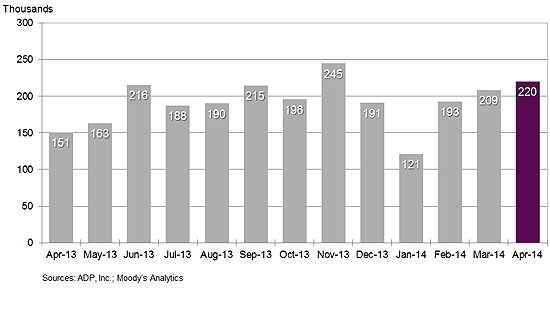
Change in Total Nonfarm Private Employment.
The American economy picked up very little steam in the first quarter of the year, recording its weakest reading since the fourth quarter of 2012, according to a new U.S. Commerce Department report released Wednesday.
It advanced at an annual rate of 0.1% in this first of three readings and compares to a fourth quarter annual growth rate of 2.6%.
Personal consumption rose 3% at the start of the year, down just 0.3% from the rise at the end of 2013. The vast majority of spending was centered in services, up 4.4%, particularly health care and utilities services, as families struggled to heat their homes and combat the winter.
Goods purchases rose just 0.4% in the first quarter compared to a 2.9% rise at the end of last year. Goods exports fell 7.6% and service exports slowed 12%. Imports also fell, down 1.4%, the first quarterly decline in five quarters.
“This morning's report suggesting the U.S. economy stalled in the first quarter amid a significant decline in business spending, sizable drop in exports and reduced inventories,” said Lindsey Piegza, chief economist with the investment firm Sterne Agee. “Consumption, on the other hand continued to rise thanks to a significant pickup in services spending.”
She said while winter weather may have deterred shoppers from heading out to the stores to by electronics and apparel, consumers were busy spending elsewhere particularly on health care services and utilities to heat the family home.
“Going forward, the ability to maintain this level of 2% or better growth when it comes to personal consumption, be it on goods and/or services, will depend on subsequent job creation and income growth,” Piegza said.
She noted, at this point, businesses remain hesitant to grow or invest in anything from a new office space to updated equipment to a new employee, “a trend that has been in play well before this winter's arctic blast.”
Piegza believes from the Federal Reserve’s point of view, this morning's weaker-than-expected GDP report will not change the policy path. “The Fed will most likely focus instead on the recent rebound in several of the economic indications, painting a much rosier tone than last month's statement.”
Meantime, a separate report shows private sector employment in the U.S. increased by 220,000 jobs from March to April, according to the April ADP National Employment Report.
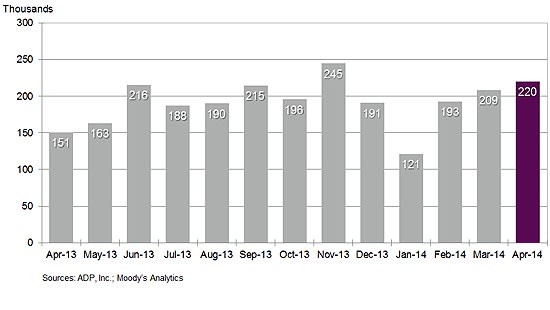
Change in Total Nonfarm Private Employment.
Goods-producing employment rose by 24,000 jobs in April, down from 28,000 jobs gained in March. Most of the gains again came from the construction industry which added 19,000 jobs over the month, compared to 21,000 in March. Manufacturing continued to be sluggish adding 1,000 jobs in April, down from 4,000 in March.
Service-providing employment rose by 197,000 jobs in April, up from the upwardly revised 181,000 in March. Professional/ business services contributed the most to growth in service-providing industries, adding 77,000 jobs, up from 67,000 in March. Expansion in trade/transportation/utilities grew by 34,000, about equal to the 35,000 jobs added in March. The 8,000 new jobs in financial activities mark the strongest pace of growth in the industry since June 2013.
"The 220,000 U.S. private sector jobs added in April is well above the twelve-month average,” said Carlos Rodriguez, president and chief executive officer of ADP. “Job growth appears to be trending up and hopefully this will continue.”
Payroll growth for businesses with 49 or fewer employees increased slightly in April adding 82,000 jobs, up from an upwardly revised 81,000 in March and almost reaching the twelve-month average of 84,000. Job growth accelerated over the month for medium-sized firms while dropping for large firms. Employment among medium-sized companies with 50-499 employees rose by 81,000, the most jobs added since December 2012. Employment at large companies, those with 500 or more employees, increased by 57,000, down from an upwardly revised 71,000 the previous month.
"The job market is gaining strength,” said Mark Zandi, chief economist of Moody’s Analytics. “After a tough winter employers are expanding payrolls across nearly all industries and company sizes. The recent pickup in job growth at mid-sized companies may signal better business confidence. Job market prospects are steadily improving.”
The ADP National Employment Report is a monthly measure of the change in total U.S. nonfarm private employment derived from actual, anonymous payroll data of client companies served by ADP, a provider of payroll and other business management services.
Update adds employment report.
More Fleet Management

Color Match Smarter: Tools That Restore & Perform
For fleet managers and collision repair professionals keeping heavy-duty trucks on the road, getting the color right the first time isn't just about appearance — it's about efficiency, turnaround time, and bottom-line results. Discover how today's digital color tools are transforming the repair process from guesswork to precision.
Read More →
FMCSA Pauses Biennial-Update Enforcement Amid Motus Transition
Carriers whose updates were due on or after June 1 have more time, while FMCSA works to stabilize its new registration system and warns of phishing sites impersonating its new carrier registration system, Motus.
Read More →
2026 Blueprint for Countering Smarter Supply Chain Theft
Cargo theft is no longer just the cost of doing business. It's a multi-billion-dollar criminal enterprise exploiting vulnerabilities across your fleet, drivers, and supply chain.
Read More →


How Telematics Improves Visibility, Control, and Performance in Refrigerated Fleets
Explore how telematics help refrigerated fleets improve visibility, uptime, efficiency, compliance, and cargo protection across connected cold chain operations.
Read More →
What the U.S.-Canada Trade War Means for Trucking
Escalating U.S.-Canada tariffs could disrupt cross-border freight, reduce truck volumes, raise costs, and create new uncertainty for carriers on both sides of the border.
Read More →
What Are Trucking’s Top Concerns for 2026?
The American Transportation Research Institute wants to know what's worrying trucking fleet managers, drivers, and other stakeholders in its annual Industry Issues survey.
Read More →
American Trucking Associations Looks for a New Leader
ATA President and CEO Chris Spear abruptly left his job at the association on August 21, at a pivotal time for the trucking industry.
Read More →
Public Wi-Fi Cybersecurity Risks: How Truck Drivers and Fleets Can Protect Their Data
Public Wi-Fi can expose truck drivers and fleets to credential theft, malware, and other cyber threats. Here’s how to reduce the risk on the road.
Read More →
For Nicky Cupp, Fleet Innovation Starts With Frustration
HDT Truck Fleet Innovator Nicky Cupp turns everyday pain points at Fraley & Schilling into opportunities for better technology and smarter processes.
Read More →
Adam Buttgenbach’s Approach to Electric Trucks: Start With Where They Fit
HDT Truck Fleet Innovator Adam Buttgenbach helped PepsiCo build one of North America’s largest EV fleets by focusing on where electric trucks make operational sense.
Read More →