




Transport Industry Survey Finds Carriers Sensing an Improving Marketplace
The fourth-quarter Transport Capital Partners survey suggests the slow, but upward growth of the economy is moving the freight market to a higher level.

Continuing the positive trends of last quarter, more carriers are expressing optimism for increases in volumes and rates. The steady growth of the economy is producing increasingly positive expectations from carriers. Since the fourth quarter of 2012, positive volume expectations have risen to 61% from 29%, according to a survey by Transport Capital Partners.
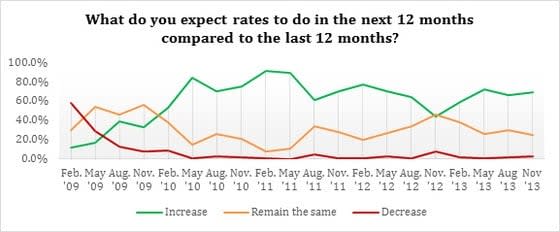
Following from expectations of increased volumes, a majority of carriers are also expecting rates to climb over the coming 12 months. Almost three times as many carriers are optimistic about rate increases than those that are pessimistic. Smaller carries (those grossing under $25 million per year) are slightly more positive about rate expectations that their larger counterparts - 65% vs. 60%.
“Volumes and rates continue to be more entwined as positive GDP numbers are laid on top of effective capacity brought down by the CSA driver hour mandates. If 5% to 10% of driver hours have been reduced in the systems, 5% to 10% more drivers are required with higher pay. And in most cases it appears carriers will need to buy more trucks, adding to their fixed costs,” says Steven Dutro, TCP partner.
Despite this optimism, rate and volume growth has yet to fully materialize – aside from the construction, petroleum and seasonal freight sectors.
For the past 16 quarters (since February 2010), a majority of carriers have expected rates to increase. However, it is only since the first quarter of 2013 that rates have actually risen. Seventy-two percent of carriers saw rates remain the same for this quarter. This quarter, more smaller carriers experienced rate increases than larger carriers – 36% vs. 20%.
TCP Partner, Richard Mikes notes, “Initial carrier contacts and load board reports show strength in spot market rates. This, coupled with positive political news in D.C., gives hope for stability in the economy with carrier rate expectations in the survey.”
More Drivers

Why Hiring Truck Drivers Is Getting Harder
Higher recruiting costs, a shrinking driver pool, and renewed pay competition are raising the stakes for fleets heading into 2027.
Read More →
Roehl Offers Truck Drivers $10,000 Retention Incentive
Payments begin after the first load and continue in mileage-based installments for eligible experienced drivers joining the fleet.
Read More →
Platform Science Adds Dispatch and Safety Tools
Four additions to PS Fleet help fleets monitor loads, manage driver coaching, share truck locations and adjust video system settings.
Read More →
When Language Stops the Truck: The Return of ELP Out-of-Service Orders
English language proficiency rules for commercial drivers aren’t new, but renewed out-of-service enforcement has raised the stakes. Here’s what carriers need to know before a driver reaches a roadside inspection.
Read More →
Samsara Launches Custom AI Agent Builder
Agent Studio lets fleets create AI tools for hours-of-service monitoring, reporting and driver support, including agents that communicate by phone.
Read More →
Trucker Path Expands Reserved Parking Network
Trucker Path has added close to 6,000 more truck parking spaces to its Trucker Path Reserved Parking Network with the addition of Safe Truck Parking.
Read More →
EEOC Sues Texas Trucking Company Over Driver Age Limits
The agency says Trancasa USA rejected applicants over 65 and applied tougher driving-record standards to those over 60.
Read More →
Nussbaum, Roehl Announce Second Driver Pay Increase This Year
This year has seen a swath of major truck driver pay increases as freight capacity has tightened.
Read More →
From One Generation to the Next: How Mentorship Builds Safer Truck Drivers
After three decades in trucking, Harold Perry shares what he's learned about driver safety, mentorship, and helping the next generation build confidence behind the wheel.
Read More →
Truck Drivers Need More Than Another Alert
Fleets have more visibility into truck health, safety events, and driver activity than ever. The next challenge is turning all that information into useful guidance for the person who has to decide what to do next.
Read More →