




Tokyo Motor Show: Commercial Vehicles Are Back to Basics
The 43rd Tokyo Motor Show, which ran from Nov. 20 to Dec. 1, showcased international manufacturers’ latest technology in trucks, buses, cars, motorbikes and accessories. HDT International Editor Sven-Erik Lindstrand returned with this report.

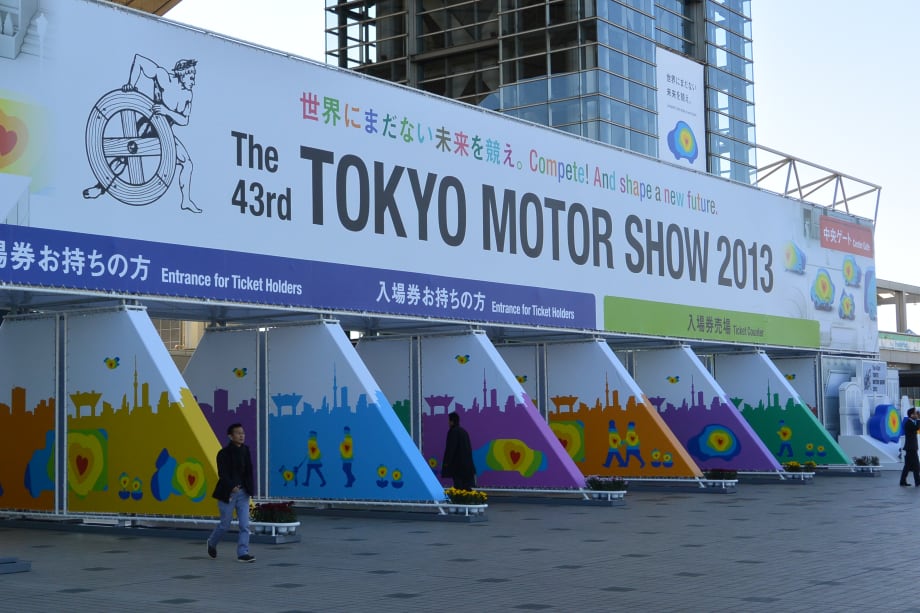
The Tokyo Motor Show is held every two years.
The 43rd Tokyo Motor Show, which ran from Nov. 20 to Dec. 1, showcased international manufacturers’ latest technology in trucks, buses, cars, motorbikes and accessories.
The biannual show took place at the Big Sight along the Tokyo Bay waterfront, where it had moved in 2011 after 24 years at the distant Makuhari Messe area in the direction of Narita airport.
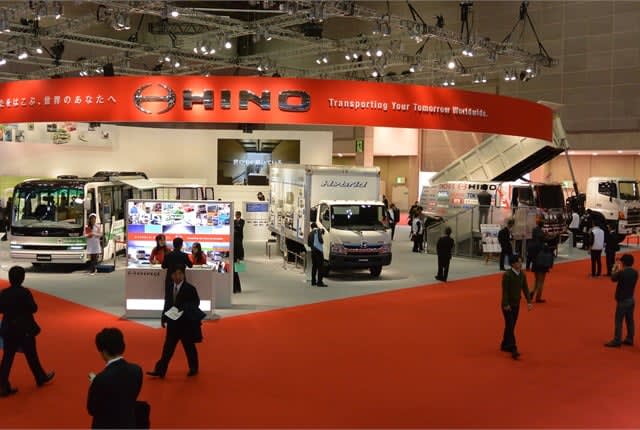
Hino is pushing hard to regain its top spot in the market.
The complex of four gigantic upside-down pyramids is a landmark impossible to miss, although most of the exhibition halls are located underground.
In Japan, the economy continues to recover. In October, for energy and fresh food, the rate of inflation was positive for the first time in five years. This is a sign that Japan is on its way out of years of deflation. While unemployment was unchanged at 4%, household consumption as well as industrial production increased in October.
This is reflected in truck sales, where sales steadily have increased since 2009, when the world economy became paralyzed when the US home loan bubble burst. 2013 is expected to be slightly better than 2012.
This year at the show, there were a great number of hybrids, plug-ins and fuel cell equipped vehicles in all categories, including two-wheelers.
Still, for the commercial vehicles it was obvious that the diesel engine is the solid power source for the foreseeable future, and also what the majority of customers put their money into.
In Japan, the strict JP90 emission standards are comparable with Euro 6 and EPA2010 in U.S. Still, one problem remains – truck drivers in parking lots or leaving their vehicle for a coffee break let their trucks idle.
Hino vs Isuzu
Hino, part of the Toyota group, is the traditional market leader in Japan. However, in 2012 Isuzu moved ahead and managed to pass Hino, who this year is pressing strong to regain the number one position.
At the show, Hino displayed six vehicles, including a massive 700 Series mining truck with twin steering axles and a 12.9-liter engine channeling 480 horsepower with a 16-speed automated manual transmission.
This 700 Series truck is almost 10 meters in length and has a gross vehicle weight of 50 tons, designed for tackling hard rock mining overseas. The Hino theme for the Show was ”Transporting Your Tomorrow Worldwide."
A concept EV truck chassis and a plug-in hybrid Poncho Minibus were also in place at the Hino stand, among a full sized city bus and a coach with advanced safety technology.
Isuzu
During a press conference, Isuzu Motors President Susumu Hosoi announced the company’s motto for the show, "Always Next to You." He also gave an overview on the vehicles on display.
Starting with a true crowd-pleaser, the 1.5-ton Wolseley CP type truck, the very first model of Isuzu trucks. It was completed in 1924 after Isuzu overcame the Great Kanto Earthquake the year before. This remarkably elegant wood and brass creation of British construction was built under license by Ishikawajima Shipbuilding and Engineering Co. This was the predecessor of Isuzu Motors Ltd and the truck managed to develop 25 horsepower from its 3-liter petrol engine.
Trucks on display were a small ELF CNG-MPI. Also at the booth was a truck in the F Cargo series, the mid-duty truck model Forward with a temperature-controlled van body.
We also found a beefed-up 6X6 construction truck, also named Forward. An all-terrain vehicle designed to cope with disasters such as forest fires and floods caused by heavy rains.
There was also a GIGA light-duty dump truck with reduced weight of both body and chassis for a payload as large as possible.
Isuzu’s long history with diesel engines was also on display, starting with its very first DA4, which was manufactured between 1936 to 1939 followed by a row of other classics.
European owned
Two of the four major Japanese truck brands are owned by Europeans. Mitsubishi Fuso is a subsidiary of Daimler and UD (formerly Nissan Diesel) is owned by Volvo.
Mercedes introduced its previous SK series in the early 1990s in cooperation with Mitsubishi, shortly after the arrival of Volvo on the Japanese market. At the most, some 500 Actros and Ategos were sold per year until the Mercedes nameplate was withdrawn from Japan in 2003 as a result of Daimler's acquisition of Mitsubishi Fuso Truck & Bus Corp.
Volvo was the first foreign truck company to enter the Japanese market and exhibited an F16 at the Tokyo Motor Show in 1989. The first few years Isuzu was the distributor, but starting in 1995, Volvo went further on its own.
Volvo sales in Japan has been between 200 and 400 units per year, the last two years in the 200-range.
In 2007 the Volvo Group fully acquired Nissan Diesel and in early 2010 the company name as well as the trucks were changed into UD Trucks.
Fuso and Volvo today
At this year's show, Fuso unveiled several highlights, including a world premiere of the Canter Eco Hybrid 'Canna' truck, a design concept model aimed at supporting women professionals in the transportation business. There was also Japan premiere of FUSO's all-new strategic truck for Asia and Africa: The custom-tailored and designed Fuso F1 to meet the demands of those markets.
Fuso's overall show theme was ”Building Together."
During a press conference, Dr. Albert Kirchmann, MFTBC president and CEO as well as head of Daimler Trucks Asia, announced that his company will invest 300 million euro in the extension of the sales and production networks for Fuso and BharatBenz trucks from 2014 to 2018.
Meanwhile, Volvo had the ”old” FH13 on display. Paperwork and other formalities will not allow the new FH to go on sale in mid-2014.
A rolling FMX cab was on display to give a hands-on demonstration of the benefits of a safety belt.
UD president and CEO launched the theme for not only the show but also for the brand: "Going the Extra Mile."
The Tokyo Motor Show is held every two years.
UD runs the extra mile
UD had its entire engine range, as well as the Condor and Quon models for the Japanese market, at its booth. It also displayed its Escot-V (5), which is the UD version of the Volvo I-Shift 12-speed Automated Manual Transmission.
The new UD Quester was showcased at the show. This was its first public appearance in Japan. However, this new heavy-duty truck is not intended to be sold here. Instead, Quester has been developed specifically to meet the needs of growth markets.
“With Quester we have build a truck with the same mindset and endurance as a long-distance runner – efficient, determined and tough," said Loic Mellinand, senior vice president of UD Global Brand.
”Quester will have a wide range of applications, from long-haulage and distribution to construction and mining, allowing it to meet the varying needs of growth markets," he concluded.
South Korean Entry
On the heavy truck side was the first sighting of the new Hyundai XCient. This is a 530-horsepower, 12.7-liter truck available as 4x2, 6x2 and 6x4. It was launched into the South Korean market earlier in 2013. This was its first appearance in Japan and a decision to import has yet to be made.
At first sight, the Hyundai XCient is far ahead of Chinese trucks when it comes to fit and finish, and the truck may live up to the Hyundai cars’ reputation. The transmission is a 12-speed ZF AS-Tronic and the fifth wheel is made by Jost, both premium suppliers.
Next time
Although the Tokyo Motor Show won't return until 2015, there is a strong chance that the industry specialized Tokyo Truck Show will turn international in the autumn of 2014. Here, there will be plenty of not only trucks but also bodies and trailers of all kinds.
For more, see Sven-Erik Lindstrand's photo gallery of the Tokyo Motor Show.
Related Stories:
2011 Tokyo Motor Show: Fuso Shows Electric, Hybrid Trucks That Might Come to the States
More Equipment

How Volvo Updated Its D13 for EPA 2027 [Watch]
Volvo’s updated D13 promises lower emissions without sacrificing performance or fuel economy. Take a closer look at what changed inside the engine in this HDT Spotlight video.
Read More →
Michelin Tire Improves Efficiency and Durability for Regional Fleets
The Michelin X Multi Energy D2 is a regional haul drive tire engineered to help fleets improve fuel efficiency, durability and traction in demanding stop-and-go operations.
Read More →
ZF Expands Commercial Vehicle Push in North America
ZF is expanding its North American commercial-vehicle presence with new transmission applications, electrification, trailer technology and autonomous-driving systems.
Read More →
Tesla Wants a Self-Driving Semi. Are Cameras Enough?
Could Tesla’s camera-only autonomous driving technology work on an 80,000-pound Semi? In this commentary, HDT's Deborah Lockridge takes a look at Tesla, Cybercab, and how autonomous trucks see the road.
Read More →
Kodiak: Driverless Long-Haul Truck Launch on Track for 2026
Kodiak AI says its driverless long-haul safety case is 93% complete and it remains on track to begin commercial operations by year-end 2026.
Read More →
What DOT’s Automated Vehicle Strategy Means for Trucking
The U.S. Department of Transportation issued a new automated-vehicle strategy that outlines plans for driverless-truck regulations, cross-state freight corridors, and federal safety standards.
Read More →
East Coast Port Launches $45M Electric Truck Push
The Port Authority of New York and New Jersey announced millions in incentives for zero-emission drayage trucks, yard tractors, and new charging hubs near the port.
Read More →
PlusAI Going Public to Fund Autonomous Truck Launch
A SPAC deal could provide PlusAI with up to $300 million as it works toward a 2027 commercial launch of factory-built autonomous trucks.
Read More →
NHTSA Moves to Rewrite Truck Fuel-Economy Rules
The National Highway Traffic Safety Administration says it lacks authority to regulate medium- and heavy-duty truck engines separately from complete vehicles, but the existing standards have not yet been eliminated.
Read More →
Detroit Opens Orders for EPA 2027 Engines
Detroit isn’t starting from scratch to meet EPA 2027 diesel emissions standards. Its Gen 6 DD13 and DD15 engines keep much of today’s platform while updating the fuel and aftertreatment systems.
Read More →