




Capacity Additions Remain Conservative
Modest optimism regarding rates and volumes, and a rising number of unseated trucks, continues to influence whether carriers will add capacity.
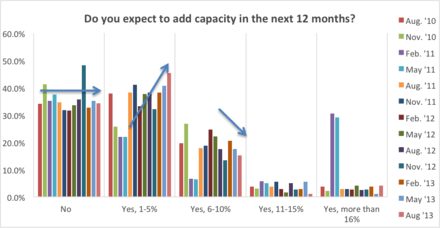
Nearly two-thirds of carriers surveyed in this quarter’s Transport Capital Partners Business Expectations Survey indicated they plan to increase capacity. These numbers have remained fairly constant since August 2010.
“The balance between freight and trucks remains tight. It seems we must face up to the fact, early on, that drivers are truly a brake on truck supply, as well as on truck orders,” noted Richard Mikes, TCP partner.
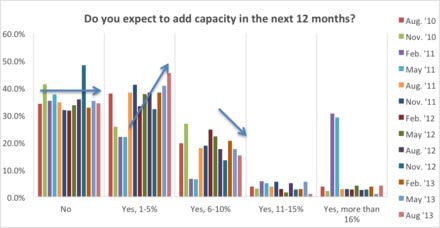
The number of carriers expecting capacity additions of less than 5% has inched upward, from 22% in February 2011 to 45% today. For those intending to add more capacity (i.e., 6-10%), the trend has been downward, from 25% in February 2011 to 15% today.
Smaller carriers are more conservative than larger carriers in their buying plans. Twenty-three percent of larger carriers intend to add more than 6% capacity, compared with only 15% of smaller carriers.
With smaller carriers also less optimistic about volumes, it is unsurprising that they are less likely to add capacity. These smaller carriers may also be having a harder time finding financing for expansion than their larger competitors.
“Tight credit remains a challenge for a lot of businesses, particularly for truckers, and especially those not well positioned,” observed Steven Dutro, TCP Partner.
Trac Leases Most Common
Among carriers intending to add capacity, the most common methods have shifted. The percentage of carriers intending to add capacity through the use of independent contractors has decreased by 50% (from 30% to 16%), over the last three years.
Twenty-six percent of carriers indicated that acquiring equipment financed or purchased on a Trac Lease was their preferred method for growing capacity. This is down from 34% last quarter, but was the most commonly reported method reported in this survey.
Unseated Trucks on the Rise
Continued reluctance to add new capacity stems, in part, from the fact that the number of unseated trucks continues to grow.
The number of carriers reporting 6-10% of their equipment unseated grew from 10% in August 2011 to 26% in August 2013. Carriers reporting fully seated equipment declined, albeit slightly, from 25% to 22%. Smaller carriers are much more likely to seat all their trucks than larger carriers – 33% versus 17%.
“Typically, smaller carriers, have lower employee turnover due to shorter hauls and a more direct, personal approach. However, as smaller carriers cut health care benefits, this advantage may not last,” commented Steven Dutro, TCP Partner.
Fifty percent of larger carriers reported 1-5% of their trucks unseated, a number that does not bode well for future capacity for shippers.
Significant Driver Pay Increases Unlikely
One way to fill seats is to raise driver pay. But the number of carriers expecting to raise driver pay has fallen from 79% in August 2012 to 66% in August 2013. Among those carriers planning to raise wages, the expectations are very modest. Fifty-nine percent expect the increase to be less than 5%.
“Many observers believe higher driver pay is needed to bring more drivers into the industry. But, until shippers are willing to pay more, carriers will be unable to meaningfully increase compensation levels,” noted Richard Mikes, TCP Partner.
Expectations for increasing pay did not differ between large and small carriers. These survey results correlate with comments from carriers to TCP partners, and other reported pay metrics, over the past year.
More Drivers
Platform Science Adds Dispatch and Safety Tools
Four additions to PS Fleet help fleets monitor loads, manage driver coaching, share truck locations and adjust video system settings.
Read More →
When Language Stops the Truck: The Return of ELP Out-of-Service Orders
English language proficiency rules for commercial drivers aren’t new, but renewed out-of-service enforcement has raised the stakes. Here’s what carriers need to know before a driver reaches a roadside inspection.
Read More →
Samsara Launches Custom AI Agent Builder
Agent Studio lets fleets create AI tools for hours-of-service monitoring, reporting and driver support, including agents that communicate by phone.
Read More →
Trucker Path Expands Reserved Parking Network
Trucker Path has added close to 6,000 more truck parking spaces to its Trucker Path Reserved Parking Network with the addition of Safe Truck Parking.
Read More →
EEOC Sues Texas Trucking Company Over Driver Age Limits
The agency says Trancasa USA rejected applicants over 65 and applied tougher driving-record standards to those over 60.
Read More →
Nussbaum, Roehl Announce Second Driver Pay Increase This Year
This year has seen a swath of major truck driver pay increases as freight capacity has tightened.
Read More →
From One Generation to the Next: How Mentorship Builds Safer Truck Drivers
After three decades in trucking, Harold Perry shares what he's learned about driver safety, mentorship, and helping the next generation build confidence behind the wheel.
Read More →
Truck Drivers Need More Than Another Alert
Fleets have more visibility into truck health, safety events, and driver activity than ever. The next challenge is turning all that information into useful guidance for the person who has to decide what to do next.
Read More →
FMCSA Removes 110 Truck Driver Training Schools from Certified ELDT List
Federal regulators also are targeting more than 160 additional training providers and launching a nationwide audit of third-party CDL skills testers as part of a broader crackdown on trucking fraud.
Read More →
Hours of Service Pilot Programs: FMCSA Readies for 2027 Rollout
Two pilot programs could eventually reshape hours-of-service rules, giving truck drivers options to pause their 14-hour clock or use longer split sleeper rest periods.
Read More →