




NTSB Utilizes Driving Simulator in Testing of Accident Avoidance
The National Transportation Safety Board will soon be using an innovative driving simulator made by the Mechanical Simulation Corp. The simulator will be used by NTSB engineers for accident investigation and development, testing and demonstration of accident avoidance and mitigation strategies.
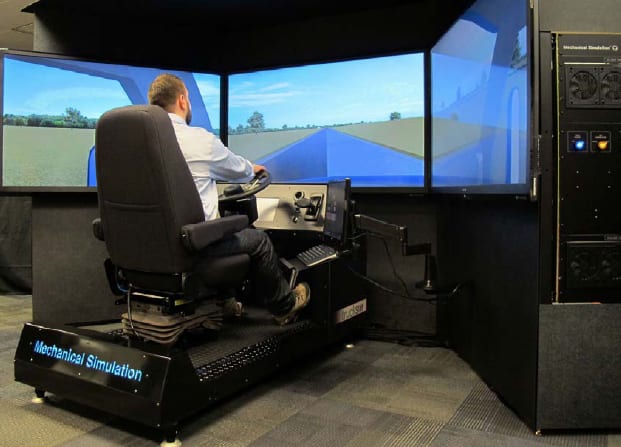
The National Transportation Safety Board will soon be using an innovative driving simulator made by the Mechanical Simulation Corp.
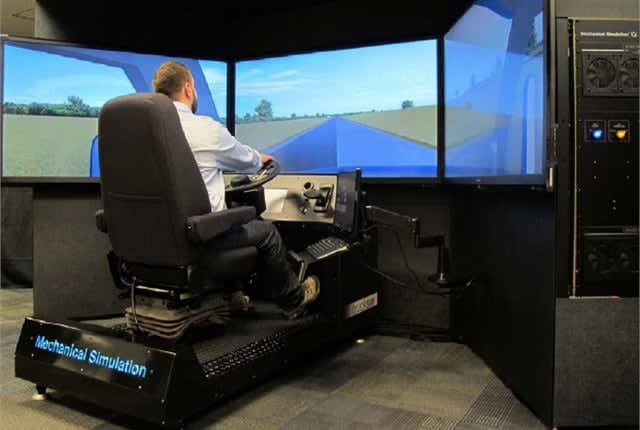
The National Transportation Safety Board will soon be using an innovative driving simulator made by the Mechanical Simulation Corp.
The National Transportation Safety Board will soon be using an innovative driving simulator made by the Mechanical Simulation Corp. The simulator will be used by NTSB engineers for accident investigation and development, testing and demonstration of accident avoidance and mitigation strategies.
The three degree of freedom (3 DOF) motion simulator features Mechanical Simulation's flagship vehicle simulation software product - TruckSim for Driving Simulators.
Dr. Carl R. Schultheisz from NTSB said, "We worked very closely with Mechanical Simulation to define the performance and operational requirements of the simulator. This successful collaboration resulted in an open-architecture tool that we will be able to integrate with a wide range of accident investigation and engineering operations. With a TruckSim based simulator, we will be able to more quickly understand the unique characteristics of heavy-duty and commercial vehicle accidents and to evaluate new technologies and accident avoidance strategies."
"We use TruckSim in desktop simulations because it allows us to control the physics in an accident scenario - the vehicle parameters and interactions with the road surface through th tires, suspension and braking," said Dr. Schultheisz. "In moving to the real-time driving simulator, our experience with TruckSim made the implementation fairly straightforward, and still allowed us complete control of vehicle properties, and the driving scene - complete with 3D models of vehicles. This lets us optimize all conditions to provide the most realistic driving experience for each investigation we want to demonstrate."
More Fleet Management

How MFA Helps Protect Trucking Fleets
Multi-factor authentication adds protection when passwords are stolen. Here’s how it works and where fleets should start.
Read More →
How Better Freight Data Helps Trucking Teams Get Ahead of Disruption
Trucking and logistics teams have plenty of data. The problem is getting the right information in front of the right people soon enough to act. Better-connected data can help teams spot trouble earlier and make smarter decisions before small problems become big ones.
Read More →
Trimble: Taking Artificial Intelligence in Trucking Beyond Faster Tasks
At Insight 2026, Trimble executives argued that fleets may need to redesign workflows to get more from AI as it introduced new products and enhancements. AI’s value will depend on how fleets combine automation with their people's knowledge.
Read More →

Nominations Open for HDT Emerging Leaders
Heavy Duty Trucking is looking for accomplished trucking fleet professionals under 40 who are making an impact and helping lead the industry forward.
Read More →
Why Private Fleets Are Taking More Freight
Private fleets are putting their own trucks on demanding customers and high-cost lanes as companies seek greater control over service, costs, and capacity.
Read More →
Color Match Smarter: Tools That Restore & Perform
For fleet managers and collision repair professionals keeping heavy-duty trucks on the road, getting the color right the first time isn't just about appearance — it's about efficiency, turnaround time, and bottom-line results. Discover how today's digital color tools are transforming the repair process from guesswork to precision.
Read More →
FMCSA Pauses Biennial-Update Enforcement Amid Motus Transition
Carriers whose updates were due on or after June 1 have more time, while FMCSA works to stabilize its new registration system and warns of phishing sites impersonating its new carrier registration system, Motus.
Read More →
2026 Blueprint for Countering Smarter Supply Chain Theft
Cargo theft is no longer just the cost of doing business. It's a multi-billion-dollar criminal enterprise exploiting vulnerabilities across your fleet, drivers, and supply chain.
Read More →
What the U.S.-Canada Trade War Means for Trucking
Escalating U.S.-Canada tariffs could disrupt cross-border freight, reduce truck volumes, raise costs, and create new uncertainty for carriers on both sides of the border.
Read More →
What Are Trucking’s Top Concerns for 2026?
The American Transportation Research Institute wants to know what's worrying trucking fleet managers, drivers, and other stakeholders in its annual Industry Issues survey.
Read More →