




New Hours-of-Service: You've Got Questions, We've Got Answers
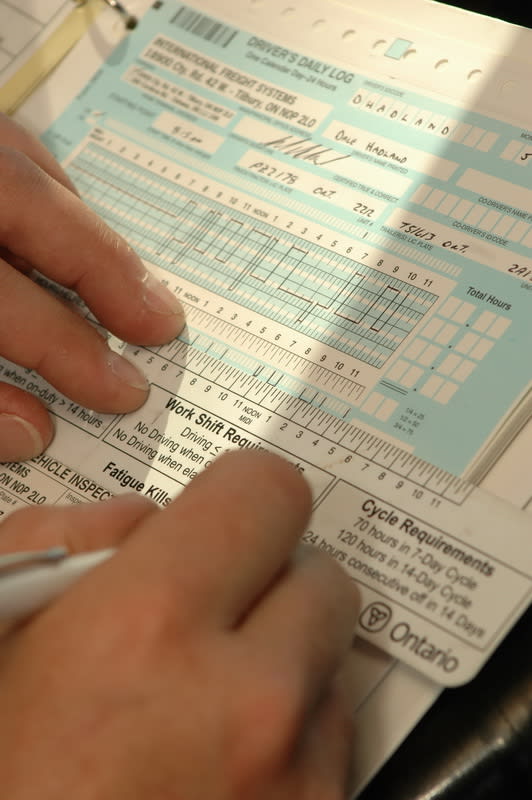
The clock is ticking down toward July 1, when truck drivers and carriers must comply with new hours-of-service rules, but a lot of questions about them remain. Below is an outline of the rules and some frequently asked questions, courtesy of the New Jersey Motor Truck Association.

The clock is ticking down toward July 1, when truck drivers and carriers must comply with new hours-of-service rules, but a lot of questions about them remain. Below is an outline of the rules and some frequently asked questions, courtesy of the New Jersey Motor Truck Association.
Mandatory Rest Break
The final rule requires that if more than 8 consecutive hours on duty have passed since the last off-duty (or sleeper-berth) period of at least half an hour, a driver must take an off-duty or sleeper berth break of at least 30 minutes before driving.
To address an issue raised by commenters, FMCSA has also added an exception for drivers of commercial motor vehicles (CMVs) carrying Division 1.1, 1.2, or 1.3 explosives to allow them to count on-duty time spent attending the CMV, but doing no other on-duty work, toward the break.
Frequently Asked Questions
1. Why is FMCSA requiring drivers to take breaks?
Recent research found that any break from driving reduces risk in the hour following the break, but off-duty breaks produced the largest reduction. This study also showed that when non-driving activities (both work- and rest-related) were introduced during the driver's shift-creating a break from the driving task-these breaks significantly reduced the risk of being involved in a safety critical event during the 1-hour window after the break. The benefits of breaks from driving ranged from a 30- to 50-percent reduction in risk with the greatest benefit occurring for off-duty (non-working) breaks.
2. Do I have to take a break exactly 8 hours after I come on duty?
No, the rule gives drivers flexibility in when and where to take the break. The rule only prohibits driving if more than 8 consecutive hours have passed since the last off-duty period of at least 30 minutes. For example, if a driver spends 2 hours loading at the beginning of the day, then has a 10-hour drive ahead, he or she must take the break no later than 8 hours after coming on duty. The driver can, however, take the break earlier. If he or she takes a half-hour or more break at some point between the 4th and 8th hours after coming on duty, the driver can complete the rest of the planned 10 hours of driving without another break.
3. Does the break have to be spent resting?
No. The driver must be off duty for at least a half hour. Meal breaks or any other off-duty time of at least 30 minutes qualifies as a break. Drivers carrying certain explosives, who are required to attend the vehicle at all times, are allowed to count attendance time, which is on duty, toward the break if they do no other work during that time.
4. Can the shorter sleeper-berth break (minimum 2 hours) be used to meet the half-hour break requirement?
Yes. Any off-duty or sleeper-berth period of 30 minutes or more will meet the requirement.
5. Does the break count against the 14-hour driving window?
Yes. Allowing off-duty time to extend the work day would allow drivers to drive long past the time when fatigue becomes extreme. The 14-consecutive-hour rule was adopted to prevent that and to help drivers maintain a schedule that is consistent with circadian rhythms.
6. Which drivers are most likely to be affected by this provision?
Commenters to the proposed rule stated that most drivers already take breaks, so they are unlikely to be affected. The only drivers who will be affected are those who drive after working for more than 8 hours without taking any off-duty time.
7. Can time spent waiting to be loaded or unloaded count toward the break requirement?
Time spent waiting to be loaded or unloaded is on duty unless the driver has been released from all responsibility for the truck. Except for drivers attending loads of certain explosives, on-duty time cannot be considered as a break.
8. Are drivers using the "100 air-mile radius" or "non-CDL 150 air-mile radius" provisions in § 395.1(e) required to take the minimum 30-minute break if applicable?
Yes. Drivers operating under the 395.1(e) exceptions may not drive if more than 8 consecutive hours have passed since the last off-duty period of at least 30 minutes. Because they are not required to maintain records of duty status ("logbooks"), they are not required to record the break periods.
34-Hour Restart
Drivers can only use the 34-hour restart once every seven calendar days (168 hours). In addition, the restart must include two nighttime period of 1 a.m. to 5 a.m. using one's home terminal time zone. If you go off duty at 7 p.m. on a Friday, for example, you would be eligible to drive again at 5 a.m. on Sunday. After you've taken 34 consecutive hours off duty that include the two nighttime periods, you have your full 60 or 70 hours available again.
Frequently Asked Questions
1. What is the purpose of the 168-hour provision?
The purpose of the rule change is to limit work to no more than 70 hours a week on average. Working long daily and weekly hours on a continuing basis is associated with chronic fatigue, a high risk of crashes, and a number of serious chronic health conditions in drivers.
2. Which drivers are most likely to be affected by the 168-hour provision?
Drivers who work very long hours (more than 70 per week) on a continuing basis are most likely to be affected by the 168-hour provision. The available data indicate that a small percentage of truckload drivers work these extreme hours.
3. How will inspectors be able to enforce the provision during roadside inspections?
FMCSA recognizes that this provision will not always be enforceable during roadside inspections. FMCSA and our State partners will be able to verify compliance with this provision during compliance reviews or other interventions.
4. Who will be affected by the 2-night provision?
Only drivers who drive nights and work more than 60 or 70 hours in a week will be impacted. The nighttime operations of the major less-than-truckload (LTL) carriers should be minimally impacted, as their drivers generally receive 2 days off duty a week. Drivers who will be impacted by this provision work heavy and irregular schedules that include some nighttime driving.
5. What is the minimum length of time a driver has to be off duty to get the 2 night periods?
The minimum period is 34 hours. Most drivers driving day-time schedules will be able to obtain the 2 nights in a minimum 34-hour restart, if they need to use the restart at all. For example, a driver who begins a restart period when going off duty at 7:00 pm on a Friday would complete the minimum 34 hours off duty at 5:00 a.m. on Sunday. This would have included the required 2 nights off between 1:00 a.m. and 5:00 a.m. Only drivers who have a regular overnight driving schedule and who work more than 5 nights a week will need to take longer restarts to obtain the 2 nights off.
6. If a driver works 10 hours a night 6 nights a week and takes the 7th night off, does he then have to take an extra night off?
No, the driver would be working 60 hours in 7 days and would not need a restart to start working again on the 8th day. The driver, therefore, would not need to use the restart provision.
7. Are the two nighttime periods based on the driver's terminal time or local time, when different?
Drivers' logs are based on the time zone of their home terminal. The 2-night periods are, therefore, set by the time at the home terminal. They are not related to "local time."
Click here for new Hours of Service visor card for drivers.
Click here for more information about Hours of Services regulations.
If you have a question about a specific scenario or are looking for an interpretation related to these changes, please contact the Federal Motor Carrier Safety Administration at 609-275-2604.
More Drivers

Platform Science Adds Dispatch and Safety Tools
Four additions to PS Fleet help fleets monitor loads, manage driver coaching, share truck locations and adjust video system settings.
Read More →
When Language Stops the Truck: The Return of ELP Out-of-Service Orders
English language proficiency rules for commercial drivers aren’t new, but renewed out-of-service enforcement has raised the stakes. Here’s what carriers need to know before a driver reaches a roadside inspection.
Read More →
Samsara Launches Custom AI Agent Builder
Agent Studio lets fleets create AI tools for hours-of-service monitoring, reporting and driver support, including agents that communicate by phone.
Read More →
Trucker Path Expands Reserved Parking Network
Trucker Path has added close to 6,000 more truck parking spaces to its Trucker Path Reserved Parking Network with the addition of Safe Truck Parking.
Read More →
EEOC Sues Texas Trucking Company Over Driver Age Limits
The agency says Trancasa USA rejected applicants over 65 and applied tougher driving-record standards to those over 60.
Read More →
Nussbaum, Roehl Announce Second Driver Pay Increase This Year
This year has seen a swath of major truck driver pay increases as freight capacity has tightened.
Read More →
From One Generation to the Next: How Mentorship Builds Safer Truck Drivers
After three decades in trucking, Harold Perry shares what he's learned about driver safety, mentorship, and helping the next generation build confidence behind the wheel.
Read More →
Truck Drivers Need More Than Another Alert
Fleets have more visibility into truck health, safety events, and driver activity than ever. The next challenge is turning all that information into useful guidance for the person who has to decide what to do next.
Read More →
FMCSA Removes 110 Truck Driver Training Schools from Certified ELDT List
Federal regulators also are targeting more than 160 additional training providers and launching a nationwide audit of third-party CDL skills testers as part of a broader crackdown on trucking fraud.
Read More →
Hours of Service Pilot Programs: FMCSA Readies for 2027 Rollout
Two pilot programs could eventually reshape hours-of-service rules, giving truck drivers options to pause their 14-hour clock or use longer split sleeper rest periods.
Read More →