Obama Proposes Energy Security Trust, Sets Aside $2 Billion to Fund Alt-Fuel Transportation Research
U.S. President Barack Obama delivered a speech at Argonne National Laboratory on Friday, March 15, where he described his proposal for a new U.S. Energy Security Trust. The Trust would set aside $2 billion from revenues from oil and natural gas production on domestic, publicly owned land over a 10-year period.
by Staff
March 18, 2013
2 min to read
U.S. President Barack Obama delivered a speech at Argonne National Laboratory on Friday, March 15, where he described his proposal for a new U.S. Energy Security Trust. The Trust would set aside $2 billion from revenues from oil and natural gas production on domestic, publicly owned land over a 10-year period.
In unveiling the details of his “Blueprint for a Clean and Secure Energy Future,” the President said, “The only way to really break this cycle of spiking gas prices, the only way to break that cycle for good, is to shift our cars entirely—our cars and trucks—off oil.”
Ad Loading...
The President said he chose Argonne as the location to make the announcement because advances at laboratories such as Argonne have helped the auto industry develop a wider range of alternative-fuel vehicles. He went on to say that the idea for an Energy Security Trust came from retired admirals and generals in different branches of the U.S. armed services and from corporations. He specifically mentioned the CEO of FedEx as an influence on this plan.
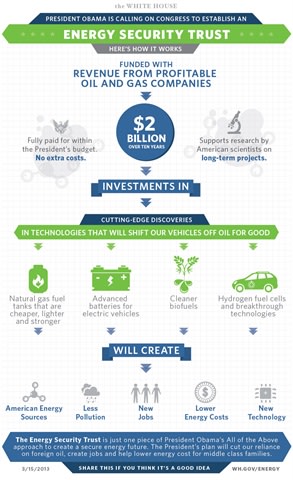
The $2 billion in the Trust would fund research on a range of alternative-fuel transportation technologies, including vehicles that run on electricity, biofuels, fuel cells, and natural gas. The President’s proposal also calls on Congress to set a goal of cutting U.S. net oil imports by half (compared to 2008 levels) by 2020.
Other items in the plan include committing to partnerships with the private sector to adopt natural gas and other types of alternative-fuel vehicles in truck fleets. The plan would create a new incentive, which would be in place for five years, that provides a credit for 50% of the incremental cost of purchasing a medium- or heavy-duty truck that operates on natural gas or other alternative fuels.
Beyond transportation, the proposal calls for research into areas that will improve the Department of Interior’s ability to grant permits related to energy production, make the renewable energy Production Tax Credit permanent and refundable, improve the efficiency of electricity generation technologies and facilities, and invest in technologies that improve energy efficiency and reduce waste.
The White House released an infographic that details some of the key points of the proposal, which you can see below.
Nearly 400 executives and fleet leaders will address AI, autonomy, zero-emission vehicles, and connected technologies at ACT Expo 2026 event in Las Vegas in May.
Thermo King's AI-powered telematics enhance fleet efficiency with smart monitoring, predictive maintenance, and real-time insights. Improve uptime and help reduce costs with these advanced digital solutions.
Bobit Business Media has acquired key partner agreement assets from Roadz, expanding its role as a go-to-market partner for fleet technology providers and strengthening its digital sourcing capabilities.
Cargo theft has shifted from parking-lot break-ins to organized international schemes using double brokering, phishing, and even spoofing tracking signals. In this HDT Talks Trucking video podcast episode, cargo-theft investigator Scott Cornell explains what’s changed and what fleets need to do now.
Daimler Truck’s David Carson sees early signs of tightening capacity — yet buyers remain wary, extending trade cycles and resisting a pre-2027 emissions surge.
The American Transportation Research Institute's annual analysis of truck speeds through congested interchanges yielded a new worst bottleneck this year.