




FMCSA Announces Steps to Reduce GPS-Caused Bridge Strikes
The Federal Motor Carrier Safety Administration will begin issuing official recommendations to members of the commercial trucking industry on the proper uses of Global Positioning System navigation devices and incorporate GPS training into new entry-level certification programs for commercial motor vehicle operators.
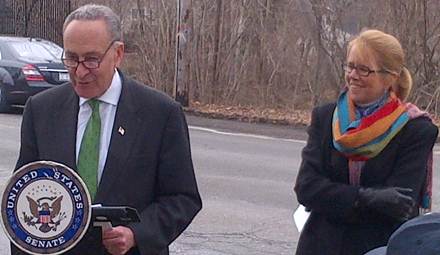
Sen. Charles Schumer and FMCSA Administrator Ann Ferro stand at the Eagle Avenue overpass in New York, which spans the Southern State Parkway at exit 18. The overpass has been struck at least 27 times by trucks that are prohibited from driving on the parkway.

Sen. Charles Schumer and FMCSA Administrator Ann Ferro stand at the Eagle Avenue overpass in New York, which spans the Southern State Parkway at exit 18. The overpass has been struck at least 27 times by trucks that are prohibited from driving on the parkway.
The Federal Motor Carrier Safety Administration will begin issuing official recommendations to members of the commercial trucking industry on the proper uses of Global Positioning System navigation devices and incorporate GPS training into new entry-level certification programs for commercial motor vehicle operators.
This means that commercial drivers will be trained, and reminded, to only use GPS systems designed specifically for the industry. These specialized units take into account the specifics of the truck they're in, including the height, weight and contents, and will then route the trucks onto appropriate roads. The consumer GPS units too often being used are frequently routing trucks onto inappropriate roads, causing them to crash into low overpasses and bridges.
In September, U.S. Sen. Charles Schumer called on the Department of Transportation to investigate the dramatic increase in low bridge strikes by commercial trucks across New York State as a result of the growing use of GPS by drivers. According to reports from local police organizations, GPS-related bridge strikes in New York represent over 80% of all such accidents. Schumer has been working with the DOT on investigating this problem and, alongside FMCSA Administrator Anne S. Ferro, announced that major steps are being taken to address GPS-related bridge strikes.
The FMCSA will implement a two-step solution to address low bridge strikes by commercial trucks as a result of GPS devices.
First, FMSCA will begin distributing official recommendations which will prescribe to the industry how to use GPS devices in commercial motor vehicles. The recommendations will be issued in brochures and flyers and will be distributed to operators throughout the region. For example, tips will include recommendations to select professional grade navigation systems, instructions to input the size, axle weight and other important details of the commercial truck into the GPS, and important tips on avoiding distracted driving.
Second, last year's highway funding bill, Moving Ahead for Progress in the 21st Century Act, required that FMCSA finish a new entry-level certification program for commercial motor vehicle operators. As part of this new rulemaking, FMSCA agreed to include a GPS training component in response to the dramatic increase in low-bridge strikes.
Schumer revealed the details of this national campaign to reduce low-bridge strikes through new training and safety visor cards. According to a 2009 study, 80% of bridge strikes in New York State are caused by misused GPS devices, and the accidents, in addition to being life threatening, cause massive delays and impose significant costs on taxpayers. Schumer said there was more work to be done, but this was a very significant step towards improving safety and reducing these accidents. The new GPS training would be proposed as a component of a federal rulemaking for entry-level commercial driver license certification later this year.
Commercial truck traffic is prohibited on New York State Parkways such as the Southern and Northern State Parkways on Long Island, the Hutchinson and Saw Mill Parkways in the Hudson Valley, and the FDR and Bronx River Parkway in New York City. Overpasses constructed over these parkways were built, in some cases, over 50 years ago, and at low heights. Although these parkways consist of numerous warning and directional signs alerting commercial drivers of the dangers, basic GPS devices often do not show these restrictions and funnel trucks into major danger zones.
According to a recent N.Y. Department of Transportation study, over 200 bridge accidents per year have occurred in New York since 2005. Of that total, over 25% of these accidents occurred in Nassau, Suffolk or Westchester counties. Major repairs on the Long Island Expressway connected to these types of accidents have cost taxpayers $4.1 million in recent years, according to the NYS Department of Transportation.
More Drivers

Platform Science Adds Dispatch and Safety Tools
Four additions to PS Fleet help fleets monitor loads, manage driver coaching, share truck locations and adjust video system settings.
Read More →
When Language Stops the Truck: The Return of ELP Out-of-Service Orders
English language proficiency rules for commercial drivers aren’t new, but renewed out-of-service enforcement has raised the stakes. Here’s what carriers need to know before a driver reaches a roadside inspection.
Read More →
Samsara Launches Custom AI Agent Builder
Agent Studio lets fleets create AI tools for hours-of-service monitoring, reporting and driver support, including agents that communicate by phone.
Read More →
Trucker Path Expands Reserved Parking Network
Trucker Path has added close to 6,000 more truck parking spaces to its Trucker Path Reserved Parking Network with the addition of Safe Truck Parking.
Read More →
EEOC Sues Texas Trucking Company Over Driver Age Limits
The agency says Trancasa USA rejected applicants over 65 and applied tougher driving-record standards to those over 60.
Read More →
Nussbaum, Roehl Announce Second Driver Pay Increase This Year
This year has seen a swath of major truck driver pay increases as freight capacity has tightened.
Read More →
From One Generation to the Next: How Mentorship Builds Safer Truck Drivers
After three decades in trucking, Harold Perry shares what he's learned about driver safety, mentorship, and helping the next generation build confidence behind the wheel.
Read More →
Truck Drivers Need More Than Another Alert
Fleets have more visibility into truck health, safety events, and driver activity than ever. The next challenge is turning all that information into useful guidance for the person who has to decide what to do next.
Read More →
FMCSA Removes 110 Truck Driver Training Schools from Certified ELDT List
Federal regulators also are targeting more than 160 additional training providers and launching a nationwide audit of third-party CDL skills testers as part of a broader crackdown on trucking fraud.
Read More →
Hours of Service Pilot Programs: FMCSA Readies for 2027 Rollout
Two pilot programs could eventually reshape hours-of-service rules, giving truck drivers options to pause their 14-hour clock or use longer split sleeper rest periods.
Read More →