




Accident Specialist Casts Doubt on Reliability of Police Reports
Police accident reports are not reliable enough to determine who’s at fault in truck crashes for the CSA safety enforcement system, according to an accident reconstruction specialist during a CSA advisory panel meeting Tuesday. Washington Editor Oliver B. Patton reports.
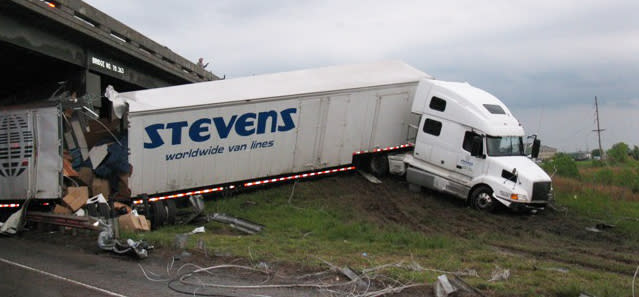

Police accident reports are not reliable enough to determine who’s at fault in truck crashes for the CSA safety enforcement system, according to an accident reconstruction specialist.
Jeffrey Kidd, president of Collision Specialists Inc., told a CSA advisory panel Tuesday that even when the reports are 100% accurate, they are not reliable as a stand-alone source.
Kidd, who was a Georgia state trooper before he started his accident investigation firm in 2005, said there are not enough officers to handle the commercial truck workload and their training is not adequate to the task.
He was speaking to the CSA Subcommittee of the Motor Carrier Safety Advisory Committee, whose meeting is continuing in Alexandria, Va., Wednesday.
The subcommittee is preparing recommendations on a host of CSA issues for consideration by the full MCSAC panel. That panel, in turn, will present a final report to FMCSA later this year.
The committee, composed of representatives from safety enforcement, industry, the safety advocacy community and others, analyzes issues and makes recommendations to the agency. The agency is not obliged to accept the recommendations but the group’s deliberations have become an important part of the agency’s process.
The Crash Accountability Question
Tuesday's discussion of police accident reports was significant because it goes to one of the toughest CSA problems. Right now, the data the agency uses in CSA does not say whether or not the carrier was at fault in a crash.
The CSA Safety Measurement System rates a carrier’s crash history in comparison to other carriers’ history, presuming a certain degree of fault throughout the data. This has led to the conclusion that past crashes are a predictor of future crashes no matter who is at fault.
Trucking interests and others contend that the agency needs to find a way to measure fault, and the agency is studying the issue.
The reliability of police accident reports is one of several areas the agency is examining. It also wants to determine if the benefits of determining accountability are worth the costs, and how to give the public a chance to participate in the evaluation process.
MCSAC’s recommendations will influence the agency’s report, which is due this summer.
On the Ground in Georgia
Kidd, who said he has done 3,500 accident reconstructions, told the panel that in Georgia there simply are not enough trained officers to keep up with the crashes.
There are 500,000 crashes in Georgia each year – an injury crash every five minutes and a fatal crash every seven hours, he said.
The state has 59,000 officers, but not enough are certified North American Standard inspectors, he said. "With the amount of commercial crashes we have each day, the qualified personnel are just not available."
Moreover, the initial training for commercial vehicle crashes covers just the paperwork. It does not touch on trucking basics such as vehicle configurations, licensing, conspicuity, braking or hours of service, Kidd said.
An investigator who’s not trained in electronic control module technology could erase vital data by moving the vehicle, he said.
Moreover, the state does not have enough money for investigation equipment such as cameras, measuring devices, specialized training or uniforms for the dirty job of inspecting the wrecked vehicle, he said.
Inspectors face additional pressures, as well, he added. A thorough examination of a truck wreck can take hours, but states have incentive programs to expedite clearing of the road.
There is no uniformity among the states in reporting or training, although there is a national standard for the information that needs to be gathered, he said.
Another Voice
Another accident reconstruction specialist, consulting engineer James Hrycay of Windsor, Ontario, said that in his experience police reports all cover the same basic information.
Hrycay’s take is that the states have begun a long-term process of improving their accident reporting.
“The emphasis needs to be on making sure officers on the scene are collecting good data,” he said. “Enforcement agencies need to keep up the effort on this issue.”
He would like to see a North American standard for accident reporting, such as exists for truck inspections.
Screening Panel?
One suggestion from the industry for accounting for fault in crashes is to have a panel of experts screen police accident reports to determine who’s to blame.
Subcommittee member Robert Petrancosta, vice president of safety for Con-way Freight, asked Kidd if he thought the idea would work.
Kidd said no, which was the answer Petrancosta later said he was looking for.
“I think it’s inconceivable you can take every DOT reportable accident and run it through a central body … and get clear, accurate, consistent determinations,” he said.
It would be possible to cull out the accidents where a carrier is obviously not at fault, he said. “You could make that determination fairly – but at what expense? There are others where you can’t make it as clearly, and then it becomes a game of chance.”
Con-way’s solution is to put cameras in its tractors, which will give it the data to challenge a police report through the DataQ’s correction process. But Petrancosta acknowledged that this is an expense not all carriers can bear.
“I wish there was this great entity that could be used as a governance body for all accidents, but just the sheer numbers say that isn’t going to happen,” he said.
By Oliver B. Patton, Washington Editor
More Safety & Compliance

How Waste Connections is Using Data, Telematics, and AI
How do you manage and maintain more than 18,000 connected trucks? Data. Lots of it.
Read More →
Fleet Advantage: Top Logistics Fleets Outperform National Safety Benchmarks
Fleet Advantage's latest TRUST Safety Index found leading logistics fleets maintained significantly lower out-of-service rates and stronger safety scores than national averages, while highlighting persistent challenges related to tires, brakes, and unsafe driving behaviors.
Read More →
Why Fleet Data Matters More Than Ever at Waste Connections [Watch]
Waste Connections' Chuck Palmer explains how telematics, predictive maintenance, safety analytics, and AI help keep vehicles on the road and drivers safe in this episode of HDT Talks Trucking.
Read More →
Short Takes: How K&B is Using AI
Fleets need to "get on board the train" with AI, says Lance Evans of K&B Transportation in this HDT Talks Trucking Short Takes episode.
Read More →
Short Takes: Inside K&B’s Truck Safety Tech
Listen to learn how K&B Transportation uses cellphone-blocking technology, speed management systems, weather geofencing, bridge avoidance tools, and more to improve driver safety.
Read More →
The Biggest Gap in Driverless Trucking Isn’t Tech. It’s Safety Validation
Nauto’s Stefan Heck says autonomous trucks are advancing quickly but proving they’re safe enough for large-scale deployment may be the industry’s hardest challenge.
Read More →
Truck Crash Rates Are Down. So Why Do Insurance Costs Keep Rising?
ATRI’s latest research points to litigation, social inflation, and soaring claims costs as key drivers behind record-high liability premiums for trucking fleets. But there are things motor carriers can do.
Read More →
FMCSA Removes More Than a Dozen ELDs from Registered List
The FMCSA continues its efforts to fight electronic logging devices that don't meet federal requirements, removing more than a dozen from the registered ELD list in May.
Read More →
How the Supreme Court Broker Liability Ruling Could Reshape Trucking’s Safety Landscape
The Supreme Court’s May 11 broker-liability ruling may not radically rewrite transportation law overnight. But industry experts say it will intensify pressure on brokers, carriers, and shippers to prove they are prioritizing safety.
Read More →
Recall of Fontaine Fusion Flatbeds Warns Owners Not to Use the Trailers
Some Fontaine Fusion flatbed trailer manufactured between February 2025, and March 2026 could have mainbeams weakened by hydrogen embrittlement because of a problem in the galvanizing process.
Read More →