




NTSB Says Driver Inattention, Bad Brakes Led to Amtrak-Truck Collision
An inattentive driver and poorly maintained brakes, including antilock brakes that had been rendered inoperable, were the probable cause of a commercial truck hitting an Amtrak passenger train in the Nevada desert last summer, killing six and injuring 16, the National Transportation Safety Board said Tuesday
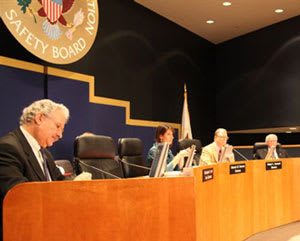
The National Transportation Safety Board blamed bad brakes, driver inattention for deadly train-truck crash.
An inattentive driver and poorly maintained brakes, including antilock brakes that had been rendered inoperable, were the probable cause of a commercial truck hitting an Amtrak passenger train in the Nevada desert last summer, killing six and injuring 16, the National Transportation Safety Board said Tuesday.

On Friday, June 24, 2011, at 11:19 a.m. PDT, a 2008 Peterbilt truck-tractor pulling two empty trailers on northbound U.S. 95 struck the left side of an Amtrak train that was passing through a grade crossing en route from Chicago to Emeryville, Calif.
The collision, which destroyed the truck-tractor and several passenger railcars, also ignited a fire that engulfed two railcars and part of a third. The accident killed the truck driver, the train conductor, and four train passengers; 15 train passengers and one crewmember were injured.
When the grade crossing signals activated, the truck, traveling at least 58 mph, was still more than 2,300 feet from the tracks, however, investigators found no evidence that the truck driver began braking until the front of the truck was less than 300 feet from the crossing.
"Although we'll never know the exact cause of the truck driver's inattention, we do know that if John Davis Trucking had provided its driver with a safe and properly maintained vehicle, this accident could have been avoided," said NTSB Chairman Deborah Hersman.
Reconstruction of the accident using a recording from a forward-facing video camera mounted on the front of the train as well as physical evidence helped investigators to determine that the truck struck the crew car of the train at 26-30 mph.
The investigation revealed that nine of the 16 brakes on the truck were either out-of-adjustment or inoperative. In addition, the antilock brake systems of both trailers were not functional. Wires to missing sensors were cut and zip-tied and wires to malfunction indicator lights had been disconnected, raising serious questions about the maintenance practices of the trucking company, NTSB said.
Several months after the collision, NTSB investigators returned to the accident site and conducted a series of tests with a truck in which the braking system was in proper working order. Test results showed that if the accident truck been able to decelerate as well as the test vehicle, the accident would have been avoided, with the accident truck coming to a stop 15-67 feet short of the rail tracks.
Investigators also found that the driver, who had an erratic employment history with as many as 30 jobs over the 10 years prior to the accident, had been cited for more than a dozen moving violations, had at least three accidents, and had his driver's license suspended or revoked at least four times.
When he applied to work at John Davis Trucking, he omitted information and misrepresented parts of his employment history. The board concluded that since the process in place to obtain a full employment and driver license history was inadequate, John Davis Trucking did not have sufficient information to make an informed hiring decision when considering the driver's application.
As a result of the investigation, the NTSB made a total of 20 safety recommendations to John Davis Trucking, the Federal Motor Carrier Safety Administration, the National Highway Traffic Safety Administration, the Federal Highway Administration, the Federal Railroad Administration, the Nevada Highway Patrol, the Commercial Vehicle Safety Alliance, the American Trucking Associations, The Owner-Operator Independent Drivers Association, the Towing and Recovery Association of America, the American Bus Association, and the United Motorcoach Association.
A synopsis of the NTSB report, including the probable cause, findings, and a complete list of the safety recommendations, is available at http://go.usa.gov/gUtG.
An animation of the accident reconstruction:
More Safety & Compliance
How Waste Connections is Using Data, Telematics, and AI
How do you manage and maintain more than 18,000 connected trucks? Data. Lots of it.
Read More →
Fleet Advantage: Top Logistics Fleets Outperform National Safety Benchmarks
Fleet Advantage's latest TRUST Safety Index found leading logistics fleets maintained significantly lower out-of-service rates and stronger safety scores than national averages, while highlighting persistent challenges related to tires, brakes, and unsafe driving behaviors.
Read More →
Why Fleet Data Matters More Than Ever at Waste Connections [Watch]
Waste Connections' Chuck Palmer explains how telematics, predictive maintenance, safety analytics, and AI help keep vehicles on the road and drivers safe in this episode of HDT Talks Trucking.
Read More →
Short Takes: How K&B is Using AI
Fleets need to "get on board the train" with AI, says Lance Evans of K&B Transportation in this HDT Talks Trucking Short Takes episode.
Read More →
Short Takes: Inside K&B’s Truck Safety Tech
Listen to learn how K&B Transportation uses cellphone-blocking technology, speed management systems, weather geofencing, bridge avoidance tools, and more to improve driver safety.
Read More →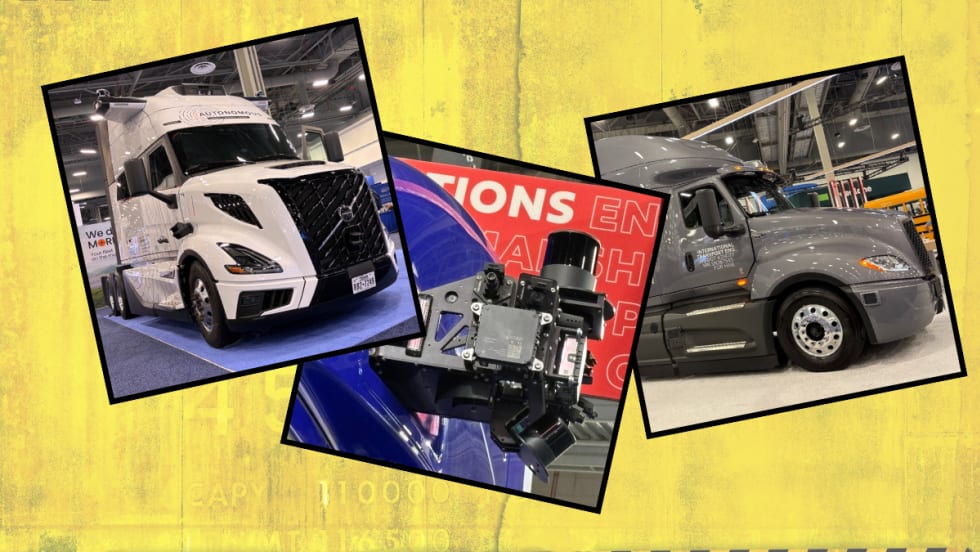
The Biggest Gap in Driverless Trucking Isn’t Tech. It’s Safety Validation
Nauto’s Stefan Heck says autonomous trucks are advancing quickly but proving they’re safe enough for large-scale deployment may be the industry’s hardest challenge.
Read More →
Truck Crash Rates Are Down. So Why Do Insurance Costs Keep Rising?
ATRI’s latest research points to litigation, social inflation, and soaring claims costs as key drivers behind record-high liability premiums for trucking fleets. But there are things motor carriers can do.
Read More →
FMCSA Removes More Than a Dozen ELDs from Registered List
The FMCSA continues its efforts to fight electronic logging devices that don't meet federal requirements, removing more than a dozen from the registered ELD list in May.
Read More →
How the Supreme Court Broker Liability Ruling Could Reshape Trucking’s Safety Landscape
The Supreme Court’s May 11 broker-liability ruling may not radically rewrite transportation law overnight. But industry experts say it will intensify pressure on brokers, carriers, and shippers to prove they are prioritizing safety.
Read More →
Recall of Fontaine Fusion Flatbeds Warns Owners Not to Use the Trailers
Some Fontaine Fusion flatbed trailer manufactured between February 2025, and March 2026 could have mainbeams weakened by hydrogen embrittlement because of a problem in the galvanizing process.
Read More →