




'Carriers Have No Sense of Their Pricing Power.' A Q&A With Noel Perry
If, as many economists are predicting, we start to see decent economic growth in the second half of 2013, trucking will have an almost unprecedented advantage in the marketplace to adjust rates upward and turn operating ratios on their ear
If, as many economists are predicting, we start to see decent economic growth in the second half of 2013, trucking will have an almost unprecedented advantage in the marketplace to adjust rates upward and turn operating ratios on their ear.
Noel Perry, managing director and senior consultant with Nashville, Ind.-based FTR Associates, says the only thing standing in trucking's way is trucking itself.
"There's a great deal of room for freight rates to rise," he says. "But the supply chain simply doesn't believe that transportation costs will go up. And shippers have precedent on their side on that one."
The other problem is that truckers are very, very shy pricers, Perry says.
"In the middle of 2011, carriers were getting good price increases, but they got so embarrassed by all the crap they took from their customers that they rolled back the increases," he says. "They didn't have to, but they did. Carriers have no sense of their pricing power."
But there's more to it than simply being reluctant to look your customer in the eye and stand firm on pricing. Perry says the entire supply chain culture is built on the assumption that transportation costs always go down.
"It has become a core value in that community that you always save on transportation," he notes.
The challenge for trucking, clearly, is convincing shippers and manufacturers that trucking is serious about rate increases, and that it needs sufficient margins to sustain our business too.
Perry offers an interesting perspective on why rate have not kept pace with inflation, and how trucking can turn that around.
Question: How can trucking keep doing the same job over the years for less and less money, for fewer and fewer real dollars?
Perry: Look at it from the supply side. From 1950 to 2000, the cost of moving a truck fell every year -- not the price, the cost. So there you are in 1991, negotiating a rate. Inflation then was running about 3.5% to 4%, so you ask for 5%. The customer says no way and threatens to pull all their freight unless you come in at three percent -- 1% less than inflation. So you say okay.
Here's what happens. At the beginning of the year, you're down 2% from where you want to be, but by the end of the year, your operational guys have found 4% in savings. They save your bacon. They always do. Truckers are exceptionally good at cutting costs, but they always give it away at the other end. In an environment like that, who would risk losing business with a rate increase?
Question: Can the economy afford rate increases on the magnitude trucking needs to restore operating ratios to a reasonable level and to make the required investments in labor and new equipment?
Perry: The usefulness or utility of trucking is so extraordinarily high, and the price that we pay for the service -- relative to other things we purchase -- is so low that the demand for transportation is infinitely inelastic. (Demand is said to be infinitely inelastic when demand remains constant regardless of the price.) Demand for trucking services won't change because the price goes up.
Let me give you an example. A pair of jeans at a major retailer sells for about $20. The transportation component of the price is -- let's use a really aggressive number; 7-10% -- about $2. If transportation costs increased by 50%, the increase reflected in the price of the jeans would be a dollar. Will the public still buy those jeans?
The truth of the matter is transportation costs, in inflation-adjusted dollars, have been going down since 1830. It's a fact that it costs less to move a truck from Buffalo, N.Y. to Nashville, Tenn. in the year 2000 than it did in 1990.
Actually, for the first time in history, during the middle years of the last decade, we saw real increases in transportation costs -- something in the order of 10 to 20%. The shock of that change was mitigated by the fact that during the last three years of the 2000s, rates fell again. So everybody forgot that rates increased, on average, double-digits in the mid-years of the decade. Inflation-corrected, they were up about 25% and they fell again by about 15%.
Question: So, why can't we make the increases stick?
Perry: This time the problem is human nature. People in almost every industry, except maybe BMW and Apple, believe they have no pricing power. Since the human tendency is to avoid conflict, rather than look the customer in the eye and say, I need this price increase, people give.
The problem on the other side is that shippers have never been punished for beating our rates down. They had a field day at our expense back in 2008 because we found ourselves wildly overcapactized. A few year earlier, in 2004 and 2005, there were sporadic capacity shortages, and some shippers got a little nervous, but it wasn't a big deal.
We haven't yet had the disaster that changes behavior. The smarter customers that are even partially aware say, yeah, it's going to happen someday, but I'm going to try to hold it off as long as possible. The other 90% of the customers say, bullshit. People don't believe it.
Question: We're in the midst of a tepid upturn -- we can't seem to get the economy into gear -- but we're seeing orders for new trucks and trailers tank, which implies carriers are not making any attempt to grow their fleets. Where are we today with respect to capacity and pricing?
Perry: It's a little different with this upturn. Carriers have quite purposefully limited capacity by not overbuying and expanding their fleets. Even though demand has been softer than we thought, and even though regulations that will eventually restrict productivity have been delayed, the marketplace is still relatively tight on capacity. Tighter than my standardized calculations would allow for, and certainly tighter than you'd expect from such a crappy recovery.
We started to gain strength back in 2004, but backslid during the recession, but going forward, I'm seeing carriers getting more aggressive with their pricing, but there's still a lot of room for upward movement there. Here's why I think that's the case: What's the cost of a supply chain failure? What does it cost to shut a plant down today? What's the cost of empty shelves at the supermarket? If you were a manufacturer or a retailer, would you be willing to risk all that and more over a 5% rate increase?
Question: How can we change decades of history and precedent, and get the supply chain to buy into our need for reasonable increases?
Perry: First, we have to dismiss the cultural assumption that you always save on transportation. It's historically true; transportation has not kept pace with GDP for the past 40 years. That has to change. We're facing some very real cost increases in the coming years -- labor, equipment, new regulations, compliance costs, it's a long list.
The supply chain has to believe we will make the increases stick. It's paramount.
Here are the stakes we're playing to. If, as a carrier, you let that culture overwhelm you and we have another downturn -- which is likely -- you may lose your company. As a shipper, if you let that culture blind you, during the next upturn, you won't have product and your competitor will. We're not playing to whether it's a 5% or 6% increase, we're playing to whether or not your trucking firm survives, and whether or not, as a shipper, you have the goods on the shelves when nobody else does.
Question: What sort of a strategy would you recommend for trucking over the next four or five years?
Perry: I'm basically a pessimist, so I tend to plan for the worst, and hope for the best. Here's what parties on both sides of the equation need to keep in mind. Ever since WWII, we've never gone more than 4 or 5 years without a some kind of a recession. We're overdue now. 2008-2012/13 were supposedly an upturn. All of the trends say capacity is going to get tighter with each up turn. The only reason it hasn't happened yet is because this upturn has been a lousy upturn.
But look what has happened: fleets have cut their orders, which is very prudent, and good for them. We have limited capacity now, so the next recession is going to take down a few fleets and tighten capacity even further. All of the long-term trends say capacity is going to be more of a problem with each upturn.
If I was a carrier, I'd be keeping a lid on capacity and selling rate increases based on future assurance.
If I was a shipper I'd be nervous. Historically, I would be asking myself, why would I spend more money now on the chance that in three years from now I'll see a payback, when it's never been required before. I think the probably of a genuine capacity shortage during the next upturn is higher than it was this time around.
Noel Perry is managing director and senior consultant with Nashville, Ind.-based FTR Associates. He is an economist specializing in transportation and logistics. Perry served in senior research positions at Schneider National, Cummins Engine Company and CSX, giving him a uniquely broad perspective on the market.
More Fleet Management
Import Cargo Volume to See Year-Over-Year Gain Again in June, Then Remain Below 2025 Levels Into Fall
After July, the report predicts a weakening in import volume as consumer uncertainty remains high and the impact of increasing inflation takes its toll.
Read More →
AUCTION OF EQUITY INTEREST IN HEAVY HAUL TRUCKING COMPANY!!
Mark your calendar: June 30, 2026 (10:00 a.m. PDT). MagnaTrans, LLC, a California limited liability company doing business as Magna Transportation Group is going to auction! Bid on a 37.5% ownership interest in this Rancho Cucamonga-based heavy haul and over-dimensional trucking company operating across California, Oregon, and Arizona. The equity interest will be sold to the highest bidder or bidders under Article 9 of the Uniform Commercial Code at 10:00 a.m. PDT.
Read More →
Volvo Trucks Adds Unattended Over-the-Air Software Update Capabilities
The latest evolution of Volvo’s over-the-air update technology allows software updates to run while trucks are parked, helping fleets keep vehicles current without disrupting operations.
Read More →

How Waste Connections is Using Data, Telematics, and AI
How do you manage and maintain more than 18,000 connected trucks? Data. Lots of it.
Read More →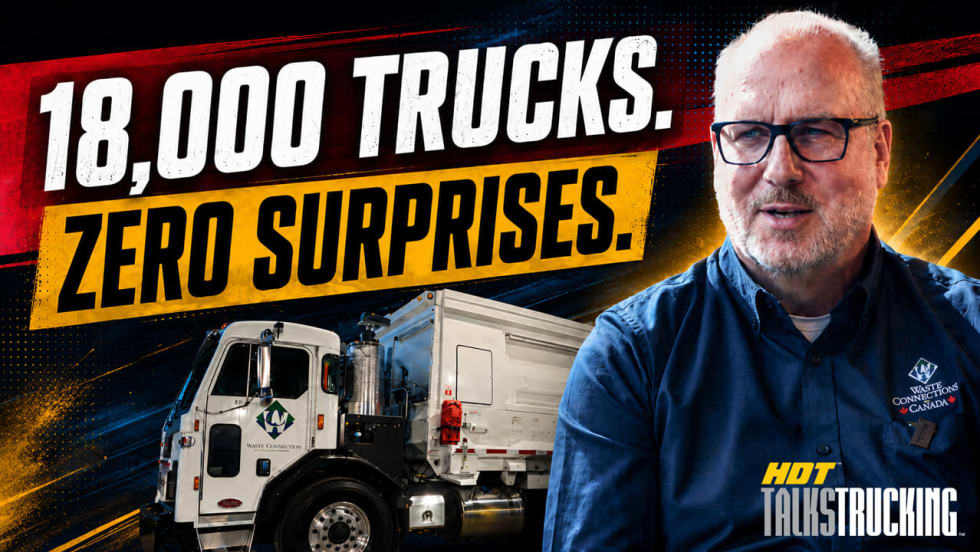
Why Fleet Data Matters More Than Ever at Waste Connections [Watch]
Waste Connections' Chuck Palmer explains how telematics, predictive maintenance, safety analytics, and AI help keep vehicles on the road and drivers safe in this episode of HDT Talks Trucking.
Read More →
NMFTA Launches Free, Anonymous Cybersecurity Threat Report Portal
Organizations are encouraged to anonymously report freight fraud, cargo crime, and cyber threats while gaining visibility into incidents reported across the transportation sector.
Read More →
AI Can Optimize a Fleet. Can It Replace Human Judgment?
Fleets fear falling behind if they don’t adopt AI quickly enough. They also fear what happens if the technology makes the wrong decision.
Read More →
Jamie Hagen Gets Real About Running a Small Fleet in an Uncertain Economy
Small fleet owner Jamie Hagen says new legal risks, volatile fuel prices, and a changing freight market are forcing small carriers to rethink how they operate — and what they can afford.
Read More →
Jamie Hagen Gets Real About Freight, Fuel Prices, Safety, and Small-Fleet Survival
Running a small trucking fleet right now isn’t easy, especially right now. And Jamie Hagen doesn’t sugarcoat it.
Read More →
Jamie Hagen Gets Real About Freight, Fuel Prices, Safety, and Small-Fleet Survival
Running a small trucking fleet right now isn’t easy, especially right now. And Jamie Hagen doesn’t sugarcoat it.
Read More →