




Researchers Identify Common Factors in Truck-Related Crashes
Two Kansas State University civil engineers are working to make Kansas roads and highways safer by reducing the number and severity of vehicular crashes that involve large, cargo-carrying trucks
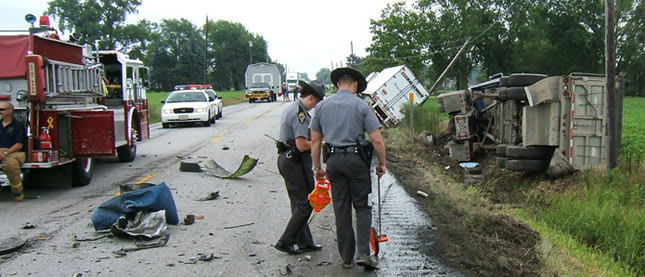
Two Kansas State University civil engineers are working to make Kansas roads and highways safer by reducing the number and severity of vehicular crashes that involve large, cargo-carrying trucks.
Sunanda Dissanayake, associate professor of civil engineering, and Siddhartha Kotikalapudi, master's student in civil engineering, India, are looking at five years' worth of statistics about crashes involving commercial trucks. Although large trucks account for just 3% of registered vehicles in the U.S., truck-related crashes tend to be more severe than non-truck crashes.
"In 2009 the Federal Motor Carrier Safety Administration recorded that one out of every 10 traffic fatalities in the U.S. was a result from collisions involving large trucks," Dissanayake says. "When you consider that between 30,000 to 35,000 people die each year in all motor vehicle crashes, it's a pretty significant issue."
Dissanayake and Kotikalapudi are currently in the second phase of their study, titled "Study of characteristics and evaluation of factors associated with large truck crashes," which is being funded by the Mid-America Transportation Center.
Using information from the National Highway Traffic Safety Administration's Fatality Analysis Reporting System - a comprehensive database with statistics about fatal crashes - the researchers analyzed truck-related fatalities throughout the nation for the first phase. Currently, they are analyzing Kansas data from 2004-2008 and identifying the characteristics and factors that contributed to the crashes. A total of 18,919 crashes involving large trucks were recorded in the state throughout those five years. Of those accidents involving another vehicle, 81% ended with fatalities to occupants in the other vehicles, Dissanayake says.
To find the cause of these truck crashes, the engineers studied the driver, road, vehicle and environmental characteristics involved in accident.
Researchers found that among the 18,919 truck crashes in Kansas, 13,260, or 73%, were contributory causes related to the truck driver. Failing to give enough time and attention to the task being completed - such as switching lanes, passing another vehicle, etc. - was the biggest contributor to driver-related crashes. Similarly, speeding, failing to yield the right of way, improper lane changes and following another vehicle too closely made up the top five contributors.
"Even though it may not feel that way, there are a lot of processes going on when you drive," Dissanayake says. "Your brain is getting lots of information and processing it to determine what your action will be. So if a driver misses a detail or doesn't give enough time to process that information related to what they are doing, it could lead to a crash."
Other causes contributing to truck crashes included: environmental-related, such as animals or rain (13%); road-related, such as ice or wet asphalt (7.8%); and vehicle-related, such as falling cargo or defective brakes (6.1%).
Additionally, researchers found:
- Nearly 78% of truck-crashes happened during daylight and with no adverse weather conditions such as rain or snow
- A majority of the truck crashes happened between noon and 3 p.m.
- More truck crashes happened in locations with a high speed limit.
Dissanayake and Kotikalapudi are using these findings, as well as those from statistical models based on the data, to develop new safety guidelines and educational tools for truck drivers in an effort to reduce truck-related crashes.
Similarly, recommendations may also be made for new or amended legislation - both for the truck drivers and other drivers - Dissanayake says.
"Kansas recently introduced the 'Click It or Ticket' seatbelt law, for example," she says. "The fine for not wearing a seat belt is $10. Some people may feel that a $10 fine is affordable and is not a deterrent to have their freedom compromised, so that might be an issue that needs to be looked into further."
More Safety & Compliance
How Waste Connections is Using Data, Telematics, and AI
How do you manage and maintain more than 18,000 connected trucks? Data. Lots of it.
Read More →
Fleet Advantage: Top Logistics Fleets Outperform National Safety Benchmarks
Fleet Advantage's latest TRUST Safety Index found leading logistics fleets maintained significantly lower out-of-service rates and stronger safety scores than national averages, while highlighting persistent challenges related to tires, brakes, and unsafe driving behaviors.
Read More →
Why Fleet Data Matters More Than Ever at Waste Connections [Watch]
Waste Connections' Chuck Palmer explains how telematics, predictive maintenance, safety analytics, and AI help keep vehicles on the road and drivers safe in this episode of HDT Talks Trucking.
Read More →
Short Takes: How K&B is Using AI
Fleets need to "get on board the train" with AI, says Lance Evans of K&B Transportation in this HDT Talks Trucking Short Takes episode.
Read More →
Short Takes: Inside K&B’s Truck Safety Tech
Listen to learn how K&B Transportation uses cellphone-blocking technology, speed management systems, weather geofencing, bridge avoidance tools, and more to improve driver safety.
Read More →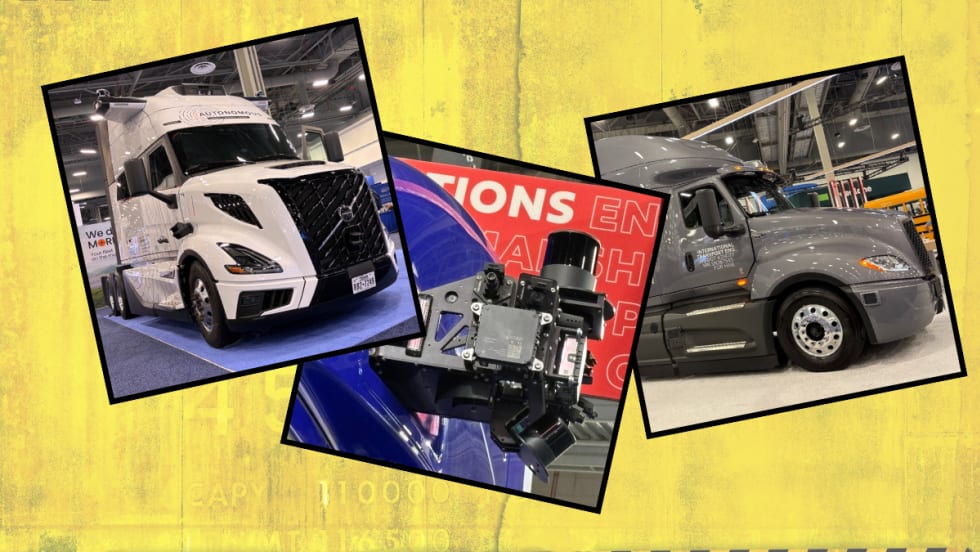
The Biggest Gap in Driverless Trucking Isn’t Tech. It’s Safety Validation
Nauto’s Stefan Heck says autonomous trucks are advancing quickly but proving they’re safe enough for large-scale deployment may be the industry’s hardest challenge.
Read More →
Truck Crash Rates Are Down. So Why Do Insurance Costs Keep Rising?
ATRI’s latest research points to litigation, social inflation, and soaring claims costs as key drivers behind record-high liability premiums for trucking fleets. But there are things motor carriers can do.
Read More →
FMCSA Removes More Than a Dozen ELDs from Registered List
The FMCSA continues its efforts to fight electronic logging devices that don't meet federal requirements, removing more than a dozen from the registered ELD list in May.
Read More →
How the Supreme Court Broker Liability Ruling Could Reshape Trucking’s Safety Landscape
The Supreme Court’s May 11 broker-liability ruling may not radically rewrite transportation law overnight. But industry experts say it will intensify pressure on brokers, carriers, and shippers to prove they are prioritizing safety.
Read More →
Recall of Fontaine Fusion Flatbeds Warns Owners Not to Use the Trailers
Some Fontaine Fusion flatbed trailer manufactured between February 2025, and March 2026 could have mainbeams weakened by hydrogen embrittlement because of a problem in the galvanizing process.
Read More →