




Truck Crashes into Amtrak Train, Killing at Least Six, Injuring Dozens
UPDATE 2 -- A truck driver is the focus of an investigation after he and at least five others were killed after his tractor-trailer ran into an Amtrak train at a rural crossing in the desert near Miriam, Nev., Friday
UPDATE 2 -- A truck driver is the focus of an investigation after he and at least five others were killed after his tractor-trailer ran into an Amtrak train at a rural crossing in the desert near Miriam, Nev., Friday.
The Amtrak train was traveling from Chicago to Emeryville, Calif., when it was stuck by a truck at about 11:25 a.m. Pacific time, creating a fireball that incinerated two of the passenger cars on the train.
Attention is focusing on the driver, 43-year-old Lawrence R. Valli of Winnemucca, Nev., as investigators try to figure out how he could have missed the warnings that a train was in the crossing. They will be looking at his record, toxicology reports, and signs as to whether he may have been fatigued or distracted, including his cell phone records.
Two other truck drivers following the lead truck in a convoy described ample warning signs and functioning crossing gates and warning lights. According to the National Transportation Safety Board, which has a team on site investigating the crash, the first warning sign was almost 900 feet before the crossing, and there were pavement markings at about 750 feet. Skid marks showed the driver applied the brakes only about 320 feet from the crossing. The flashing lights at the crossing, which were set to blink for 25 seconds before a train approaches, would have been visible from a half-mile away if a motorist was driving at the highway's 70-mph speed limit, according to the NTSB.
More than 80 people were taken to hospitals in nearby Reno and the surrounding area, and five were unaccounted for at the time of this writing.
NTSB says the double-bottom dump rig was owned by John Davis Trucking of Battle Mountain, Nev.
The Associated Press reports that the Nevada Department of Public Safety cited the company for two crashes in the last two years, including one in February 2010 that injured a person. In a January inspection, a tractor-trailer was put out of service for tires without enough tread depth.
A number of media reports have trumpeted the fact that the company had a truck taken off the road for bald tires, using terms such as "imminent hazard to public safety." As Nevada Highway Patrol Trooper Chuck Allen pointed out in an MSNBC report, it's "not unusual for state public safety officials conducting spot roadside inspections to take trucks out of service for unsafe driving practices or discrepancies in travel logs." MSNBC said while Allen wasn't familiar with the trucking company's record, he said, "having just a couple of tickets, I don't think is an alarming issue."
The NTSB's Earl Weener outlined various teams that will be investigating the crash over the next week to 10 days. One team will examine the trucking company, and oversight by pertinent regulatory agencies. The company had a state compliance review in May 2010 and the NTSB team will be looking at those records.
A second team will look at vehicle records and whether there were any recording devices that could provide data on the crash. Another team will look at the driver -- his history, training, experience, and the results of toxicology tests. "We will be taking a very close look at what the driver's professional driver's license records are," Weener said.
The NTSB says from what they have been able to determine so far, the gates were down and the lights were working properly at the grade crossing, which Weener called "the most advanced version of the grade crossing."
The engineer on the train told investigators that the gates were down at the crossing. He saw the crash in his rear-view mirror and applied emergency braking. The train, which was traveling near the 80-mph limit on that stretch of track, took half a mile to stop, which Weener said is a reasonable distance given the speed of the train.
It's expected to take up to a year to pinpoint the cause of the crash.
Updated 10 a.m. EDT to update number of missing, add details about driver investigation; updated 2:50 p.m. EDT to add identity of driver.
More Safety & Compliance
How Waste Connections is Using Data, Telematics, and AI
How do you manage and maintain more than 18,000 connected trucks? Data. Lots of it.
Read More →
Fleet Advantage: Top Logistics Fleets Outperform National Safety Benchmarks
Fleet Advantage's latest TRUST Safety Index found leading logistics fleets maintained significantly lower out-of-service rates and stronger safety scores than national averages, while highlighting persistent challenges related to tires, brakes, and unsafe driving behaviors.
Read More →
Why Fleet Data Matters More Than Ever at Waste Connections [Watch]
Waste Connections' Chuck Palmer explains how telematics, predictive maintenance, safety analytics, and AI help keep vehicles on the road and drivers safe in this episode of HDT Talks Trucking.
Read More →
Short Takes: How K&B is Using AI
Fleets need to "get on board the train" with AI, says Lance Evans of K&B Transportation in this HDT Talks Trucking Short Takes episode.
Read More →
Short Takes: Inside K&B’s Truck Safety Tech
Listen to learn how K&B Transportation uses cellphone-blocking technology, speed management systems, weather geofencing, bridge avoidance tools, and more to improve driver safety.
Read More →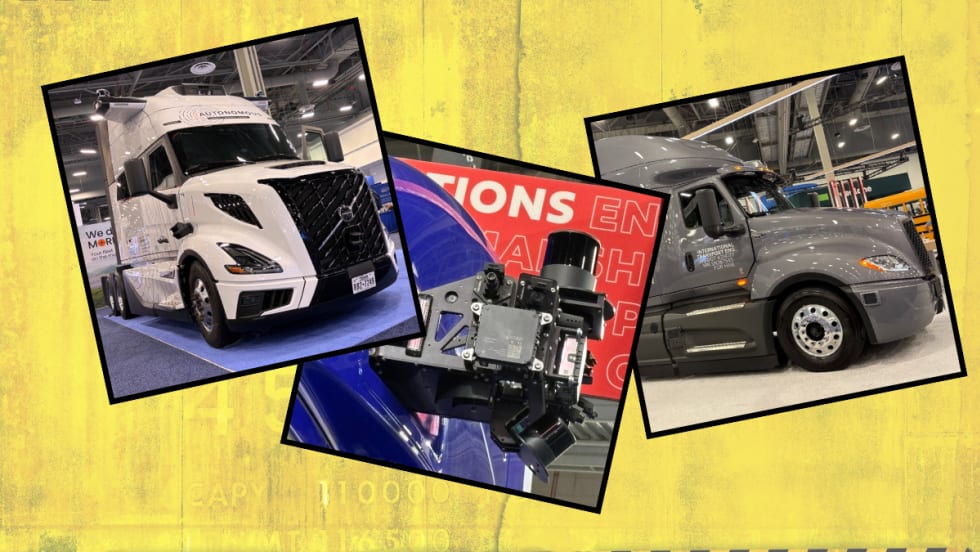
The Biggest Gap in Driverless Trucking Isn’t Tech. It’s Safety Validation
Nauto’s Stefan Heck says autonomous trucks are advancing quickly but proving they’re safe enough for large-scale deployment may be the industry’s hardest challenge.
Read More →
Truck Crash Rates Are Down. So Why Do Insurance Costs Keep Rising?
ATRI’s latest research points to litigation, social inflation, and soaring claims costs as key drivers behind record-high liability premiums for trucking fleets. But there are things motor carriers can do.
Read More →
FMCSA Removes More Than a Dozen ELDs from Registered List
The FMCSA continues its efforts to fight electronic logging devices that don't meet federal requirements, removing more than a dozen from the registered ELD list in May.
Read More →
How the Supreme Court Broker Liability Ruling Could Reshape Trucking’s Safety Landscape
The Supreme Court’s May 11 broker-liability ruling may not radically rewrite transportation law overnight. But industry experts say it will intensify pressure on brokers, carriers, and shippers to prove they are prioritizing safety.
Read More →
Recall of Fontaine Fusion Flatbeds Warns Owners Not to Use the Trailers
Some Fontaine Fusion flatbed trailer manufactured between February 2025, and March 2026 could have mainbeams weakened by hydrogen embrittlement because of a problem in the galvanizing process.
Read More →