




New Study Puts Spotlight on FMCSA Insurance Requirement
A group of trucking companies released research indicating that the federal insurance requirement for the industry is too low, but others such as ATA and OOIDA disagree. The Trucking Alliance, a group of seven carriers that lobby for safety legislation on Capitol Hill, found that the dollar settlements in some cases were far above the $750,000 minimum federal insurance requirement.

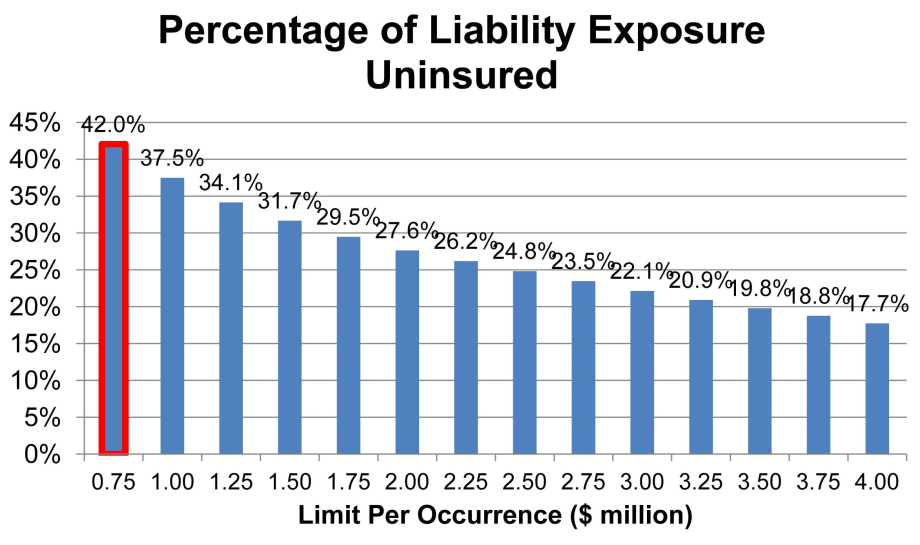
Uninsured liabilities increasing for trucking companies, according to a new report. (Graphic: actuarial firm of Bickerstaff, Whatley, Ryan & Burkhalter)
A group of trucking companies released research indicating that the federal insurance requirement for the industry is too low.
The Trucking Alliance, a group of seven carriers that lobby for safety legislation on Capitol Hill, found that the dollar settlements in some cases were far above the $750,000 minimum federal insurance requirement.
While these high settlements occurred only about 1% of the time, the amounts were enough to create an uninsured liability of 42% for the companies, according to an analysis of the data by the actuarial firm of Bickerstaff, Whatley, Ryan & Burkhalter.
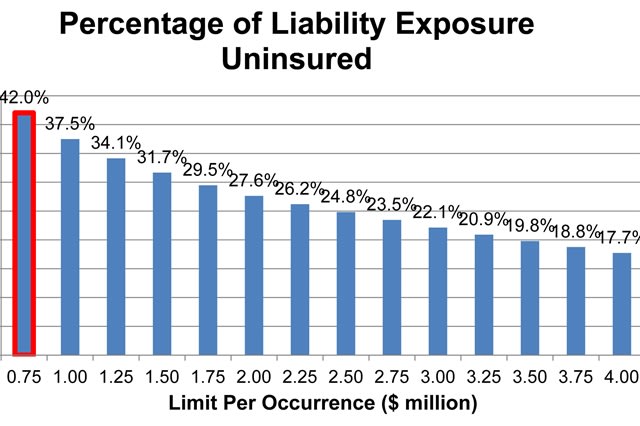
Uninsured liabilities increasing for trucking companies, according to a new report. (Graphic: actuarial firm of Bickerstaff, Whatley, Ryan & Burkhalter)
The study comes as the Federal Motor Carrier Safety Administration completes its own analysis of the insurance standard, as required by the highway law Congress passed last year.
As it drafted the law, Congress considered raising the insurance minimum from $750,000 to $1 million, but eventually decided to have the agency prepare an analysis that could become the basis for changes in the standard.
That analysis is close to being done, said an agency official speaking on background. It is being reviewed at the agency internally and still must go to the White House Office of Management and Budget. The process will take two to three months, the official said.
The Alliance’s aim in releasing the study is to prod FMCSA to increase the insurance requirement, said Lane Kidd, senior manager of the Alliance and president of the Arkansas Trucking Association.
Study is 'Just Garbage'
Other trucking groups take a dim view of the Alliance’s work, however. “It’s pretty much just garbage,” said Todd Spencer, executive vice president of the Owner-Operator Independent Drivers Association.
He cited the small number of carriers in the survey and the caveat of the Bickerstaff firm that the analysis is informal and not a statement of actuarial opinion.
Spencer also said OOIDA believes the current requirement is adequate. “Most truckers have a minimum of $1 million (in coverage) and in the overwhelming majority of instances that’s plenty,” he said.
“We have never seen a correlation between insurance minimums and safety,” Spencer added. “What increased minimums would do is result in tremendous increases in the number of personal injury lawyers that specialize in suing trucking companies.”
The American Trucking Associations also was dismissive.
“ATA read the press release from these carriers, and the 3.5 page ‘study’ performed by an actuarial firm,” said Sean McNally, vice president of communications and press secretary, in an email response to a query.
Even though just 1% of settlements exceeded the minimum coverage requirement, the Alliance recommended that the limits be increased “to some undetermined amount in satisfaction of some unstated goal,” he said.
“FMCSA has consistently found over the same time period examined by the Trucking Alliance that the average cost of a crash involving a large truck is less than a third of the minimum limit required today,” he said.
ATA still is developing its position on the insurance requirements, McNally said.
“As part of that process we are looking for all available data, including FMCSA’s upcoming study of the topic. Whenever we ultimately adopt a position, it will be data driven.”
The last time the insurance minimum was changed was in 1986, when it was increased from $500,000 to $750,000.
Congress has always intended that DOT should review the requirement more often than every 27 years, said the agency official who spoke on background.
The pending agency study will mirror the Alliance study in at least one respect. It will include a finding that while the overall accident rate is going down, the number of high-cost settlements is increasing, the official said.
The agency study will not answer all questions about the issue but it could provide more justification for action, the official said.
In addition, the agency is planning to ask the Motor Carrier Safety Advisory Committee to take up the insurance question, the official said.
The committee, a group of 20 officials from industry, the enforcement community and labor and safety advocacy groups provides counsel to FMCSA on a variety of issues.
The Alliance Study
For the study, members of the Alliance provided data on more than 8,600 accident settlements between 2005 and 2011.
Not all of the Alliance’s members participated but there are just seven fleets on the roster: Maverick Transportation, J.B. Hunt Transport Services, Knight Transportation, Schneider National, Boyle Transportation, Dupre’ Logistics and Fikes Truck Line.
“The stats were interesting because only 90 of the claims were settled above $750,000. But that made all the difference, because those claims were so high above the $750,000 that the risk is way above that number,” said Kidd.
Insurers say that the truest measure of risk in insurance is a per-occurrence average, as opposed to the raw numbers of how many were below $750,000 and how many were above, Kidd said.
“If all of the crash settlements represented in the database were covered by a $750,000 insured limit of liability, then 42% of the monetary exposure from these crashes would represent an uninsured liability of the trucking company,” the Bickerstaff analysis concluded.
Kidd said the analysis shows that carriers insured at the $750,000 level are, in effect, uninsured. “They are just rolling the dice that they don’t have an accident,” he said.
The analysis found that the uninsured exposure goes down as the per-occurrence coverage went up. At $1 million in coverage, for example, the exposure is 37.5%. At $2 million it is 27.6%. At $3 million it is 22.1% and at $4 million its is 17.7%.
The Alliance believes that FMCSA has not kept the insurance minimum current with changing times and circumstances. The study notes, for instance, that a 2% inflation rate alone will increase the 42% exposure rate to more than 45% over the next decade.
Insurance is one of a half-dozen initiatives on the group’s agenda for this congressional cycle. The others are hair testing for drugs, creation of a drug and alcohol clearinghouse, mandatory speed limiters, and consideration of alternative compliance methods for determining safety fitness.
More Drivers

From One Generation to the Next: How Mentorship Builds Safer Truck Drivers
After three decades in trucking, Harold Perry shares what he's learned about driver safety, mentorship, and helping the next generation build confidence behind the wheel.
Read More →
Truck Drivers Need More Than Another Alert
Fleets have more visibility into truck health, safety events, and driver activity than ever. The next challenge is turning all that information into useful guidance for the person who has to decide what to do next.
Read More →
FMCSA Removes 110 Truck Driver Training Schools from Certified ELDT List
Federal regulators also are targeting more than 160 additional training providers and launching a nationwide audit of third-party CDL skills testers as part of a broader crackdown on trucking fraud.
Read More →
Hours of Service Pilot Programs: FMCSA Readies for 2027 Rollout
Two pilot programs could eventually reshape hours-of-service rules, giving truck drivers options to pause their 14-hour clock or use longer split sleeper rest periods.
Read More →
Medical Cards, English Proficiency Reshape Roadcheck Violations
Medical-card violations jumped to the top of the driver out-of-service list during CVSA’s 2026 International Roadcheck, while English-language proficiency violations appeared among the leading violations for the first time.
Read More →
Driver Trust Can Make or Break the Success of Fleet Safety Technology
New Teletrac Navman research suggests that onboarding, transparency about driver data, and positive feedback can play a significant role in how commercial drivers respond to safety and coaching technology.
Read More →
EEOC Sues KLLM Over Alleged Sex Discrimination in Driver Training
KLLM is facing a federal sex-discrimination lawsuit over policies the EEOC alleges put female truck driver trainees at a disadvantage.
Read More →
FMCSA Moves to Codify English Language Requirements for Commercial Drivers
By changing regulations on English-language proficiency requirements for commercial drivers, rather than relying on a guidance memo, the FMCSA said future administrations won't be able to walk back the Trump administration's stricter enforcement with just a memo.
Read More →
Drivers Put Western Star Trucks to the Test at Star Nation Experience
Watch to get an inside look at the Western Star trucks, technology, and community behind the Star Nation Experience 2026!
Read More →
Trump Administration Looks to Put More Veterans Behind the Wheel
The Freedom Haulers program pulls together existing and expanded programs at several federal agencies to recruit veterans to drive commercial heavy-duty trucks and cut the red tape for them to get a CDL, training, and employment.
Read More →