




ATA White Paper Outlines Flaws in CSA Data
In a new white paper, the American Trucking Associations demonstrates how the Federal Motor Carrier Safety Administration's safety monitoring and measurement system, Compliance Safety Accountability, lacks sufficient data on the majority of the industry to render meaningful scores for most motor carriers
In a new white paper, the American Trucking Associations demonstrates how the Federal Motor Carrier Safety Administration's safety monitoring and measurement system, Compliance Safety Accountability, lacks sufficient data on the majority of the industry to render meaningful scores for most motor carriers.
FMCSA said it has sufficient violation data to assess 40% of active carriers in at least one category but only enough to "assign a percentile rank or score" in at least one category to 12% of active carriers.
In fact, the vast majority of these carriers are only assigned a score in one category. The agency contends this weakness is not problematic since "those carriers are involved in 83% of the crashes."
"This statement concerns us, since FMCSA doesn't really know how many commercial motor vehicle crashes are occurring or who is involved in them," ATA President and CEO Bill Graves said. "Many crashes simply don't get reported to the agency."
Previous research conducted by the University of Michigan Transportation Institute confirmed this limitation and, as this white paper highlights, FMCSA's self-assessment that most states do a "good" job of reporting crashes is questionable, ATA says.
UMTRI's comprehensive analyses demonstrate that some states do a good job while others do a poor job of reporting crashes to FMCSA. For example, UMTRI found several states report fewer than 75% of their truck crashes to FMCSA.
FMCSA has discontinued funding for the UMTRI crash reporting studies, which provide more accurate and reliable assessments of state crash reporting.
"Moreover, sole reliance on FMCSA's estimates does little to provide an understanding of how the CSA system lacks important safety data on the vast majority of the industry," Graves said. "This is critical because, as an analysis by the American Transportation Research Institute pointed out, perceived safety risk is dependent on the amount of data available on each carrier.
"The foundation of CSA is scores that reflect measures of comparative performance," he said. "The fact that the government lacks data to score the vast majority of the industry in most categories calls into question not only the assumptions of those who don't have enough data to get scored, but those who do."
More Safety & Compliance

How Waste Connections is Using Data, Telematics, and AI
How do you manage and maintain more than 18,000 connected trucks? Data. Lots of it.
Read More →
Fleet Advantage: Top Logistics Fleets Outperform National Safety Benchmarks
Fleet Advantage's latest TRUST Safety Index found leading logistics fleets maintained significantly lower out-of-service rates and stronger safety scores than national averages, while highlighting persistent challenges related to tires, brakes, and unsafe driving behaviors.
Read More →
Why Fleet Data Matters More Than Ever at Waste Connections [Watch]
Waste Connections' Chuck Palmer explains how telematics, predictive maintenance, safety analytics, and AI help keep vehicles on the road and drivers safe in this episode of HDT Talks Trucking.
Read More →
Short Takes: How K&B is Using AI
Fleets need to "get on board the train" with AI, says Lance Evans of K&B Transportation in this HDT Talks Trucking Short Takes episode.
Read More →
Short Takes: Inside K&B’s Truck Safety Tech
Listen to learn how K&B Transportation uses cellphone-blocking technology, speed management systems, weather geofencing, bridge avoidance tools, and more to improve driver safety.
Read More →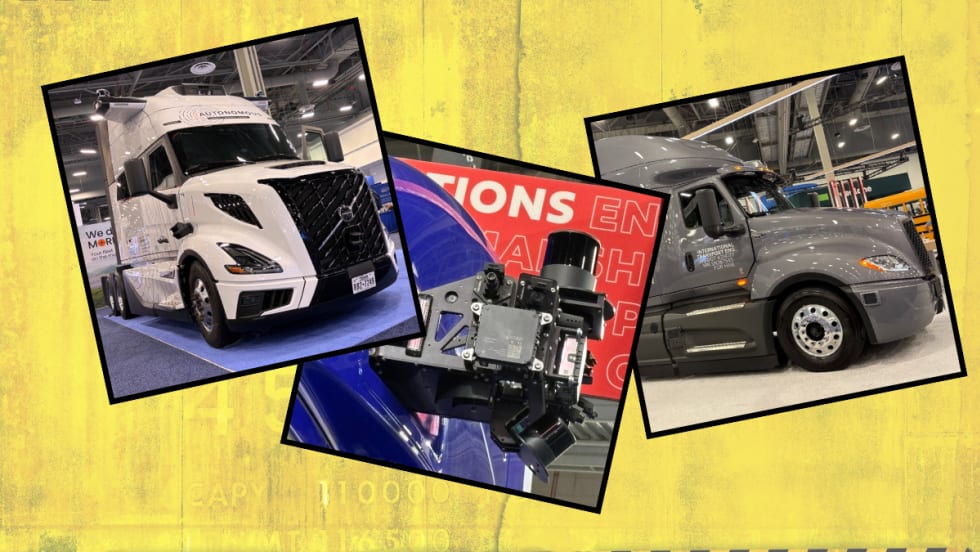
The Biggest Gap in Driverless Trucking Isn’t Tech. It’s Safety Validation
Nauto’s Stefan Heck says autonomous trucks are advancing quickly but proving they’re safe enough for large-scale deployment may be the industry’s hardest challenge.
Read More →
Truck Crash Rates Are Down. So Why Do Insurance Costs Keep Rising?
ATRI’s latest research points to litigation, social inflation, and soaring claims costs as key drivers behind record-high liability premiums for trucking fleets. But there are things motor carriers can do.
Read More →
FMCSA Removes More Than a Dozen ELDs from Registered List
The FMCSA continues its efforts to fight electronic logging devices that don't meet federal requirements, removing more than a dozen from the registered ELD list in May.
Read More →
How the Supreme Court Broker Liability Ruling Could Reshape Trucking’s Safety Landscape
The Supreme Court’s May 11 broker-liability ruling may not radically rewrite transportation law overnight. But industry experts say it will intensify pressure on brokers, carriers, and shippers to prove they are prioritizing safety.
Read More →
Recall of Fontaine Fusion Flatbeds Warns Owners Not to Use the Trailers
Some Fontaine Fusion flatbed trailer manufactured between February 2025, and March 2026 could have mainbeams weakened by hydrogen embrittlement because of a problem in the galvanizing process.
Read More →