




NHTSA's Stability Control Proposal Gets First Public Airing
Trucking interests, including manufacturers and carriers, support the idea of a federal mandate for stability control systems in new tractors, but have concerns about details in the National Highway Traffic Safety Administration's proposed rule
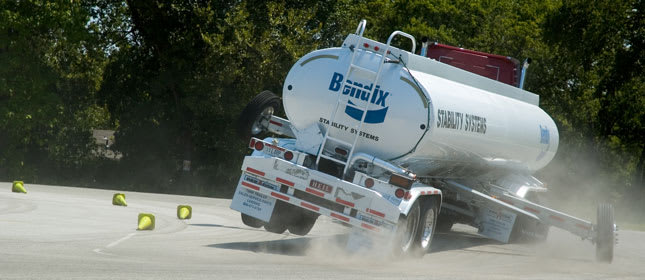
Trucking interests, including manufacturers and carriers, support the idea of a federal mandate for stability control systems in new tractors, but have concerns about details in the National Highway Traffic Safety Administration's proposed rule.
At a hearing hosted by NHTSA yesterday, truck and equipment suppliers uniformly applauded the agency's proposal to require electronic stability control systems, but warned that the certification method the agency is considering will create more problems than it solves.
American Trucking Associations likes stability control technology but is not so keen on the agency's choice of ESC versus roll stability control.
Both systems detect the risk of rollover or instability and slow the vehicle by cutting back the throttle and applying the brakes automatically. But RSC is triggered only by roll instability, while ESC reacts to both roll instability and yaw instability, such as a skid that could lead to a jackknife.
Ted Scott, director of engineering at ATA, said the rule needs to consider the diversity of the industry.
"One size does not fit all," he said. ESC is more effective than RSC, but the difference is not enough to justify going with the ESC mandate, he said.
"The point is that such a diverse industry needs standards that provide flexibility."
But ATA does not speak for all carriers.
Jim Burg, president of steel hauler James Burg Trucking, has ESC systems in a half-dozen new tractors and has RSC on 10 trailers. He sees ESC as the common-sense approach.
He prefers ESC to RSC on his power units because it provides both roll and directional control.
"I was convinced to purchase ESC technology after watching a 10-minute video demonstration taped on a snow-covered test track in Michigan's Upper Peninsula," he said. "I have driven over 1.2 million miles in a commercial motor vehicle and immediately recognized the value ESC could bring in unpredictable circumstances."
The hearing was the beginning of the public phase of the agency's rulemaking process. The agency posted the proposed rule last May and will accept comments until August 21.
The rule, aimed at vehicles rated 26,000 pounds or more, would be phased in over two to four years after it goes through public comment and becomes final, a process that probably will take a year or more.
The Certification Concern
Manufacturing interests at the hearing unanimously said that the agency needs to reconsider its approach to certifying ESC systems.
The agency is proposing a "sine with dwell" procedure that would put trucks through high-speed maneuvers that can only be done at one facility in the country, said Tim Blubaugh of the Truck and Engine Manufacturers Association.
The agency is borrowing this procedure from its testing of stability control systems on cars, but it won't work with trucks, he said.
It requires expensive and complicated new equipment on the truck, and the maneuvering that's required could damage the truck. Moreover, it does not reflect how trucks have to maneuver on the highway, he said.
He warned that the agency's certification approach could jeopardize the entire rule.
"The sine with dwell certification test would impose enormous resource demands on heavy-duty truck manufacturers for no purpose, and would make the rule impractical to implement," he said.
Manufacturers are working on alternative certification procedures that they intend to recommend to the agency, said Blubaugh.
A number of manufacturers testified in the same vein, including Navistar, Volvo, Daimler Trucks North America, Meritor Wabco, Bendix Commercial Vehicle Systems and the Heavy Duty Brake Manufacturers Council.
Also testifying in support of the proposal were Rep. Betty Sutton, D-Ohio, whose district includes the headquarters of Bendix, and John Hill, former chief of the Federal Motor Carrier Safety Administration and a long-time advocate of advanced safety technologies.
More Drivers

Prime Inc. to Open $7.9M Flagship Used-Truck Dealership
A new driver-focused facility to sell Prime Inc's used trucks and trailers will be the first purpose-built location in the company's history.
Read More →
Short Takes: Inside K&B’s Truck Safety Tech
Listen to learn how K&B Transportation uses cellphone-blocking technology, speed management systems, weather geofencing, bridge avoidance tools, and more to improve driver safety.
Read More →
Nussbaum Expands Driver Compensation with Pay Raises, Profit Sharing
Nussbaum Transportation said its latest compensation package could push first-year driver earnings above $90,000 in key hiring markets.
Read More →
Listen: Inside Modern Fleet Safety: AI, Cameras & Speed Control at K&B Transportation
Fleet safety is evolving fast—and technology is at the center of it. Learn how a former commercial vehicle enforcement officer turned director of safety at K&B Transportation is embracing real-world safety technology.
Read More →
Maverick Announces 2026 Driver Pay Raises
New raises for Maverick Transportation drivers will take effect on May 31, 2026.
Read More →
Illinois Trucker Indicted for Nearly $22,000 in Ohio Turnpike Toll Evasion
Authorities say an Illinois trucker avoided paying tolls for two years, and now faces felony charges, possible prison time, and forfeiture of his Freightliner tractor.
Read More →
New Trojan Driver Cargo Theft Scam Bypasses Carrier Vetting Systems
Cargo theft rings plant operatives as drivers inside legitimate, fully vetted carriers, then execute coordinated thefts that look like a traditional straight theft from the outside.
Read More →
WIM, Trucker Path Name Top 3 Women-Friendly Truck Stops
ATA’s Women In Motion Council and Trucker Path highlight three truck stops that meet all seven safety-focused criteria and rank highest among female drivers.
Read More →
FMCSA Extends Paper Medical Card Exemption … Again
Five states still aren't ready to accept commercial driver medical exam information directly from the medical examiner's registry.
Read More →
Mack Launches Digital Driver Guide for Chassis-Specific Truck Info
Mack’s new, virtual owner’s manual delivers VIN-based, on-demand guidance for vehicle systems via web, app, and soon in-cab displays.
Read More →