





Related: Where Did the Hours of Service Rules Come From, Anyway?
FMCSA Chief: Agency ‘Open to Ideas’ on Improving Safety
Federal Motor Carrier Safety administrator Raymond Martinez spoke at the TCA annual convention saying right off the bat that the FMCSA does not have a monopoly on safety and explained that the agency he’s helmed for just shy of a month “needs to remain open to ideas other may have” on how to improve highway safety.
March 27, 2018
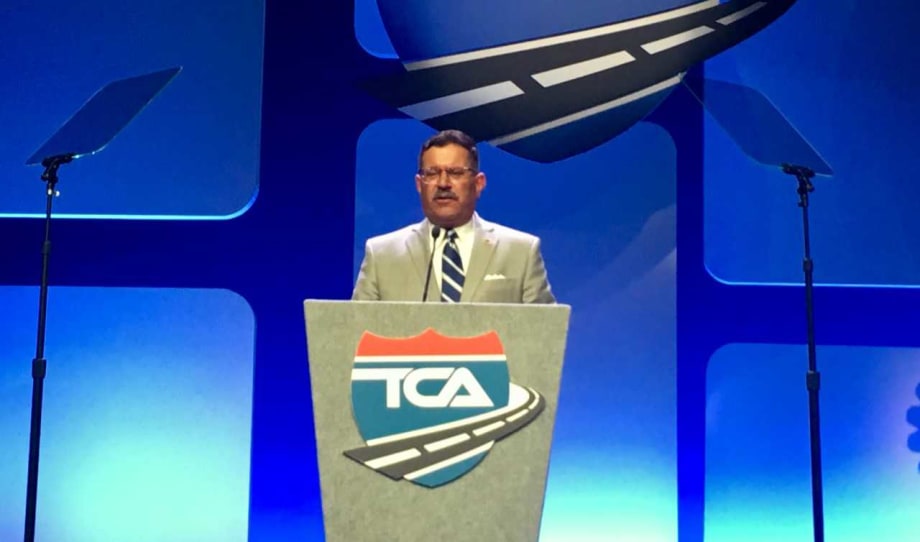
FMCSA administrator Raymond Martinez said that the agency would be open to ideas from others on how to improve highway safety. Photo: David Cullen
2 min to read
FMCSA administrator Raymond Martinez said that the agency would be open to ideas from others on how to improve highway safety.Photo: David Cullen
ORLANDO, FLORIDA — Greeted warmly as he stepped up to the podium to address the 80th annual convention of the Truckload Carriers Association on March 26, Federal Motor Carrier Safety Administrator Raymond Martinez opened his remarks in kind, saying right off the bat that “safety is our priority, but we [at FMCSA] do not have a monopoly on that.” He explained that the agency he’s helmed for just shy of a month “needs to remain open to ideas other may have” on how to improve highway safety.
Martinez said he wants to “drive down” fatalities involving large trucks, which rose 5.4% in 2016. But, he said, “I’m not sure we are going to get answers from people who work in our [FMCSA] building. We need some answers from you.”
“If we can reach our safety goals through guidance, and not additional rulemaking, we will take that path,” he added.
Martinez said listening to what trucking advocates have to say on safety rules will only become more critical now. “The challenge is that as the economy improves, more miles will be run and with that the possibility of more crashes. But we can drive those incidences down.
“We have work to do,” he continued, stating that it is a fact that “large trucks and buses are disproportionately involved in crashes. Martinez said he has been charged by President Donald Trump and Secretary of Transportation Elaine Chao with “reviewing existing regulations to see what may not be working or needs updating.”
“I believe the electronic logging device rule is an improvement [for complying with] hours of service,” Martinez stated. “But there is some worth in looking at hours of service” to improve how that rule works. He stressed that the “process must start with an honest conversation” between FMCSA and stakeholders on what works and what does not in the current HOS rule.
Noting that the so-called “soft enforcement” period for the ELD rule ends on April 1, Martinez was happy to report that “compliance rates [for the ELD mandate] continue to improve weekly and have hit a rate as high as 96%.”
Martinez reiterated that FMSCA has promised to soon publish final guidance for the ELD rule regarding both the 150 air-mile exemption and use of personal conveyance. He noted that the agency is also readying final rules on setting minimum entry-level driver training requirements and building a national clearinghouse of alcohol and drug use violation data.
Subscribe to Our Newsletter
More Safety & Compliance
PrePass, Kodiak Connect Driverless Trucks to Roadside Enforcement
The system will allow enforcement agencies to verify Enhanced Inspection information and decide whether Kodiak’s autonomous trucks can bypass roadside screening sites.
Read More →
From One Generation to the Next: How Mentorship Builds Safer Truck Drivers
After three decades in trucking, Harold Perry shares what he's learned about driver safety, mentorship, and helping the next generation build confidence behind the wheel.
Read More →
FMCSA Pauses Biennial-Update Enforcement Amid Motus Transition
Carriers whose updates were due on or after June 1 have more time, while FMCSA works to stabilize its new registration system and warns of phishing sites impersonating its new carrier registration system, Motus.
Read More →
ZF Expands Commercial Vehicle Push in North America
ZF is expanding its North American commercial-vehicle presence with new transmission applications, electrification, trailer technology and autonomous-driving systems.
Read More →
Truck Drivers Need More Than Another Alert
Fleets have more visibility into truck health, safety events, and driver activity than ever. The next challenge is turning all that information into useful guidance for the person who has to decide what to do next.
Read More →
Tesla Wants a Self-Driving Semi. Are Cameras Enough?
Could Tesla’s camera-only autonomous driving technology work on an 80,000-pound Semi? In this commentary, HDT's Deborah Lockridge takes a look at Tesla, Cybercab, and how autonomous trucks see the road.
Read More →
What DOT’s Automated Vehicle Strategy Means for Trucking
The U.S. Department of Transportation issued a new automated-vehicle strategy that outlines plans for driverless-truck regulations, cross-state freight corridors, and federal safety standards.
Read More →
NYC Expands Speed, Pedestrian Safety Tech Across Fleet
New York City is expanding intelligent speed assistance and pedestrian-alert systems across its municipal fleet, moving the technologies from pilot programs into vehicle procurement and retrofit requirements.
Read More →
FMCSA Removes 110 Truck Driver Training Schools from Certified ELDT List
Federal regulators also are targeting more than 160 additional training providers and launching a nationwide audit of third-party CDL skills testers as part of a broader crackdown on trucking fraud.
Read More →
Beyond DOT Compliance: What Makes a Trucking Fleet Truly Safe?
A trucking fleet can follow every rule and still make unsafe decisions. The real test comes when safety conflicts with freight, productivity, or cost.
Read More →