




Jon Morrison on Wabco's Technology Strategy
Wabco is increasing its presence in the North American market and working to push the implementation of advanced driver assistance systems. HDT's Deborah Lockridge recently sat down with Wabco chief Jon Morrison to discuss the changes.

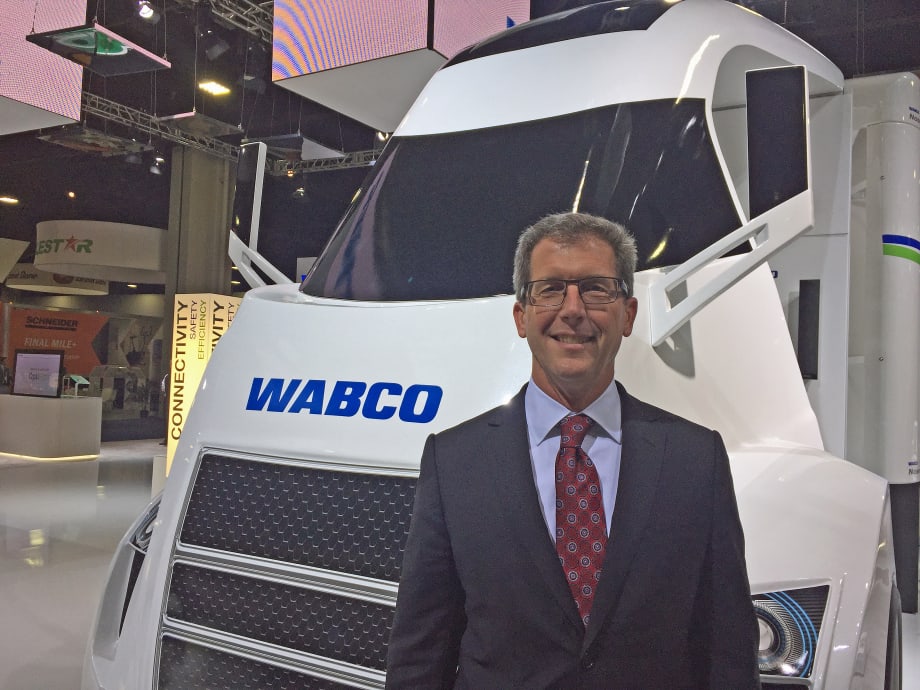
Wabco's Jon Morrison at the North American Commercial Vehicle Show earlier this fall. Photo: Deborah Lockridge
Wabco's Jon Morrison at the North American Commercial Vehicle Show earlier this fall.Photo: Deborah Lockridge
Wabco is increasing its presence in the North American market, recently buying Meritor out of its longtime joint venture and buying RH Sheppard for its active steering technology. Earlier this year it opened a new U.S. plant to produce air disc brakes, and it’s partnering with companies such as Peloton and Nexteer to push the implementation of advanced driver assistance systems.
We recently sat down with Jon Morrison, Wabco’s president Americas, about what he called the company’s “full commitment to the North American commercial vehicle industry.”
Wabco’s joint venture with Meritor started 27 years ago, he says. “It was in the early days of ABS for commercial vehicles. Wabco at that time was predominantly European based company, it had really no infrastructure in North America. At that time it was Rockwell, they had a very strong position and were also developing an ABS system. I think Wabco had some technology advantages, while Rockwell had a strong sales and support network.”
But as the industry has become more global, “in 2012 Wabco kind of re-emerged and came back as a global brand within the region.”
The company is working “carefully and thoughtfully” to manage the brand transition, but eventually you will see the Meritor Wabco brand disappear and Wabco will be the overarching brand within the region.
“You now have Landon composites and Mico [off-highway braking] and Sheppard that we bought last year, so there's a lot of work to do to keep the value of those brands but make sure the Wabco value proposition is clear.”
Morrison also pointed out that many of Wabco’s existing and recently acquired products are the building blocks of autonomous vehicle technology, from the OnGuard collision mitigation system to the braking system to lanekeeping.
“What I really try to stay focused on is when we can provide value and safety as an intermediate step on the way to get there,” he said. “Adding steering and integrating with the braking system – we use the lane departure warning camera to do that – we can help drivers at the end of the day.”
Wabco recently announced OnLaneAssist, which combines active steering technology with a forward-looking camera to help actively compensate for road crown and crosswinds that can cause trucks to drift from their lane.
“If you think about a trucker fighting the wind all day, with the active steering features you mitigate the effect of that so it's very easy to steer the vehicle and reduce driver fatigue.” Wabco is working with truck makers now, he says, and hopes to have it available by 2020.
When asked what kind of questions he was getting in discussions with fleets, Morrison said, “On the one hand, the technology is the big story. On the other hand, they're in business and we have to keep that business focus in mind – how long is this going to last, when do I get my payback?”
More Safety & Compliance

From One Generation to the Next: How Mentorship Builds Safer Truck Drivers
After three decades in trucking, Harold Perry shares what he's learned about driver safety, mentorship, and helping the next generation build confidence behind the wheel.
Read More →
FMCSA Pauses Biennial-Update Enforcement Amid Motus Transition
Carriers whose updates were due on or after June 1 have more time, while FMCSA works to stabilize its new registration system and warns of phishing sites impersonating its new carrier registration system, Motus.
Read More →
ZF Expands Commercial Vehicle Push in North America
ZF is expanding its North American commercial-vehicle presence with new transmission applications, electrification, trailer technology and autonomous-driving systems.
Read More →
Truck Drivers Need More Than Another Alert
Fleets have more visibility into truck health, safety events, and driver activity than ever. The next challenge is turning all that information into useful guidance for the person who has to decide what to do next.
Read More →
Tesla Wants a Self-Driving Semi. Are Cameras Enough?
Could Tesla’s camera-only autonomous driving technology work on an 80,000-pound Semi? In this commentary, HDT's Deborah Lockridge takes a look at Tesla, Cybercab, and how autonomous trucks see the road.
Read More →
What DOT’s Automated Vehicle Strategy Means for Trucking
The U.S. Department of Transportation issued a new automated-vehicle strategy that outlines plans for driverless-truck regulations, cross-state freight corridors, and federal safety standards.
Read More →
NYC Expands Speed, Pedestrian Safety Tech Across Fleet
New York City is expanding intelligent speed assistance and pedestrian-alert systems across its municipal fleet, moving the technologies from pilot programs into vehicle procurement and retrofit requirements.
Read More →
FMCSA Removes 110 Truck Driver Training Schools from Certified ELDT List
Federal regulators also are targeting more than 160 additional training providers and launching a nationwide audit of third-party CDL skills testers as part of a broader crackdown on trucking fraud.
Read More →
Beyond DOT Compliance: What Makes a Trucking Fleet Truly Safe?
A trucking fleet can follow every rule and still make unsafe decisions. The real test comes when safety conflicts with freight, productivity, or cost.
Read More →
Hours of Service Pilot Programs: FMCSA Readies for 2027 Rollout
Two pilot programs could eventually reshape hours-of-service rules, giving truck drivers options to pause their 14-hour clock or use longer split sleeper rest periods.
Read More →