




Spec'ing Trailers for Safe and Quick Entry and Exit
Slips and falls constitute a major cause of injuries and worker’s compensation claims for drivers, and while that usually applies to trucks and tractors, it also includes trailers. Many trailers are bought with no clear way to climb aboard, so drivers do the best they can.

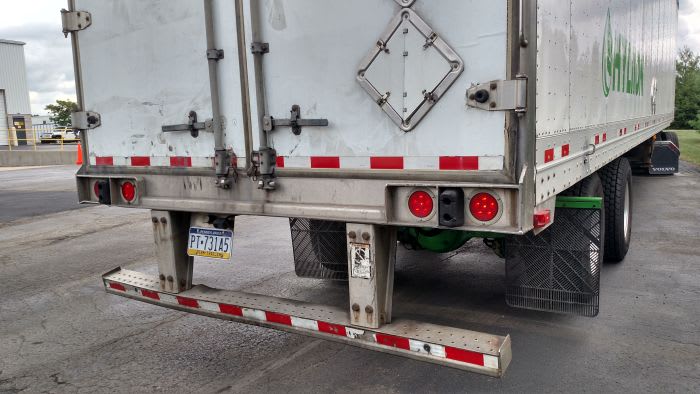
Bumper’s skid-resistant top surface allows firm planting of a driver’s foot, and end cap would stop a sideways slip as he climbs up. Handle next to door gives him a positive grip. Photo:Tom Berg
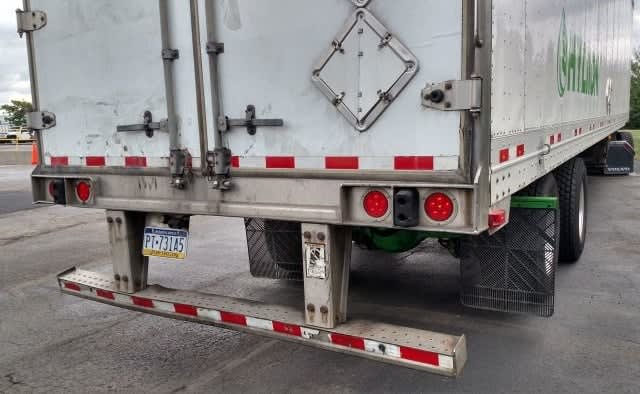
Bumper’s skid-resistant top surface allows firm planting of a driver’s foot, and end cap would stop a sideways slip as he climbs up. Handle next to door gives him a positive grip.Photo:Tom Berg
Slips and falls constitute a major cause of injuries and worker’s compensation claims for drivers, and while that usually applies to trucks and tractors, it also includes trailers. Many trailers are bought with no clear way to climb aboard, so drivers do the best they can.
That’s changing, however. Many vans and other types of trailers and truck bodies today have hardware meant to ease entry and exit, also called ingress and egress. Wabash National, for instance, says about 40% of its trailers are ordered with steps or handles.
Walk down a row of parked vans and you’ll see many rear bumpers/underride guards with skid-resistant patterns on the upward-facing surfaces of the horizontal member. Some even have extra steps built into the bumper structure. Often you’ll find handles that drivers and loaders can grab for stability while climbing up from the ground; if not, drivers learn to grasp door hinges or some other feature on the walls.
Trailer and body builders offer many options. Utility Trailer Manufacturing last year in its Utilitechniques series noted that these include side door steps, ladders, platforms and enhanced dock bumpers. “Additionally, grab handles at various locations are often included for added safety. Utility recommends that you add an optional grab handle at any location where the trailer will be accessed.”
“We use the three-point principle” in equipping trailers with steps and handles, says Scott Bartlein, fleet manager for Barry Fleet Services in the Milwaukee area. That means three of a person’s four limbs are always in contact with the vehicle while the fourth limb is moving. Well-designed hardware gives the person’s hands and feet convenient and safe points of contact. Bartlein is the current chairman of the Trailers, Bodies & Material Handling task force within the Technology & Maintenance Council of the American Trucking Associations.
Liability concerns
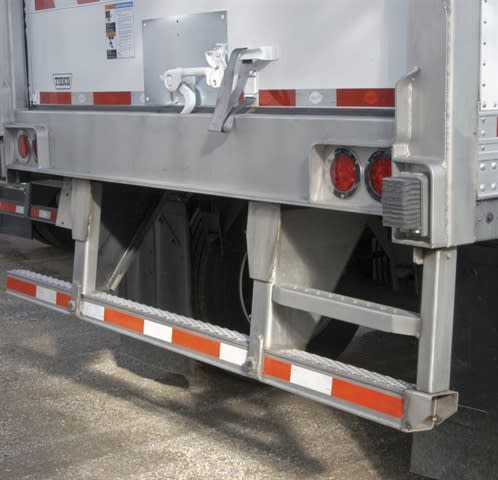
This step built into the rear impact guard of a Utility trailer adds a riser above the bumper. This trailer also has a handle adjacent to the swing door. Photos: Utility Trailer Mfg.
The TMC task force last year updated its Recommended Practice, Guidelines for Flatbed, Van Trailer and Truck Body Entry and Egress. RP 741 outlines what equipment should do but leaves design and structural details to customers and manufacturers.
That RP was written with liability issues in mind. In the 1990s, the task force tried to write a recommended practice that would describe how to order entry and exit hardware. Fleet managers wanted a document that buyers could use for guidance in writing specs for steps, handles and the like, and that trailer and body makers could follow, as they did in many other areas of truck design.
However, lawyers privy to the discussions warned that the devices could be considered “attractive nuisances” to the public, encouraging curious children or adventurous and/or imbibing adults to climb aboard. People injured while doing so could sue manufacturers and truck operators, claiming the recommendations are dangerous standards (though drivers could also sue if no equipment were present – a legal Catch 22).
So TMC went back to the drawing board and in 2004, published a two-page recommended practice. “This RP is not an industry design or performance standard to which trailer manufacturers will be held responsible,” the document states in addressing possible liability. “It merely serves as suggested items that users may refer to when spec’ing trailers. Furthermore, TMC assumes no liability to manufacturers or third parties regarding performance characteristics of flatbed, van trailer or truck body entry/egress systems.”
RP 741 emphasizes use of the three-point principle and suggests that appliances be designed for human hands and feet – something that seems obvious but requires definition. For instance, “Handholds should have clearance between the handhold and the surface to which it is mounted [so hands will fit between them]. The bottom of the handhold (or lower handhold) should be within a user’s grasp from ground level. The top of the handhold (or upper handhold) should be within a user’s grasp when standing normally or erect on the bed of the trailer. Recess mounting is preferred.”
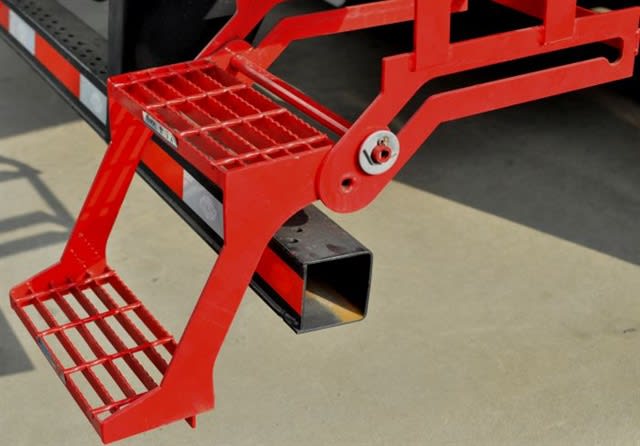
Bright-colored step folds out to form a short stairway that’s easy to climb.
Not needed, but…
Vans and reefers that travel entirely between loading docks theoretically don’t need such assist equipment because entry and exit is via the floor-level docks, experts note. But occasionally, access must be gained from street or lot level. Besides, resale will be enhanced if a second user’s operation routinely requires access from ground level.
Protruding rear deck areas, particularly on truck bodies and delivery trailers with lift gates, usually have steps built onto their sides and handles at the lower-rear of bodies or door sills. Lift gates amount to built-in elevators, but impatient drivers often hop up and off. Safety training should discourage this.
Side doors on truck bodies and trailers almost always come with stirrup steps or fold-down ladders, and pull-out ramps if cargo must be dollied out. Handles can be mounted on one or both sides of the door, though the inside walls immediately adjacent to a door’s side can amount to hand holds.
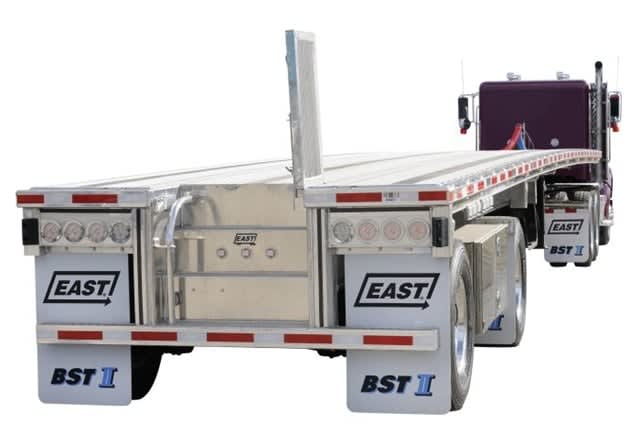
This integrated stairway from East makes for an easy and safe climb onto a flatbed’s deck. Cover plate lifts up and locks, and includes an above-deck grab handle. A curving handle is on the stairway’s left wall. The cover plate includes a housing for center ID lamps that are legally horizontal when the cover plate is folded back down. Photo: East Manufacturing
Dealing with flatbeds
Flatbeds constitute a special case. Drivers must often climb aboard to nail in securement blocks and cover loads with tarpaulins. Climbing up and down can be precarious. Young, agile drivers can pull and boost themselves aboard, sometimes clambering over a tire-wheel assembly and grabbing onto side rub rails for leverage. Older, wiser guys tend to carry step ladders that can be moved around the trailer as needed, then stowed with bungee cords underneath or on the tractor’s rear deck for travel.
However, a flatbed’s rear-impact guard, as it’s properly called, can be built like those on vans, with the non-skid surfaces and extra steps. Lack of a vertical structure makes handle placement difficult, though folding bars have been devised. Some specialty firms sell step ladders that can be placed anywhere along the trailer’s perimeter and temporarily attached to it. And at least one flatbed maker, East Manufacturing, offers a built-in stairway at the rear, complete with a fold-up railing and fold-down plate that covers the recess over the stairs.
Bulk-haul trailers and bodies like tankers and grain carriers usually have ladders to allow drivers to get on top for access to hatches and tarps. Walkways along the top let drivers creep among hatches, and safety-minded fleets also install railings.
More Safety & Compliance

FMCSA Pauses Biennial-Update Enforcement Amid Motus Transition
Carriers whose updates were due on or after June 1 have more time, while FMCSA works to stabilize its new registration system and warns of phishing sites impersonating its new carrier registration system, Motus.
Read More →
ZF Expands Commercial Vehicle Push in North America
ZF is expanding its North American commercial-vehicle presence with new transmission applications, electrification, trailer technology and autonomous-driving systems.
Read More →
Truck Drivers Need More Than Another Alert
Fleets have more visibility into truck health, safety events, and driver activity than ever. The next challenge is turning all that information into useful guidance for the person who has to decide what to do next.
Read More →
Tesla Wants a Self-Driving Semi. Are Cameras Enough?
Could Tesla’s camera-only autonomous driving technology work on an 80,000-pound Semi? In this commentary, HDT's Deborah Lockridge takes a look at Tesla, Cybercab, and how autonomous trucks see the road.
Read More →
What DOT’s Automated Vehicle Strategy Means for Trucking
The U.S. Department of Transportation issued a new automated-vehicle strategy that outlines plans for driverless-truck regulations, cross-state freight corridors, and federal safety standards.
Read More →
NYC Expands Speed, Pedestrian Safety Tech Across Fleet
New York City is expanding intelligent speed assistance and pedestrian-alert systems across its municipal fleet, moving the technologies from pilot programs into vehicle procurement and retrofit requirements.
Read More →
FMCSA Removes 110 Truck Driver Training Schools from Certified ELDT List
Federal regulators also are targeting more than 160 additional training providers and launching a nationwide audit of third-party CDL skills testers as part of a broader crackdown on trucking fraud.
Read More →
Beyond DOT Compliance: What Makes a Trucking Fleet Truly Safe?
A trucking fleet can follow every rule and still make unsafe decisions. The real test comes when safety conflicts with freight, productivity, or cost.
Read More →
Hours of Service Pilot Programs: FMCSA Readies for 2027 Rollout
Two pilot programs could eventually reshape hours-of-service rules, giving truck drivers options to pause their 14-hour clock or use longer split sleeper rest periods.
Read More →
New Guide Offers Pet Safety Tips for Truck Drivers
Hundreds of thousands of pets travel in truck cabs. A new safety guide from Volvo Trucks and the Center for Pet Safety offers practical advice for truck drivers who bring dogs and cats along for the ride.
Read More →