




Commentary: How the Public Feels About Driver Fatigue
The debate over driver fatigue and hours of service regulations may be decided by the public. But how questions are asked and facts are presented can sway opinion in opposite directions.


Deborah Lockridge, Editor in Chief

Deborah Lockridge, Editor in Chief
Mark Twain popularized the phrase “There are three kinds of lies: lies, damned lies, and statistics.” I wonder what he would have said about opinion polls.
One of the things we identified in this issue to watch for in 2015 is continued fighting over the 34-hour restart provisions in the hours of service regulations.
Those in trucking against the 2013 restart changes were on the verge of some success in Congress this summer when a case of bad timing sent the effort off the rails.
In June, the Senate Appropriations Committee voted to suspend the 34-hour restart provisions while the Federal Motor Carrier Safety Administration studies the impact of the rule.
But the provision did not make it into the House version as had been expected, because of public attention to the issue following a highly publicized crash that seriously injured comedian Tracy Morgan and killed one of his companions.
Despite the fact that the Walmart driver was using electronic logs and appears to have been legally within the HOS rules, safety advocates used the crash to whip up opposition to the bill. You can see the impact of that media frenzy in two recent surveys.
Survey 1: A poll conducted for the American Trucking Associations in September found that the public actually seems to have a pretty favorable image of trucking and truck drivers. When 800 registered voters were asked if they had a positive image of the trucking industry, 65 percent said they viewed it favorably and 23 percent “very favorably.” In addition, 80 percent said they believe truck drivers are safer than passenger vehicle drivers.
Positive answers to an open-ended question of what comes to mind when thinking of the trucking industry revolved around the reliability and efficiency of moving goods, of trucking as a source of employment, and hard-working drivers.
Many of the negative comments seemed to tie concerns about safety to the idea of drivers being overworked. For instance: “From what I understand time is money, and they push their drivers even if they are tired and if someone’s safety is on the line it doesn’t seem like the bosses care.”
In another question, 85 percent said they would view the industry more favorably if the industry put new safety technology on each truck to make sure that drivers weren’t on the road for too many hours.
Survey 2: Enter the Advocates for Highway and Auto Safety, which opposes suspension of the restart. It hired a polling company, too.
Half of the respondents in that survey were told about the Tracy Morgan truck crash, then asked if Congress should raise the weekly work limit for truck drivers from 70 to 82 hours. The other half got the same question without the reference to the Tracy Morgan crash.
Not surprisingly, when you word the question that way, 80 percent of respondents said they oppose increasing the limit, and 60 percent said they strongly oppose it.
ATA fired back, noting that the Federal Motor Carrier Safety Administration “has previously said that the alleged working hours envisioned by these industry critics are only possible in an ‘imaginary world.’”
ATA’s poll asked if respondents would prefer trucks to be on the road between midnight and 5 a.m. or in the morning. By a margin similar to that in the Advocates’ poll, respondents said they would rather not see trucks in the morning. Yet more trucks are hitting the road at dawn as a result of the 1-to-5-a.m. rest requirements in the new restart rule.
It looks like the public is sympathetic to truck drivers – they just don’t want them to be overworked to a point where safety is compromised. That’s one thing we all should agree on.
More Safety & Compliance

FMCSA Pauses Biennial-Update Enforcement Amid Motus Transition
Carriers whose updates were due on or after June 1 have more time, while FMCSA works to stabilize its new registration system and warns of phishing sites impersonating its new carrier registration system, Motus.
Read More →
ZF Expands Commercial Vehicle Push in North America
ZF is expanding its North American commercial-vehicle presence with new transmission applications, electrification, trailer technology and autonomous-driving systems.
Read More →
Truck Drivers Need More Than Another Alert
Fleets have more visibility into truck health, safety events, and driver activity than ever. The next challenge is turning all that information into useful guidance for the person who has to decide what to do next.
Read More →
Tesla Wants a Self-Driving Semi. Are Cameras Enough?
Could Tesla’s camera-only autonomous driving technology work on an 80,000-pound Semi? In this commentary, HDT's Deborah Lockridge takes a look at Tesla, Cybercab, and how autonomous trucks see the road.
Read More →
What DOT’s Automated Vehicle Strategy Means for Trucking
The U.S. Department of Transportation issued a new automated-vehicle strategy that outlines plans for driverless-truck regulations, cross-state freight corridors, and federal safety standards.
Read More →
NYC Expands Speed, Pedestrian Safety Tech Across Fleet
New York City is expanding intelligent speed assistance and pedestrian-alert systems across its municipal fleet, moving the technologies from pilot programs into vehicle procurement and retrofit requirements.
Read More →
FMCSA Removes 110 Truck Driver Training Schools from Certified ELDT List
Federal regulators also are targeting more than 160 additional training providers and launching a nationwide audit of third-party CDL skills testers as part of a broader crackdown on trucking fraud.
Read More →
Beyond DOT Compliance: What Makes a Trucking Fleet Truly Safe?
A trucking fleet can follow every rule and still make unsafe decisions. The real test comes when safety conflicts with freight, productivity, or cost.
Read More →
Hours of Service Pilot Programs: FMCSA Readies for 2027 Rollout
Two pilot programs could eventually reshape hours-of-service rules, giving truck drivers options to pause their 14-hour clock or use longer split sleeper rest periods.
Read More →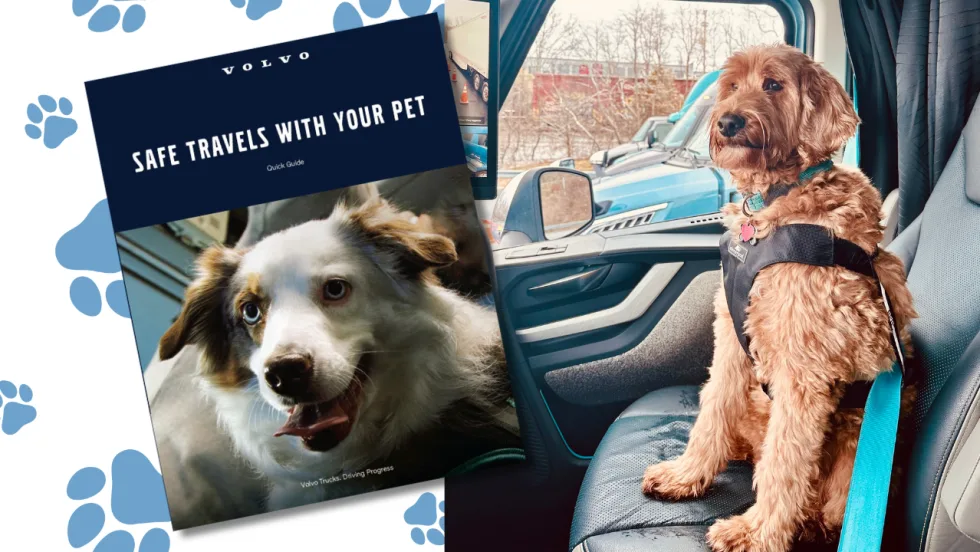
New Guide Offers Pet Safety Tips for Truck Drivers
Hundreds of thousands of pets travel in truck cabs. A new safety guide from Volvo Trucks and the Center for Pet Safety offers practical advice for truck drivers who bring dogs and cats along for the ride.
Read More →