




QuickSpin: LED Headlights vs. Halogen
A comparison between a set of standard halogen headlamps and LED headlamps reveals, well, there is no comparison.

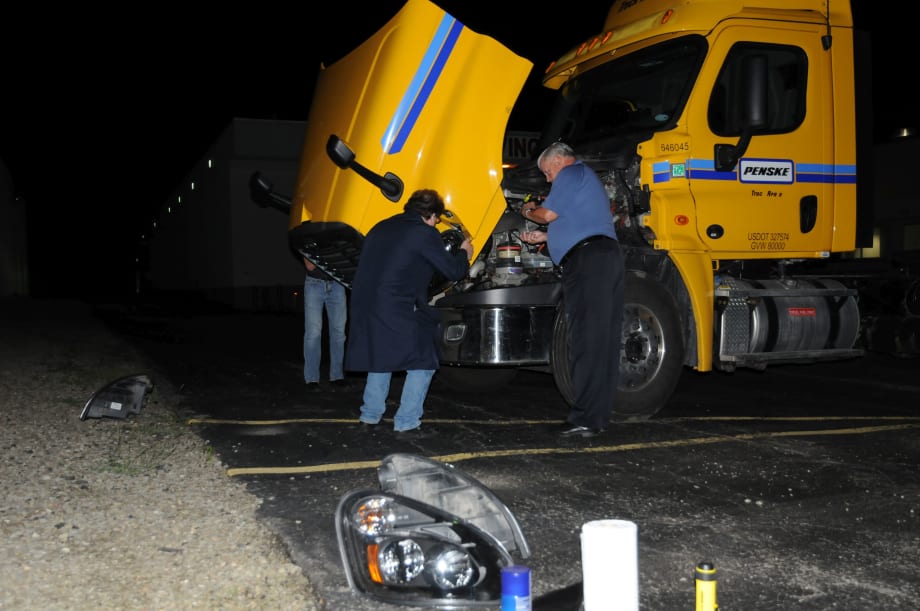
Truck-Lite's senior vice president and chief technology officer, Brad Van Riper, supervises the headlamp changeover between the test runs at the company's Falconer, N.Y., assembly plant.
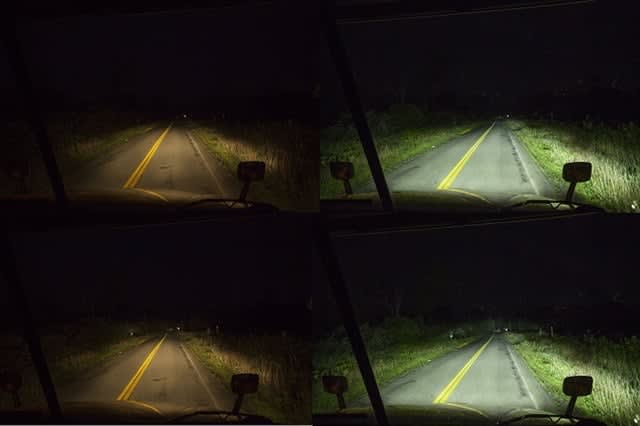
Compare the side-of-the-road lighting between both sets of lights on high and low beam. Then notice how the LEDs light the detail at the far end of the road, where the halogen lamps seem to just fade out — even on high beam. The color of the light is important, too. The LED light is closer to that of daylight, rather than the yellowish cast from the halogen lamps. This is exactly as it appeared to me in the tests.
Because headlamps are something drivers use every day, we arranged with Truck-Lite to see if LED headlamps are really as good as they are reputed to be. Manufacturers such as Truck-Lite use sensitive instruments to measure light output and the like, but I just wanted to see with my own two eyes what kind of a difference they made in night vision.
Watching headlamps being assembled at Truck-Lite's Falconer, N.Y., plant, I was amazed at the size of the light-producing part of the assembly. There are six LEDs in each assembly, four in the low-beam reflector and two in the high. Each LED is no more than a quarter-inch square, which totally doesn't reconcile with the amount of light they produce. Truck-Lite says they will last about 30,000 hours — about 10 years of average service for an over-the-road truck.
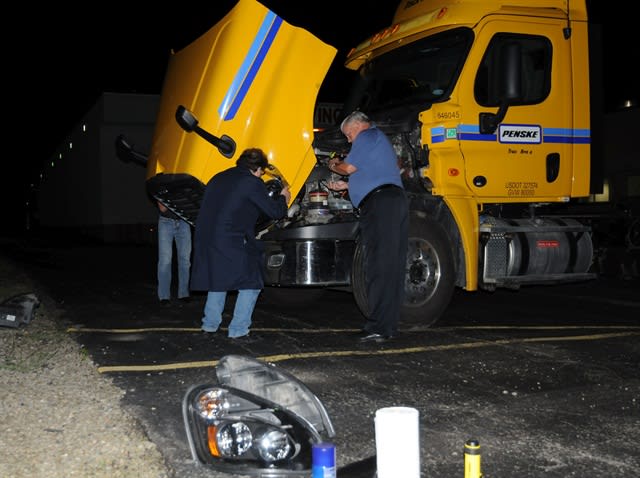
Truck-Lite's senior vice president and chief technology officer, Brad Van Riper, supervises the headlamp changeover between the test runs at the company's Falconer, N.Y., assembly plant.
The test procedure was pretty simple. We stopped the truck at the same spot on a dark, deserted stretch of road and took a few photographs from inside the cab to illustrate the difference between the two sets of headlights. We used the same Freightliner Cascadia day-cab, which underwent a headlamp transplant between the test runs. We replaced the entire assembly with the halogen lights with a module containing the LED lights.
The photos were taken with the same camera using the same settings, so the camera's exposure controls were nullified and would not affect the outcome. The settings for all the photos are as follows: Canon 5D in Manual mode; 24 mm focal length, ISO 400, 15-second exposure, manual white balance. In other words, what you see in the photos is what the camera saw; no digital trickery was applied after the fact.
What jumped out at me immediately was detail visible just off the road, where the trees are on the left in the LED photos. They were not even visible with the halogens. That gives a driver a real edge when it comes to spotting wildlife lurking at roadside or catching signage in the distance.
The difference was equally obvious on an Interstate highway. The wide roadway and the sloping roadside were beautifully lit. I think what truly made a difference was the color of the light. Truck-Lite says the color temperature of the LED light — the blue to red shift in the light spectrum — is very close to the color temperature of sunlight, around 6,000 degrees Kelvin, compared to halogen at around 4,000 K. Technically, they are not much "brighter," but they sure appear to be because of the color.
Interestingly, driving on a busier stretch of two-lane road with opposing traffic, not once did I get a flash of the high beams from oncoming cars annoyed by my brighter lights. I'm told this has a lot to do with the reflector design, which throws light where it's needed -- straight down the road and low and wide — rather than into the eyes of oncoming drivers.
While they are considerably more expensive up front than halogen headlamps, LEDs will long out-live the first service life of the truck and will give drivers night lighting like they have never seen before.
More Safety & Compliance

FMCSA Pauses Biennial-Update Enforcement Amid Motus Transition
Carriers whose updates were due on or after June 1 have more time, while FMCSA works to stabilize its new registration system and warns of phishing sites impersonating its new carrier registration system, Motus.
Read More →
ZF Expands Commercial Vehicle Push in North America
ZF is expanding its North American commercial-vehicle presence with new transmission applications, electrification, trailer technology and autonomous-driving systems.
Read More →
Truck Drivers Need More Than Another Alert
Fleets have more visibility into truck health, safety events, and driver activity than ever. The next challenge is turning all that information into useful guidance for the person who has to decide what to do next.
Read More →
Tesla Wants a Self-Driving Semi. Are Cameras Enough?
Could Tesla’s camera-only autonomous driving technology work on an 80,000-pound Semi? In this commentary, HDT's Deborah Lockridge takes a look at Tesla, Cybercab, and how autonomous trucks see the road.
Read More →
What DOT’s Automated Vehicle Strategy Means for Trucking
The U.S. Department of Transportation issued a new automated-vehicle strategy that outlines plans for driverless-truck regulations, cross-state freight corridors, and federal safety standards.
Read More →
NYC Expands Speed, Pedestrian Safety Tech Across Fleet
New York City is expanding intelligent speed assistance and pedestrian-alert systems across its municipal fleet, moving the technologies from pilot programs into vehicle procurement and retrofit requirements.
Read More →
FMCSA Removes 110 Truck Driver Training Schools from Certified ELDT List
Federal regulators also are targeting more than 160 additional training providers and launching a nationwide audit of third-party CDL skills testers as part of a broader crackdown on trucking fraud.
Read More →
Beyond DOT Compliance: What Makes a Trucking Fleet Truly Safe?
A trucking fleet can follow every rule and still make unsafe decisions. The real test comes when safety conflicts with freight, productivity, or cost.
Read More →
Hours of Service Pilot Programs: FMCSA Readies for 2027 Rollout
Two pilot programs could eventually reshape hours-of-service rules, giving truck drivers options to pause their 14-hour clock or use longer split sleeper rest periods.
Read More →
New Guide Offers Pet Safety Tips for Truck Drivers
Hundreds of thousands of pets travel in truck cabs. A new safety guide from Volvo Trucks and the Center for Pet Safety offers practical advice for truck drivers who bring dogs and cats along for the ride.
Read More →