




ATA asks FMCSA to Eliminate Tire Underinflation Violation
There is no official definition of underinflated against which to write citations, so the cops have historically been sort of making it up as they go along -- more than 30,000 tickets written on a regulation that has been proven impossible to determine.

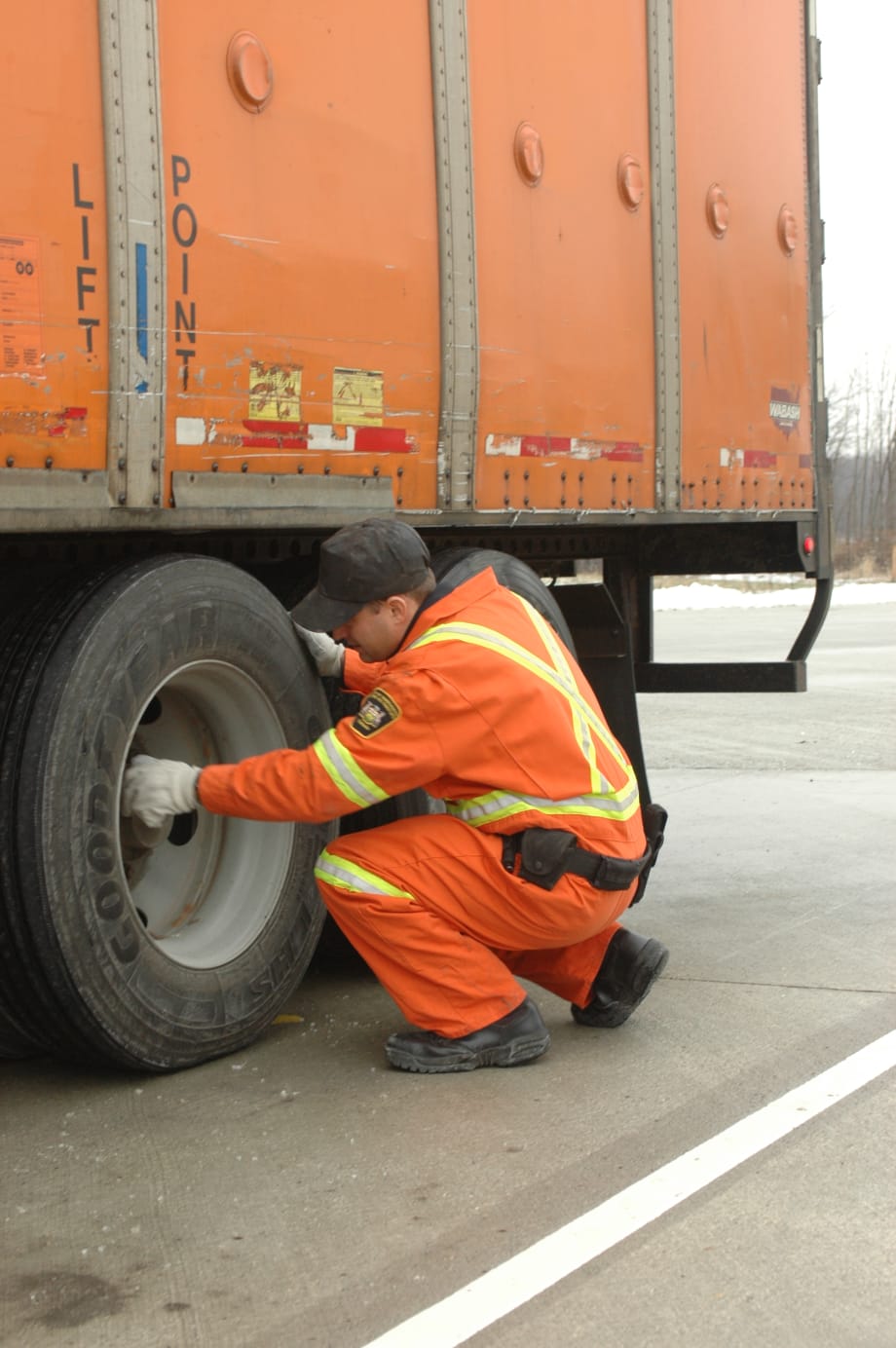
Inspectors wrote more than 30,000 violations for under-inflated tires over a two-year period. Photo by Jim Park
Inspectors wrote more than 30,000 violations for under-inflated tires over a two-year period. Photo by Jim Park
Managing tire inflation is difficult enough without enforcement looking over your shoulder. It's worse when enforcement writes tickets for underinflated tires. There is no official definition of underinflated against which to write citations, so the cops have historically been sort of making it up as they go along. Statistics show that since 2012, state inspectors have issued over 30,000 citations for under-inflated tires.
That's why The American Trucking Associations, with help from The Technology and Maintenance Council, has filed a petition with the Federal Motor Carrier Safety Administration to remove language relating to underinflation from the rule book.
Here's how CFR § 393.75(h) is currently written: “(1)no motor vehicle shall be operated on a tire which has a cold inflation pressure less than that specified for the load being carried. (2) If the inflation pressure of the tire has been increased by heat because of the recent operation of the vehicle, the cold inflation pressure shall be estimated by subtracting the inflation buildup factor shown in Table 1 from the measured inflation pressure."
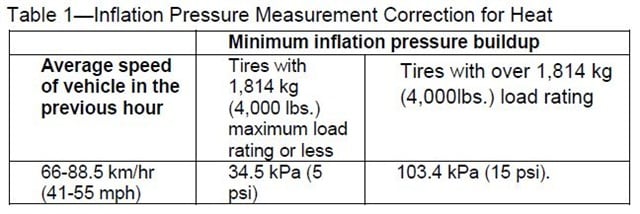
In other words, part 2 says inspectors are directed to deduct either 5 psi or 15 psi from the recorded pressure of any tire suspected of being underinflated based on the load rating of the tire and how long it had been traveling at speed. And that raises several questions that an inspector at roadside may or may not be able to determine.
"I can't determine what the load on the tire is, I don't know how long it has been running, or even how long it might have been sitting still at the scale waiting for an inspection," said Keri Wirachowsky, enforcement officer with Ontario’s Ministry of Transportation. She raised the point at TMC 2013 during as S.2 Task Force session exploring alternatives to the current regulation.
And that's what we mean when we say the cops have been making it up as they go along. All an inspector can do is interpret the regulation, follow the guidance and write the ticket or not. How many "under-inflated" tires have not been written up is anyone's guess, but certainly 30,000 tickets -- possibly unnecessary tickets -- in two years is something to be concerned about.
"The problem," says Peggy Fisher, president of Tire Stamp and then-chair of the TMC Underinflation Guidelines for CVSA Task Force, at last year's task force session, "is that there is no guidance at all, but there is a penalty for underinflation. They can write tickets or warnings, which are the same thing as far as CSA is concerned, or nothing at all."
The 5 psi or 15 psi temperature adjustment was a DOT initiative introduced back in the days of tube-type tires, designed to compensate for increases in pressure over cold inflation pressure resulting from naturally generated heat within the tire. Since then, it's never been a serious concern until FMCSA's Compliance, Safety and Accountability program forced fleets to start looking very closely at every ticket they got. Suddenly, a ticket for underinflation became more than an expensive annoyance. Under CSA, under-inflated tires are a three-point violation.
The real problem with the language of 393.75(h) is that it makes no mention of what the tire inflation pressure is when a tire is considered flat or underinflated, only that the vehicle should not be operated when the tire pressure is less than that specified for the load being carried.
The ATA petition has this to say about how proper inflation pressure should be determined:
"Determining the appropriate tire pressure for a given tire load is not particularly challenging or confusing [using load and inflation tables]. However, when a vehicle is in operation the load weight changes with every drop and hook operation. For most motor carrier fleets it is not practical to adjust tire pressure with every load change. As a result, many motor carriers set a tire inflation pressure policy that specifies a constant tire pressure for all of the tractor and trailer tires in that motor carrier fleet. Some carriers will have a separate tire pressure policy for steer axle tires which general carry a higher but more constant weight.
"On the other hand, the motor carrier enforcement community, when inspecting tires for the correct tire inflation pressure, must read the tire markings to determine tire size, determine the axle load, calculate tire load, check the tire pressure, and then adjust for cold or warm tire condition. They must then find the appropriate Load Limit Table (generally not available to them at roadside) in order to determine if the tire is underinflated or not."
Really. And that's just the beginning.
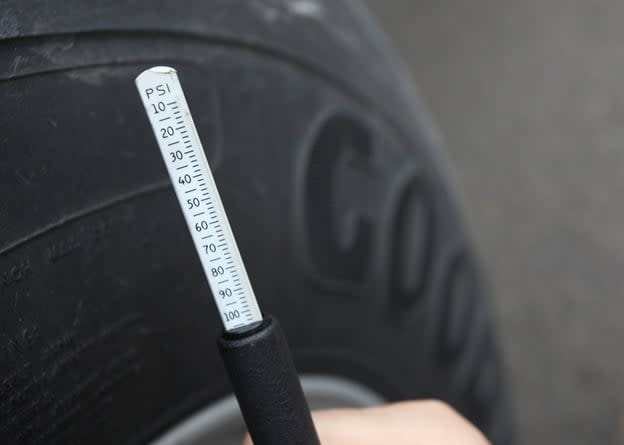
Not all fleets runn 100 psi in all tires, making it very difficulty to apply under-inflated regs fairly. Photo courtesy of Goodyear
Over the past year, The TMC Tire & Wheel Study Group has been trying to resolve this issue. The discussion on this issue at last year's TMC meeting was robust to say the least, and to anyone new to the problem, participants introduced so many angle and variations from tire size to ambient temperature that the issue seemed unresolvable. As it turned out, it was.
At the request of the Commercial Vehicle Safety Alliance, the Study Group committee looked at several options, but in each case they found exceptions where operator of one description or another could be unfairly penalized, particularly those that run pressures in the 75-85 range -- and there are more in this camp than you might think. Or, fleets than run load range H tires with 120-psi indicated on the sidewall as the maximum pressure.
The committee also tried to create a list of the most common tires found in over-the-road operations and come up with a chart that provided underinflated pressure of tires after 15 psi was deducted. That proved impractical as well.
In the end, TMC Study Group concluded that it cannot come up with a simple, practical and fair way of determining under-inflation during a roadside inspection. Below, the committee outlines its reasons.
The petition ATA submitted in January to FMCSA asks that 393.75(H) be dropped from 393.75, leaving only 393.75 (a)(3) "flat tires or tires that have an audible leak" as an enforceable item.
According to Fisher, "CVSA also met this month and voted to support the letter submitted by the ATA."
Here's hoping ...
More Safety & Compliance

FMCSA Pauses Biennial-Update Enforcement Amid Motus Transition
Carriers whose updates were due on or after June 1 have more time, while FMCSA works to stabilize its new registration system and warns of phishing sites impersonating its new carrier registration system, Motus.
Read More →
ZF Expands Commercial Vehicle Push in North America
ZF is expanding its North American commercial-vehicle presence with new transmission applications, electrification, trailer technology and autonomous-driving systems.
Read More →
Truck Drivers Need More Than Another Alert
Fleets have more visibility into truck health, safety events, and driver activity than ever. The next challenge is turning all that information into useful guidance for the person who has to decide what to do next.
Read More →
Tesla Wants a Self-Driving Semi. Are Cameras Enough?
Could Tesla’s camera-only autonomous driving technology work on an 80,000-pound Semi? In this commentary, HDT's Deborah Lockridge takes a look at Tesla, Cybercab, and how autonomous trucks see the road.
Read More →
What DOT’s Automated Vehicle Strategy Means for Trucking
The U.S. Department of Transportation issued a new automated-vehicle strategy that outlines plans for driverless-truck regulations, cross-state freight corridors, and federal safety standards.
Read More →
NYC Expands Speed, Pedestrian Safety Tech Across Fleet
New York City is expanding intelligent speed assistance and pedestrian-alert systems across its municipal fleet, moving the technologies from pilot programs into vehicle procurement and retrofit requirements.
Read More →
FMCSA Removes 110 Truck Driver Training Schools from Certified ELDT List
Federal regulators also are targeting more than 160 additional training providers and launching a nationwide audit of third-party CDL skills testers as part of a broader crackdown on trucking fraud.
Read More →
Beyond DOT Compliance: What Makes a Trucking Fleet Truly Safe?
A trucking fleet can follow every rule and still make unsafe decisions. The real test comes when safety conflicts with freight, productivity, or cost.
Read More →
Hours of Service Pilot Programs: FMCSA Readies for 2027 Rollout
Two pilot programs could eventually reshape hours-of-service rules, giving truck drivers options to pause their 14-hour clock or use longer split sleeper rest periods.
Read More →
New Guide Offers Pet Safety Tips for Truck Drivers
Hundreds of thousands of pets travel in truck cabs. A new safety guide from Volvo Trucks and the Center for Pet Safety offers practical advice for truck drivers who bring dogs and cats along for the ride.
Read More →