




High-Tech Solutions Could Address Truck Parking Problem
Nearly 100 people participated in a webinar last month on the truck parking shortage and innovative ways this problem can be addressed. The webinar was put on by the Trucking Industry Mobility and Technology Coalition. Several studies dating back to the 1990s have found that there is an inadequate supply of truck parking, especially along key freight corridor

Smartphones are one way drivers could learn about available truck parking spaces.
Nearly 100 people participated in a webinar last month on the truck parking shortage and innovative ways this problem can be addressed.
The webinar was put on by the Trucking Industry Mobility and Technology Coalition.
Several studies dating back to the 1990s have found that there is an inadequate supply of truck parking, especially along key freight corridors
, and that these shortages negatively impact highway safety, said Tom Kearney, manager of freight operations with the Federal Highway Administration.
As the result of one National Transportation Safety Board report, the Federal Motor Carrier Safety Administration initiated an investigation into technology-based approaches to developing solutions for the truck parking shortage. In turn, this research led to the multi-phase "Smart Park" initiative.
In recent years, Congress authorized $25 million in as part of highway funding for the Truck Parking Facilities Discretionary Program, which provided funding for truck parking space construction, ITS technology research and development, and to make improvements to public truck parking facilities.
However, this program was not continued under MAP-21. Instead, the seven eligible activities identified under SAFETEA-LU Section 1305 are now eligible for National Highway Performance Program, Surface Transportation Assistance Program and Highway Safety Improvement Program funds.
In a recent survey by the American Transportation Research Institute, both drivers and carriers said the best way to get information on truck parking availability was roadside variable message signs.
About half the respondents would most like to receive parking availability information 20 miles away from the truckstop/rest area. While slightly more than half of all of the survey respondents would like the ability to reserve a truck parking space, many would be unwilling to pay or, at most, pay only a minimal fee for this service.
One example of a truck parking information system in the works is Michigan's I-94 Truck Parking Information and Management System. This project will deploy sensing technology to monitor and manage parking availability to provide timely information to drivers and carriers, according to Dave Miller, founder and COO of Gnosis Management. Currently, the system plans to disseminate information through three channels: Dynamic truck parking signs, MiDrive website and a connected vehicle application. A smartphone application is also being developed.
The University of Minnesota and the Minnesota Department of Transportation are also developing a comprehensive real-time information system for truck parking availability. Ted Morris, Department of Computer Science and Engineering at the University of Minnesota, spoke about the automated parking availability detection system.
This approach uses 3-D object reconstruction to measure space occupancy by "seeing" if a vehicle is present or not. Multiple cameras are used to observe the scene and can overcome common problems such as sharp shadows, lighting changes and weather-related changes (i.e. rain, ice and snow) that can confound non-3-D image processing techniques. Field installation of the parking system at the first of four rest areas began this fall.
To view a complete recording of the "Truck Parking Issues & Opportunities" webinar, visit www.freightmobility.org.
More Safety & Compliance

How Waste Connections is Using Data, Telematics, and AI
How do you manage and maintain more than 18,000 connected trucks? Data. Lots of it.
Read More →
Fleet Advantage: Top Logistics Fleets Outperform National Safety Benchmarks
Fleet Advantage's latest TRUST Safety Index found leading logistics fleets maintained significantly lower out-of-service rates and stronger safety scores than national averages, while highlighting persistent challenges related to tires, brakes, and unsafe driving behaviors.
Read More →
Why Fleet Data Matters More Than Ever at Waste Connections [Watch]
Waste Connections' Chuck Palmer explains how telematics, predictive maintenance, safety analytics, and AI help keep vehicles on the road and drivers safe in this episode of HDT Talks Trucking.
Read More →
Short Takes: How K&B is Using AI
Fleets need to "get on board the train" with AI, says Lance Evans of K&B Transportation in this HDT Talks Trucking Short Takes episode.
Read More →
Short Takes: Inside K&B’s Truck Safety Tech
Listen to learn how K&B Transportation uses cellphone-blocking technology, speed management systems, weather geofencing, bridge avoidance tools, and more to improve driver safety.
Read More →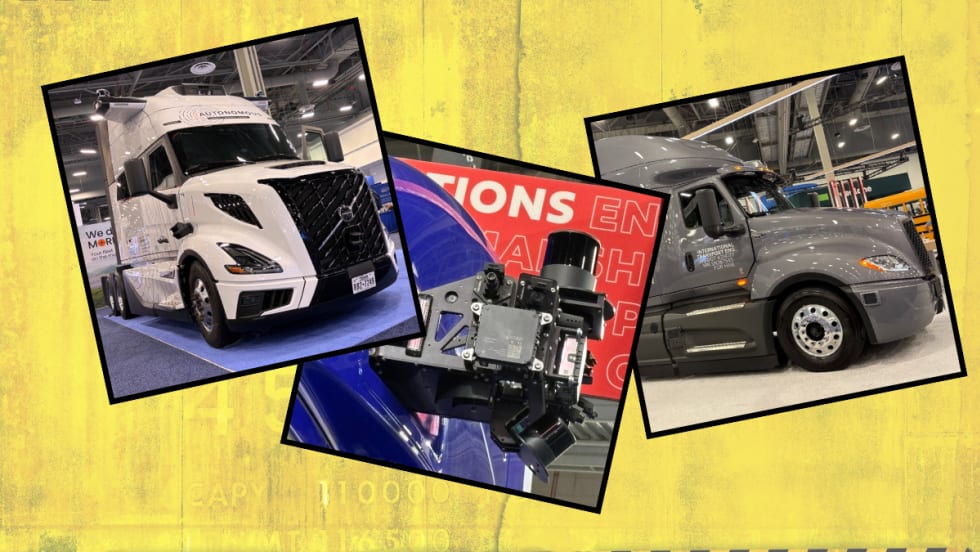
The Biggest Gap in Driverless Trucking Isn’t Tech. It’s Safety Validation
Nauto’s Stefan Heck says autonomous trucks are advancing quickly but proving they’re safe enough for large-scale deployment may be the industry’s hardest challenge.
Read More →
Truck Crash Rates Are Down. So Why Do Insurance Costs Keep Rising?
ATRI’s latest research points to litigation, social inflation, and soaring claims costs as key drivers behind record-high liability premiums for trucking fleets. But there are things motor carriers can do.
Read More →
FMCSA Removes More Than a Dozen ELDs from Registered List
The FMCSA continues its efforts to fight electronic logging devices that don't meet federal requirements, removing more than a dozen from the registered ELD list in May.
Read More →
How the Supreme Court Broker Liability Ruling Could Reshape Trucking’s Safety Landscape
The Supreme Court’s May 11 broker-liability ruling may not radically rewrite transportation law overnight. But industry experts say it will intensify pressure on brokers, carriers, and shippers to prove they are prioritizing safety.
Read More →
Recall of Fontaine Fusion Flatbeds Warns Owners Not to Use the Trailers
Some Fontaine Fusion flatbed trailer manufactured between February 2025, and March 2026 could have mainbeams weakened by hydrogen embrittlement because of a problem in the galvanizing process.
Read More →