




Daimler Almost Ready with 6D Vision Technology, Better Than Eyes
One definition of success in driving any sort of vehicle is getting where you're going without hitting stuff. Doing that involves the coordinated use of brakes and throttle and steerin
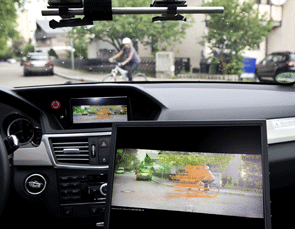
The Daimler team has devised a way to distinguish between static and moving objects, and an object's direction and speed.
One definition of success in driving any sort of vehicle is getting where you're going without hitting stuff. Doing that involves the coordinated use of brakes and throttle and steering

- but only after the eyes and the brain have done their jobs. Are they up to the task?
Actually, no, says a group of engineers at Daimler headquarters in Germany. They've been working on something quite ambitious called 6D Vision technology. The company calls it "the basis for new assistance systems and a key step along the road to accident-free driving."
Also referred to as "spatial vision," it's said to ensure instant recognition of dangerous traffic situations. It's all about augmenting human vision and speeding up an understanding of what's in front of the vehicle, then reacting to it.
Our eyes are amazing tools, but they do have their limitations, and some eyes are built better than others.
Even the best eyes have a very narrow angle of sharp vision, about two degrees, with anything outside that scope more or less blurred. We compensate for this by keeping our eyes roaming back and forth across the scene ahead. But we can only do, on average, two such sweeps per second. So even the most attentive driver might miss a critical situation. The 6D-Vision system needs only about 0.2 seconds to detect potential collisions across the full field-of-view of its camera, which is near 180 degrees. And its image is crisp and clean, not fuzzy in parts like ours.
Seeing is one thing, but the bigger challenge is understanding what we're seeing quickly enough to react. This might mean anticipating the actions of a complete stranger, perhaps a pedestrian or a bicyclist, maybe another vehicle, with very few clues that we've only picked up as blurred peripheral images.
It takes a very, very alert driver to continuously collect those clues and see what's going on ahead, and then a biggish brain to decide that an obstacle might be moving into our path.
The very best amongst us might be good enough to grasp this. But in many cases it may not be not good enough to react in time.
Enter 6D Vision, with its ability to recognize danger quickly and to distinguish between static and moving obstacles. Add to that Daimler's ability to supply the electronic gizmology needed to produce an automatic evasive reaction.
The principle here, developed by Daimler researchers Uwe Franke, Stefan Gehrig and Clemens Rabe, is that moving objects such as other vehicles, cyclists or pedestrians are detected and analyzed before they cross the driving path. Potential collision hazards are defined within a split second.
The system uses a stereo camera system to perceive the surroundings in 3D, similar to the way a human eye works. But it doesn't just see potential obstacles as static objects; it sees them in motion. By continuously analyzing the object's image sequence - frame by frame, almost pixel by pixel - the moving direction and the speed of the person or vehicle can be computed as well. This enables a prediction of where the obstacle will be in, say, half a second.
6D Vision is based on what Franke and crew call a "track before detect" algorithm. That is, a motion is determined before the image details are grouped into an object. This avoids the typical errors of other stereo methods that first form objects and then try to determine motion by tracking them.
This is where the Daimler system excels. By needing to detect only parts of the whole image that may be an errant cyclist, the system isn't fooled by partially hidden objects, those that may be very close together in space, and other difficult viewing conditions. The 6D Vision system can determine the collision risk for every single image point, independent of an object detection step.
The researchers have essentially mimicked basic human perception capability on a small, energy-efficient and low-cost microchip, a kind that's used millions of times a day in TVs and digital cameras.
By the way, they get the technology's name this way: calculation of the obstacle's position in three dimensions plus motion in an additional three dimensions gives us "6D Vision."
So let's finish by doing some math. How fast is fast? A kid running unexpectedly into the road, for example, is perceived by 6D Vision within 200 milliseconds. Even the most alert person takes twice as long to do that, and if distracted in some way, a further 500 milliseconds can be added. Then there's an additional moment of shock to create further delay until a reaction kicks in. We're talking one second plus.
In purely mathematical terms, one second at a speed of 30 mph equates to a vehicle covering a distance of around 45 feet. The computer works twice as fast as the driver and initiates safety measures after just 20 feet. In an emergency braking situation, the vehicle comes to a standstill more than a whole car length sooner.
Another bit of math explains Daimler's motivation. In 2010, in Germany alone, about 200,000 people were injured in inner-city traffic accidents and about 1,400 died. Half those deaths were bicyclists or pedestrians.
Since 6D Vision technology can contribute significantly to accident reduction, Daimler aims to make it available to other manufacturers as well. Other researchers are already working on it, too, including a team at Carnegie Mellon University in Pittsburgh, Pa., which has put all this techno wizardry into action on a stereo-camera helmet.
The Daimler folks working on this are among three teams of researchers nominated for the Deutscher Zukunftspreis, or German Future Prize, the country's prestigious award for technical and scientific innovations.
The first car with this technology will be the next Mercedes-Benz S-Class generation, which will be launched in 2013.
When will 6D Vision show up on trucks? So far no word, but it's a given that we'll get it too.
Here's a brief video explaining 6D Vision:
From the November 2011 issue of HDT.
More Safety & Compliance
How Waste Connections is Using Data, Telematics, and AI
How do you manage and maintain more than 18,000 connected trucks? Data. Lots of it.
Read More →
Fleet Advantage: Top Logistics Fleets Outperform National Safety Benchmarks
Fleet Advantage's latest TRUST Safety Index found leading logistics fleets maintained significantly lower out-of-service rates and stronger safety scores than national averages, while highlighting persistent challenges related to tires, brakes, and unsafe driving behaviors.
Read More →
Why Fleet Data Matters More Than Ever at Waste Connections [Watch]
Waste Connections' Chuck Palmer explains how telematics, predictive maintenance, safety analytics, and AI help keep vehicles on the road and drivers safe in this episode of HDT Talks Trucking.
Read More →
Short Takes: How K&B is Using AI
Fleets need to "get on board the train" with AI, says Lance Evans of K&B Transportation in this HDT Talks Trucking Short Takes episode.
Read More →
Short Takes: Inside K&B’s Truck Safety Tech
Listen to learn how K&B Transportation uses cellphone-blocking technology, speed management systems, weather geofencing, bridge avoidance tools, and more to improve driver safety.
Read More →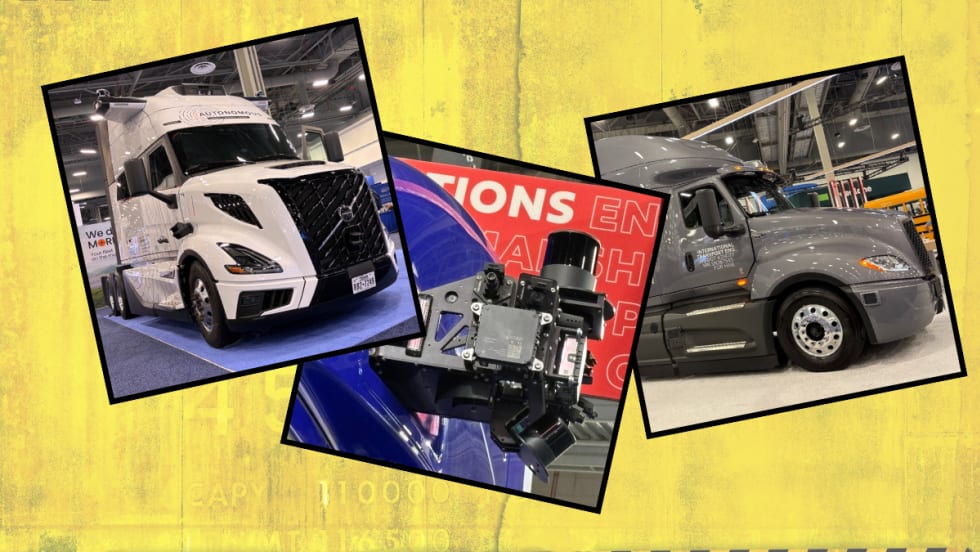
The Biggest Gap in Driverless Trucking Isn’t Tech. It’s Safety Validation
Nauto’s Stefan Heck says autonomous trucks are advancing quickly but proving they’re safe enough for large-scale deployment may be the industry’s hardest challenge.
Read More →
Truck Crash Rates Are Down. So Why Do Insurance Costs Keep Rising?
ATRI’s latest research points to litigation, social inflation, and soaring claims costs as key drivers behind record-high liability premiums for trucking fleets. But there are things motor carriers can do.
Read More →
FMCSA Removes More Than a Dozen ELDs from Registered List
The FMCSA continues its efforts to fight electronic logging devices that don't meet federal requirements, removing more than a dozen from the registered ELD list in May.
Read More →
How the Supreme Court Broker Liability Ruling Could Reshape Trucking’s Safety Landscape
The Supreme Court’s May 11 broker-liability ruling may not radically rewrite transportation law overnight. But industry experts say it will intensify pressure on brokers, carriers, and shippers to prove they are prioritizing safety.
Read More →
Recall of Fontaine Fusion Flatbeds Warns Owners Not to Use the Trailers
Some Fontaine Fusion flatbed trailer manufactured between February 2025, and March 2026 could have mainbeams weakened by hydrogen embrittlement because of a problem in the galvanizing process.
Read More →