




A Better Way to Drug Test? Hair Testing Reveals Disturbing Facts About Driver Drug Use and DOT Requirements
In late 2005 and early 2006, two J.B. Hunt drivers were involved in accidents that claimed three lives. Both drivers had clean records, but both tested positive at the scene for cocaine. The Arkansas-based transportation and logistics company decided it was time for a change.
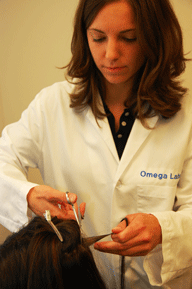
Hair testing has gotten better over the years. Labs have standardized their procedures. And demand is rising, which will presumably continue to drive quality up and cost down.
In late 2005 and early 2006, two J.B. Hunt drivers were involved in accidents that claimed three lives. Both drivers had clean records, but both tested positive at the scene for cocaine.
The Arkansas-based transportation and logistics company decided it was time for a change.
"We did what the Department of Transportation said we had to do, but they got through the system," said David Whiteside, senior director of compliance at J.B. Hunt. "We started looking at what we could do to keep this from happening again."
Whiteside had heard about the benefits of hair testing. It offered a longer look back into an applicant's past and made it more difficult for a drug user to cheat. Following the two fatal crashes, and a 2005 incident where drug use and trafficking were uncovered at a maintenance facility, J.B. Hunt became the first major carrier to adopt hair testing as a method for drug screening.
Company safety officials guessed that when they started testing hair, they were going to catch quite a few people who had slipped past urine tests. They were right.
"The first couple of weeks, we were testing just under 15% positive," said Whiteside. By comparison, the company's positive rate on urine tests ranged from 1% to 1.5%. The company's positive rate for hair testing has since dropped to 4%, much better but still much higher than urine tests.
Since then major trucking fleets such as Schneider National, C.R. England and Gordon Trucking have joined J.B. Hunt in adopting hair testing. These carriers, along with the American Trucking Associations, are pushing to have hair testing added to the list of federally accepted tests maintained by The Department of Health and Human Services.
"A lot of data from our member carriers shows that it is a superior method of drug testing," said Rob Abbott, vice president of safety policy at ATA.
'A stupidity test'
"With a urine test, what we are really asking is, 'Does the candidate know how to use the Internet?'" quipped Mark Freemal, sales manager at Omega Laboratories, a provider of hair testing services for the trucking industry. "Our president calls it a stupidity test."
A quick Google search reveals dozens of websites that provide detailed instructions on defeating urine tests, and even risk assessments should you be caught cheating. The market is flooded with drug-masking products, many of which, according to anecdotes, work fairly well.
The practice of defeating and falsifying urine tests is widespread enough in the trucking industry to have prompted a Government Accountability Office investigation in 2007 that uncovered some disturbing problems.
Undercover investigators were able to use bogus commercial driver's licenses at 24 drug-testing sites, proving that a driver could easily send a substitute in with a fake ID. In addition, 22 of the 24 sites did not follow testing protocols, which opened the door to further cheating, GAO found.
Beyond cheating, urine testing is limited even if done properly. Generally, it cannot detect use of heavier drugs longer than two or three days after use. Cocaine, methamphetamine and opiates are in and out of the digestive system very quickly. It's possible to party hard on Friday and pass a test on Tuesday. As a result, companies don't get an accurate idea of what a driver does in his or her free time.
By contrast, telltale remains of illicit substances reside in the core of hair follicles permanently. That goes for nearly all popular drugs, with the exception of LSD, which basically is impossible to test for, and psilocybin (magic mushrooms), which is difficult to detect for a variety of reasons.
Beyond signaling the presence of difficult-to-detect substances, hair tests provide a better picture than urine into a person's usage history and behavior. This is what many trucking companies find most useful.
A typical 1.5-inch hair sample from the head delivers about a 90-day record. With body hair, that number goes up due to a slower growth rate. Bald test candidates usually provide armpit hair samples, though technically any hair of sufficient length will work.
This much greater time period, matched with a somewhat higher threshold for testing positive, means test results tend to reveal habitual use rather than one-time exposure. A driver indulging once at the 4th of July barbecue is unlikely to raise a red flag. But a driver using drugs two or three times a week will almost certainly get caught. And really, the purpose of a drug screening program is to eliminate risk caused by habitually irresponsible people.
Hair testing may shield the occasionally indulgent driver from detection, but based on the experience of carriers who are using it, the testing indicates that drug use among truckers is more widespread than previously thought. It also shows that urine tests don't work as well to keep habitual drug-using drivers off the road.
C.R. England randomly tests around a fourth of incoming drivers during the employment process. Dustin England, vice president of safety, said the company has found urine tests are positive around 2% of the time. Hair tests, however, raise a flag in roughly 10% of applicants.
According to Don Osterberg, senior vice president of safety and security at Schneider National, the company caught around 6% of drivers when they first started hair testing, compared to 1% or less with urine tests. Its hair test fail rate has since dropped to just below 4%, similar to J.B. Hunt, whose drivers still fail hair tests for marijuana three times as often as urine tests.
"Most people are shocked" at usage rates, said Omega Labs' Freemal.
The official word
Even with clear benefits over the traditional urine test, and with much support from the trucking industry, hair testing has yet to make it onto the Department of Health and Human Services' roster of officially accepted tests.
HHS, through the Substance Abuse and Mental Health Services Administration, sets the federal rules for workplace drug testing. The Department of Transportation falls under that umbrella.
That means hair testing is an optional, additional test for carriers at this point. Carriers are on firm legal ground if they use hair test results to turn away a driver applicant. The rules say they cannot use a driver if they have actual knowledge of drug use.
But the current system has limitations. For the DOT-mandatory pre-employment screening, a company may not submit a hair test result in place of a urine test. So if a carrier wants to use hair testing, it still has to pay for urine tests as well to meet the federal drug-testing regs.
Hair tests also are more expensive than urine tests. According to Freemal at Omega Labs, an individual test can cost $60 on the high end, although companies can find ways to make it cheaper. C.R. England, for example, owns its own clinic, Lakeside Medical, driving down the overall cost. Still, bulk urine screening generally works out to just a few dollars per test.
That does not mean hair testing is a bad investment. The return may be difficult to pin down, because it's hard to prove that an accident was avoided, but the carriers involved think the extra peace of mind is money well spent.
"We have certainly eliminated some risk," said Dustin England.
So why hasn't hair testing gotten the approval of HHS? It has come up as a proposed rulemaking in the past, most notably in 1999 when the Substance Abuse and Mental Health Services Administration's Drug Testing Advisory Board convened the Hair Testing Working Group to assess the viability of hair testing.
Carl Selavka, a toxicologist who performs accreditation inspections for the National Lab Certification Program for HHS, was co-chair of the group.
The aim, he said, was to evaluate laboratory standards for testing hair. The group answered a number of questio
ns, such as the overall accuracy of hair testing, and addressed some commonly held misconceptions regarding bias.
For example, a notion has been floating around for years, based on a questionable scientific study involving rats, that darker hair absorbs drugs and their metabolites (digested drugs) more readily than fair hair. This led to concern about racial bias in hair testing, but after several years of investigation the working group found that labs following proper procedures achieved acceptable results.
Selavka and a partner presented their finding to the agency’s Drug Testing Advisory Board in 2004. They addressed the organization’s concerns, provided a long list of suggestions, and gave hair testing a thumbs-up. And then SAMSHA did nothing.
“The guidelines essentially got set on the shelf getting a tad dusty,” said Selavka.
It’s difficult to say exactly why the approval of hair testing stalled, as HHS doesn’t publish reasons for <I>not</I> going through with a rulemaking. But Selavka offered his own ideas. He said the science is not the problem – it’s the bureaucracy.
“It has less to do with realities [of testing], and more to do with changing a giant federal program,” he said.
Unlike alternative testing fluids such as saliva, which is being considered again by SAMSHA, hair is solid and heterogeneous. Selavka and others point out that while the federal lab infrastructure for fluids already is in place, a program for hair testing would be difficult and expensive, which is a potential reason to shelve the idea.
As Rob Abbott of ATA put it, the bureaucracy may be invested in a process it has been using for a long time.
According to Selavka, hair testing has gotten better over the years. Labs have standardized their procedures, he said. And demand is rising, as can be seen in the trucking industry, which will presumably continue to drive quality up and cost down.
A fatal loophole
Hair analysis shows more drug use among drivers than urinalysis does, but carriers can’t do a whole lot with that information beyond rejecting applicants they have tested.
Because urinalysis is a federally accepted test, carriers can pass on test records to other companies. Hair-test records, in contrast, cannot be shared – a loophole that in at least one instance has proved fatal.
Since Schneider began doing pre-employment hair follicle drug screening in 2008, 935 applicants have failed to pass. Of those, 81 failed the urine test. That leaves 854 drivers who were able to apply to carriers that use only urinalysis.
One of Schneider’s rejects did exactly that and went on to cause a fatal accident driving a truck for a different company.
“It was the trainer of the particular driver that noticed the article in the paper” and recognized the driver, said Marsha Vande Hei, director of regulatory compliance at Schneider. “If the results would have been known to the carrier, he would not have been hired.”
According to Whiteside at J.B. Hunt, since 2006 when the company started hair testing, 2,724 drivers failed the hair test but passed the urine test. Whiteside strongly believes in the test, and is happy to keep unsafe drivers out of his company but he shares Schneider’s concern about keeping these drivers off the road.
Rob Moseley, a transportation attorney with the law firm Smith Moore Leatherwood, said a carrier would violate confidentiality laws if it shared hair test results to other potential employers. “You don’t have permission to release anything else” other than urinalysis results, he said.
So carriers’ hands are tied. Breaking silence over a potentially fatal issue could invite a lawsuit.
Legal Hurdles
The higher cost of hair testing is a bar to wider use, but that’s just one impediment. The ad-hoc nature of government rules present significant management issues.
The national landscape for employee drug screening is a patchwork quilt. According to the National Center for Drug Testing Information, there are more than 550 state statutes in existence for workplace drug testing. That makes implementing a test with no federal rules a legal tangle.
“It wasn’t a flip of the switch, it was state-by-state,” said Vande Hei, describing Schneider’s ramp-up to hair testing. She said this time-consuming process is too much for many carriers to handle. “A lot of times it gets put into the ‘too hard’ box.”
The bigger a carrier is, the more troublesome this can become. Some states, such as Iowa, do not allow for hair testing at all, as the legal definition of “sample” does not include hair.
The rules are applied based on where a driver works, not where he lives, which simplifies things a little bit. But if a carrier has terminals in locations with different rules, designing a coherent company policy becomes an issue. Vande Hei said Schneider had to hire a labor attorney to write its policy.
Because of all that, Vande Hei said it took a long time to implement a hair-testing regimen. That’s time and cost that many carriers may not have, even if they want the benefits that hair testing offers.
“Once you walk outside the comfort [zone] of the regulations, the standard DOT testing, you’re in uncharted waters,” said attorney Rob Moseley.
And that’s largely where hair testing stands today. In the absence of federal regulations, the decision to screen employees’ hair is up to the company, implemented case-by-case.
It may be that the only way to spur the Department of Health and Human Services, and by extension the Department of Transportation, to action will be an act of law by Congress, said Abbott of ATA.
There’s no evidence of congressional interest in such an initiative right now, but Abbott said he would not be surprised to see ATA press for it in the future. The association’s objective would not be to require carriers to use hair testing but to make hair an accepted specimen and let carriers to share test results.
“An increasing number of our members are adopting hair testing as part of their screening protocols, and an increasing body of evidence is becoming available showing us the benefits of hair testing,” he said.
More Safety & Compliance
A Camera Isn't a Safety Program. Here's What Brokers Are Screening for Now
Footage alone may not be enough to pass broker vetting processes. Here's what counts as a defensible safety program now.
Read More →
Marijuana and Trucking’s Drug-Testing Dilemma
Marijuana is getting stronger, laws are changing, and drug tests still can’t reliably establish impairment. What does that mean for truck drivers and the fleets that employ them?
Read More →
PrePass, Kodiak Connect Driverless Trucks to Roadside Enforcement
The system will allow enforcement agencies to verify Enhanced Inspection information and decide whether Kodiak’s autonomous trucks can bypass roadside screening sites.
Read More →

From One Generation to the Next: How Mentorship Builds Safer Truck Drivers
After three decades in trucking, Harold Perry shares what he's learned about driver safety, mentorship, and helping the next generation build confidence behind the wheel.
Read More →
FMCSA Pauses Biennial-Update Enforcement Amid Motus Transition
Carriers whose updates were due on or after June 1 have more time, while FMCSA works to stabilize its new registration system and warns of phishing sites impersonating its new carrier registration system, Motus.
Read More →
ZF Expands Commercial Vehicle Push in North America
ZF is expanding its North American commercial-vehicle presence with new transmission applications, electrification, trailer technology and autonomous-driving systems.
Read More →
Truck Drivers Need More Than Another Alert
Fleets have more visibility into truck health, safety events, and driver activity than ever. The next challenge is turning all that information into useful guidance for the person who has to decide what to do next.
Read More →
Tesla Wants a Self-Driving Semi. Are Cameras Enough?
Could Tesla’s camera-only autonomous driving technology work on an 80,000-pound Semi? In this commentary, HDT's Deborah Lockridge takes a look at Tesla, Cybercab, and how autonomous trucks see the road.
Read More →
What DOT’s Automated Vehicle Strategy Means for Trucking
The U.S. Department of Transportation issued a new automated-vehicle strategy that outlines plans for driverless-truck regulations, cross-state freight corridors, and federal safety standards.
Read More →
NYC Expands Speed, Pedestrian Safety Tech Across Fleet
New York City is expanding intelligent speed assistance and pedestrian-alert systems across its municipal fleet, moving the technologies from pilot programs into vehicle procurement and retrofit requirements.
Read More →